
Share
Share
Share
Share
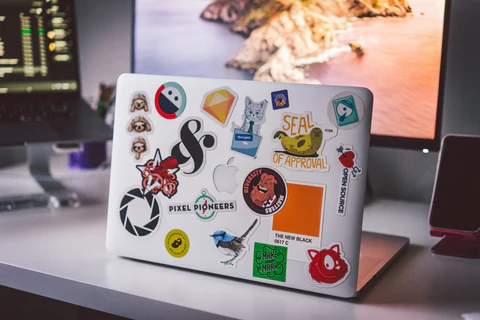
Walk into any tech conference, coworking space, or startup office and you will notice the same thing: laptops covered in stickers. Some are company logos. Some are open source project badges. Some are inside jokes only developers understand. But behind all of them sits a branding strategy that costs almost nothing and delivers something money cannot easily buy: voluntary endorsement.
The Sticker as a Signal
Tech companies spend heavily on brand awareness. Paid ads, sponsored events, billboard campaigns. Most of it gets ignored. A laptop sticker works differently because the person carrying it chose to put it there.
When an engineer at a conference has your logo on their laptop lid, they are telling the room “I use this, and I rate it.” No ad buy can replicate that. It is word-of-mouth made physical, repeated every time the laptop opens.
Companies like Dropbox, Stripe, and Workday have understood this for years. Their branded stickers show up on laptops across offices, conferences, and coffee shops worldwide. The sticker does not interrupt anyone. It just sits there, doing its job quietly, for as long as the laptop is in use.
Where Laptop Stickers Earn Their Keep
Conference swag bags. Most of the branded items in a conference swag bag end up in a bin within 48 hours. Pens, notepads, stress balls. Stickers are different. They are flat, light, and people actually want them. A well-designed sticker from a conference bag has a realistic chance of ending up on a laptop that gets seen by dozens of people every week.
New hire onboarding packs. Giving new employees a branded sticker on day one is a small thing that does real work. It signals belonging. It gives them something to put on their laptop before they have even written their first line of code. Many companies now include stickers alongside hardware and welcome letters as standard.
Developer culture and community. In developer circles, laptop stickers function almost like badges. They signal the tools you use, the communities you belong to, and the events you have attended. Open source projects, developer tools, and API platforms all benefit from this. A sticker on a developer’s laptop is a quiet but persistent endorsement in exactly the right rooms.
What Makes a Good Laptop Sticker
Not all stickers are created equal. A poorly made sticker reflects badly on the brand it represents. Here is what separates a sticker people actually use from one that goes straight in the bin.
Size matters. Laptop lids have limited real estate, and most people have more than one sticker competing for space. A 60mm square or roughly 100mm wide sticker hits the sweet spot. Large enough to be legible, small enough to coexist with other stickers. Go too big and people will not use it.
Die cut beats rectangle. A sticker cut to the shape of your logo looks more intentional and more professional than a plain rectangle with white space around it. Die cutting removes the background, leaving just the design. It looks cleaner on a laptop and signals that the company cared enough to get it right.
Material and finish. This is where most cheap stickers fail. Paper stickers curl, tear, and look rough within weeks. A custom die-cut vinyl sticker with a matte laminate will resist scratching, hold its colour, and last for years — even with daily use in bags and at desks. Matte finishes also reduce glare under office lighting, which is a small detail that makes a real difference on a laptop screen surround.
Print quality. Colours need to be accurate and consistent. If your brand blue looks slightly off on the sticker, people notice. Good print reproduction on vinyl requires proper colour management, not just a desktop inkjet.
The Psychology of Voluntary Brand Endorsement
There is a reason stickers work where other branded merchandise fails. Nobody is obligated to stick anything on their laptop. It is personal property, often expensive, and the choice to add a brand logo is entirely voluntary. That voluntary action carries weight.
People value things more when they feel they chose them freely. A sticker someone placed on their laptop becomes part of how they present themselves professionally. They are not just carrying your brand. They are associating themselves with it.
This is also why the sticker itself needs to be good. If it peels, fades, or looks cheap, the person removes it — and the association flips negative.
Cost Versus Reach
A run of 500 custom die-cut vinyl laptop stickers typically costs less than a single day of social media advertising. But those 500 stickers, placed on 500 laptops, can generate impressions for years. They travel to meetings, conferences, co-working spaces, airports, and cafes. They appear in video call backgrounds. They show up in conference talk recordings posted to YouTube.
The cost per impression is almost impossible to beat with any other physical branded item.
Getting It Right
The companies that get the most out of laptop stickers treat them as a real brand asset, not an afterthought. That means investing in proper design, choosing the right size, specifying durable materials, and ordering from a printer that understands colour accuracy and clean die cutting.
A laptop sticker is small. But it sits on something people carry everywhere and open dozens of times a day. For a branding tool that costs pennies per unit, that is a remarkable return.





