
Share
Share
Share
Share
If you’ve been researching ways to modernize your production floor, you’ve probably run into the cobot conversation more than once. Collaborative robots have generated a lot of buzz over the past several years, and for good reason. But so have traditional industrial packaging robots, which have been quietly running high-speed lines in food, beverage, and consumer goods facilities for decades. So which one actually belongs on your line?
The honest answer is: it depends. And not in the vague, non-committal way that phrase usually gets used. The choice between a cobot and an industrial robot is a genuinely technical decision, and getting it wrong can cost you throughput, budget, and a lot of frustration during commissioning. This post breaks down what each system does well, where each one falls short, and how to think through the decision for your specific operation.
First, Let’s Clarify the Difference
The term “robot” gets used loosely in manufacturing conversations, so let’s be precise.
An industrial robot is a fixed-position automation system designed to operate at high speed with high repeatability, typically inside a guarded cell or safety enclosure. These are the robots you see moving cases, palletizing product, filling trays, or performing high-volume pick-and-place tasks. FANUC robots are a well-known example in the packaging space, and they’ve earned their reputation through consistent performance on demanding lines. Industrial robots are fast, powerful, and built to run continuously at production rates that humans simply cannot match.
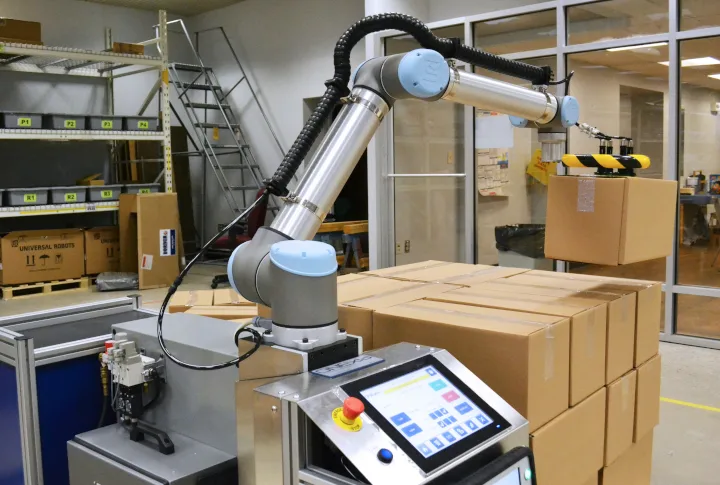
A collaborative robot, or cobot, is designed to work in closer physical proximity to people. They operate at lower speeds and with force-limiting technology that allows them to stop or slow down when a person enters their workspace. Cobots are generally lighter, easier to program, and more flexible in terms of repositioning and task reassignment.
Both are legitimate tools. Neither is universally superior. The right choice depends on what you’re actually trying to accomplish.
Where Industrial Robots Clearly Win
High-Speed, High-Volume Applications
If your line runs at 60, 80, or 100+ cycles per minute, a cobot is not the right answer. Full stop. Cobots are speed-limited by design because they need to be able to stop safely when a person is nearby. That safety feature is also a throughput ceiling.
Industrial robots have no such limitation. They’re built for relentless, high-speed operation with cycle times that cobots can’t touch. On a palletizing line, a case packing application, or a high-speed pick-and-place cell, industrial robots will consistently outperform cobots when throughput is the priority.
Heavy Payload Requirements
Cobots are generally rated for payloads ranging from a few kilograms up to around 35 kg for the largest models. That sounds reasonable until you’re moving full cases, heavy trays, or stacked product configurations that exceed those limits.
Industrial robots can handle payloads well beyond what cobots can manage, and they do so without compromising speed or repeatability. If your product is heavy or your end-of-arm tooling (EOAT) adds significant weight, an industrial robot is almost always the better choice.
Long-Run Repeatability
When you need tight, consistent placement accuracy cycle after cycle, hour after hour, industrial robots deliver. They’re engineered for precision over billions of cycles. In applications where even minor drift affects downstream processes, sealing, labeling, or quality inspection, that level of repeatability matters.
Where Cobots Offer Real Advantages
Smaller Footprint and Flexible Deployment
One of the most practical advantages of cobots is their compact size and portability. Many cobot systems can be mounted on a cart or base and relocated without major infrastructure changes. For contract packagers or facilities that run short product runs with frequent changeovers, this flexibility can be genuinely valuable.
Industrial robots typically require a dedicated cell with guarding, safety interlocks, and a fixed footprint. That investment makes sense when the application is permanent. For temporary or rotating deployments, it can be harder to justify.
Simpler Programming and Lower Technical Barrier
Traditional industrial robots require trained programmers familiar with specific robot languages and control systems. Cobots were designed with a lower technical barrier in mind. Many use intuitive teach-pendant interfaces or hand-guided programming, which means your engineering team can make simple adjustments without calling in a specialist every time.
This matters most in environments where frequent reprogramming is part of the workflow, such as seasonal product changes, new SKU introductions, or contract packaging operations with varied customer requirements.
Integration Near Human Workflows
There are tasks in a packaging operation where human judgment and manual dexterity are still valuable, and where automating the entire process isn’t practical or cost-effective. Cobots can work alongside operators to assist with tasks like kitting, light assembly, or quality checking, without the full safety cage infrastructure of a traditional industrial cell.
That said, “collaborative” does not mean “no safety review required.” Any cobot deployment still needs a proper risk assessment. The safety standards around cobots (ISO/TS 15066 and related ANSI/RIA guidelines) have specific requirements, and assuming a cobot is automatically safe because it’s a cobot is a mistake that can lead to compliance issues.
The Hybrid Reality of Modern Packaging Lines
Here’s something worth saying plainly: most well-designed packaging lines don’t use one type of robot exclusively. They use the right robot for each application.
You might have an industrial robot handling high-speed case packing or palletizing at the end of the line, while a cobot assists with a lower-volume inspection or kitting task in a separate area. The two systems serve different purposes, and treating them as competitors rather than complements misses the bigger picture.
This is where the integration question becomes more important than the cobot-vs.-industrial debate. A robot that isn’t properly integrated into your line, your controls architecture, your conveyance system, and your upstream and downstream processes doesn’t deliver its full value regardless of what type it is. The equipment decision and the integration decision are not the same thing, and they shouldn’t be made separately.
Key Questions to Ask Before You Decide
If you’re working through this decision for your facility, here are the questions that tend to cut through the noise:
What is your target cycle rate? If you need to hit more than 30 to 40 cycles per minute consistently, you’re likely looking at an industrial robot.
What is your payload? Calculate the weight of your product plus your EOAT and compare it against cobot payload ratings. Don’t cut it close.
How often does the application change? Frequent changeovers favor cobots. Stable, long-run applications favor industrial systems.
What is your floor space situation? A tight footprint with no room for a safety cell may make cobots a practical necessity in some areas.
What does your existing controls environment look like? Integration into your PLC, SCADA, or line control system has to happen regardless of which robot type you choose. Factor that into your timeline and budget.
What does long-term support look like? Both cobot and industrial robot systems require maintenance, spare parts, and software support. Know who’s responsible for that before you buy.
Don’t Let the Technology Drive the Decision
One of the more common mistakes in automation purchases is letting the technology lead the decision rather than the application. Cobots have become trendy, and that’s created situations where facilities deploy them in applications where they’re not actually the best fit, simply because they seem newer or more approachable.
The same is true in reverse. Some facilities default to large industrial systems out of habit when a cobot would actually serve their needs more cost-effectively.
The right framework is always application first, technology second. Define what you need the robot to do, the speed requirements, the payload, the flexibility needs, the safety environment, and then match the technology to those requirements.
Working with an experienced integrator during this phase can save a significant amount of time and money. An integrator who has deployed both cobot and industrial systems across a range of packaging applications can help you evaluate the tradeoffs honestly, without a stake in selling you a particular type of equipment.
Final Thoughts
Cobots and industrial robots are both mature, proven technologies that have earned their place in modern packaging operations. They solve different problems, and understanding those differences is the starting point for making a smart decision.
The short version: if you need speed, heavy payload, or long-run precision, industrial robots are hard to beat. If you need flexibility, smaller footprint, or the ability to work near operators without full guarding infrastructure, cobots offer real advantages. Many lines benefit from both.
What matters most is that the system you choose gets properly integrated into your line, is backed by solid engineering, and is supported long after commissioning. The robot itself is only part of the equation.





