
Assessment Helps Teams Avoid The Illusion Of AI Productivity
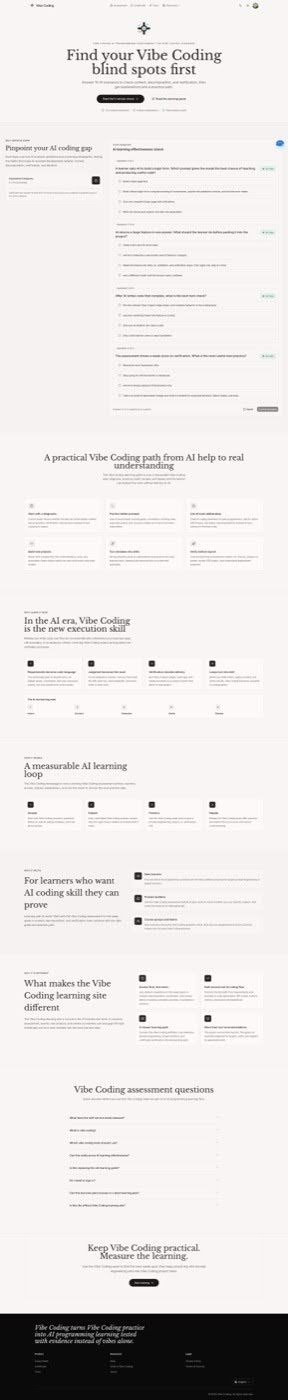
The homepage asks users to find their Vibe Coding blind spots first. It describes a short AI scenario check focused on context, decomposition, verification, and a next practice path. Those categories are exactly where teams should pay attention.
AI coding tools can create the illusion of productivity. A developer can generate a component quickly, but if the prompt ignored the design system, the result may create rework. A model can suggest a database change, but if no one checks migrations and edge cases, the team may ship risk. A chatbot can explain a bug, but if the learner never reproduces the issue, the explanation may not matter.
An assessment-first workflow helps by making these habits visible. Instead of asking, “Are people using AI?” a team can ask better questions. Are they giving enough project context? Are they breaking tasks into reviewable units? Are they asking the model to explain choices? Are they verifying outputs through tests, UI checks, or code review?
That shift is important because AI adoption should not be measured only by usage. It should be measured by whether the team becomes more reliable.
This is especially relevant for business leaders watching AI tools spread across engineering teams. A usage dashboard may show that developers are asking more questions or generating more code, but that does not prove that the organization is reducing risk. Assessment can reveal whether people understand how to frame work, how to evaluate output, and how to avoid turning AI speed into review debt. Those are the operational questions that matter after the novelty fades.
Course Practice Turns Standards Into Daily Behavior
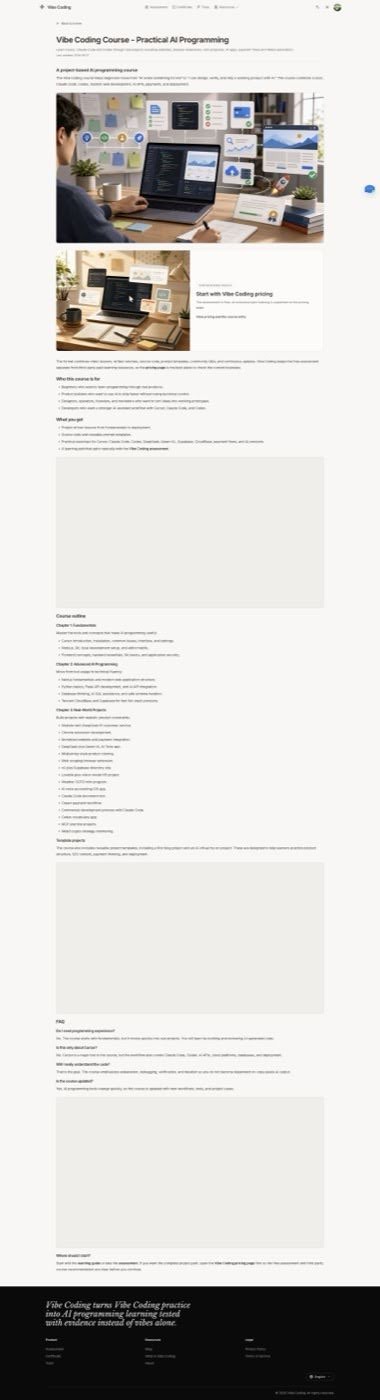
The vibe coding course gives learners a place to improve after the diagnostic. From a team perspective, this is where the tool becomes operational. A manager or technical lead can use assessment results to guide practice instead of assigning a generic AI training session to everyone.
For example, if developers struggle with decomposition, the next practice could be breaking a feature request into API, database, UI, and test slices before asking AI for implementation. If verification is weak, the next practice could require every AI-generated change to include a test plan and a manual check. If context is the issue, the team could practice giving the model relevant files, constraints, and existing conventions.
The course material is also useful because AI coding habits are not one-time knowledge. They need repetition. Teams need shared rituals around prompt framing, diff review, and rollback thinking. The more AI speeds up code creation, the more important those rituals become.
For individual learners, the course creates a less chaotic path. Instead of jumping between tool reviews and social media prompt threads, they can work through a site that connects assessment with practical programming behavior.
For teams, the course can also support a repeatable enablement program. New developers could take the diagnostic during onboarding, then complete practice tasks that mirror the company’s real workflow. Senior developers could use the same concepts when reviewing AI-generated patches. Product managers could benefit too, because better task framing often starts before a developer prompts the model. Clearer acceptance criteria, smaller slices of work, and explicit constraints all make AI-assisted development safer.
The course approach also makes it easier to separate tool training from engineering training. Tool training explains buttons, model choices, and editor integrations. Engineering training explains how to reason about requirements, code quality, test coverage, and maintainability. Vibe Coding appears to sit closer to the second category, which is where teams usually need more structure.
Certificates Make Progress Easier To Verify
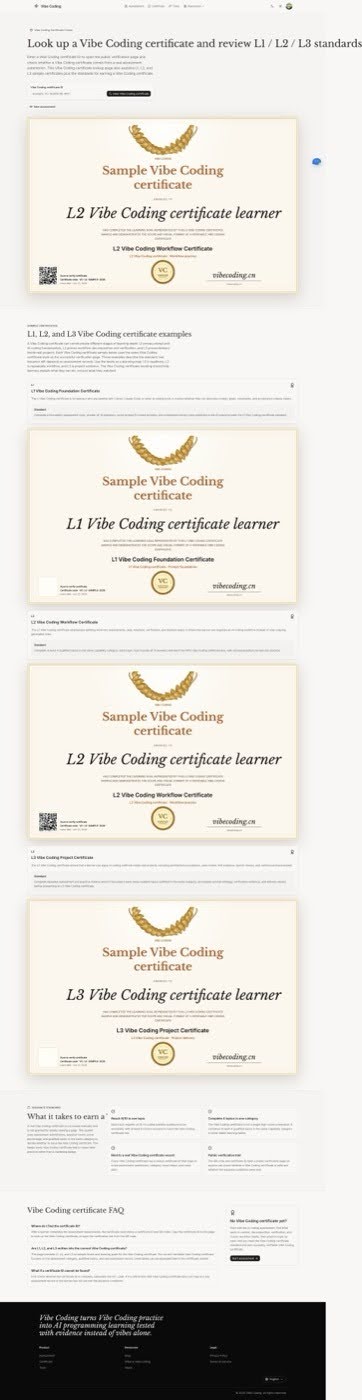
The vibe coding certificate page adds certificate lookup and L1 / L2 / L3 standards. For teams, that can be useful as a lightweight signal. It does not replace interviews, code review, or actual project history, but it can support a learning program by giving participants a visible target.
The certificate model also reinforces that AI coding skill has levels. At a basic level, someone may learn how to ask clearer questions. At a stronger level, they can guide an AI through a real feature while respecting project constraints. At a higher level, they can evaluate output, catch subtle issues, and use the model as part of a disciplined development loop.
That is the part I find most relevant for companies. The future of AI coding is not just faster autocomplete. It is better collaboration between human judgment and machine assistance. Vibe Coding’s structure reflects that. It starts by diagnosing habits, then gives learners practice material, then describes standards that make progress easier to discuss.
The certificate lookup page also supports trust after the learning happens. If a learner claims completion, a public lookup gives others a way to verify the record and understand the level language. That can be useful for communities, training programs, or teams that want a lightweight way to recognize progress without pretending that a certificate is the same as production experience.
The bigger benefit is cultural. When a team talks about levels and standards, it is implicitly saying that AI coding has quality expectations. The model is not the final authority. The human remains responsible for context, judgment, and verification. That message is healthy for any organization adopting AI development tools.
It also helps procurement and training owners compare outcomes. Instead of buying access to another AI tool and hoping usage turns into capability, they can pair tool rollout with a learning framework. A diagnostic, course path, and certificate standard make the human side of AI adoption easier to manage.
If a team is serious about AI development, the question is not whether people can generate code. The question is whether they can generate, review, and improve code responsibly. Vibe Coding gives learners and teams a practical way to begin answering that question.







