For years, businesses have treated images and videos as two separate categories of content. Images were relatively quick and affordable to produce, while video required scripts, filming, equipment, editing, sound design, and a significantly larger budget.
Artificial intelligence is rapidly removing that division.
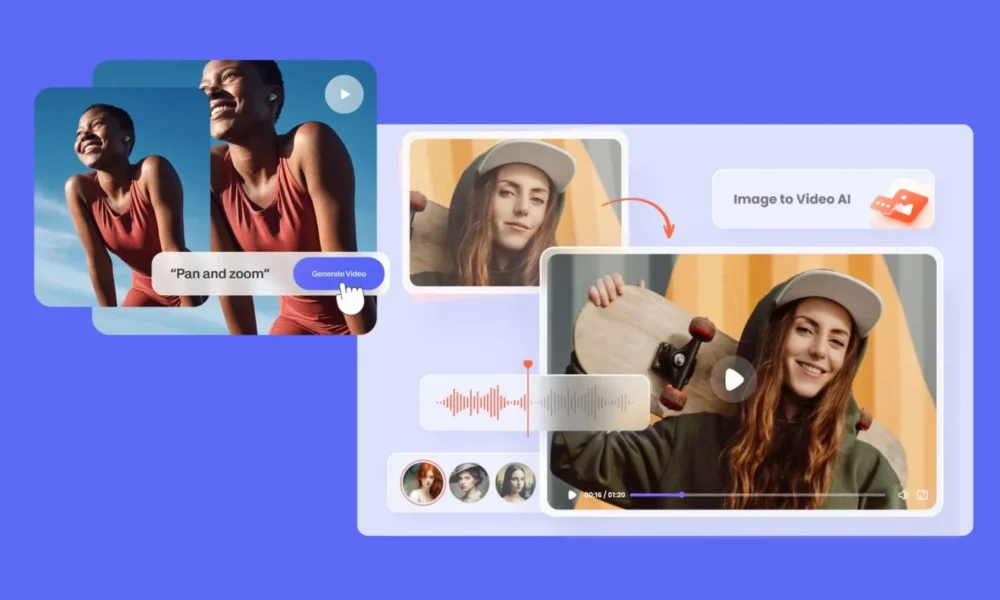
Image-to-video technology can now analyze a still photograph, illustration, product render, or concept image and transform it into a moving sequence. Instead of creating every frame manually, users can describe the desired action, camera movement, atmosphere, and visual style. The AI then generates motion while attempting to preserve the original subject and composition.
This development is more than a visually impressive novelty. It is beginning to change how marketing teams, ecommerce companies, filmmakers, designers, educators, and independent creators approach video production.
Why Image-to-Video AI Is Gaining Momentum
The demand for video continues to grow across social media, advertising, ecommerce, education, and digital publishing. However, traditional video production remains difficult to scale.
A brand may have thousands of high-quality product photographs but only a small number of videos. A designer may have a complete collection of concept art without the budget to animate it. A small marketing team may need new social media clips every week but lack an in-house production department.
Image-to-video AI offers a practical bridge between existing visual assets and the growing demand for motion content.
The key advantage is not simply faster rendering. It is the ability to reuse visual material that a business or creator already owns.
A product photograph can become a short promotional clip. A character illustration can become an animated scene. An architectural rendering can gain environmental motion, camera movement, and changing light. A travel photograph can be transformed into an atmospheric sequence for a campaign or presentation.
The Shift From Text-First to Visual-First Workflows
Text-to-video generation has received much of the attention surrounding generative video. It allows users to describe an entire scene and generate it from a written prompt.
However, text alone leaves many visual decisions open to interpretation. The model must determine the subject’s appearance, composition, color palette, environment, and framing. Even a detailed prompt may produce a result that differs significantly from the creator’s original idea.
Image-to-video generation begins with a visual reference. That reference acts as a creative anchor.
For brands, this can mean better alignment with existing product photography and visual identity. For artists, it can help preserve the appearance of an original character or environment. For filmmakers, it provides a way to animate storyboard frames and explore possible camera movements before committing to production.
The most effective workflows increasingly combine multiple types of input. A creator may begin with a generated or photographed image, add a written motion prompt, select a camera direction, generate several variations, and then refine the most promising result in an editor.
Recent multimodal video systems reflect this broader direction. Newer tools are designed to work with combinations of text, images, video references, and conversational editing instructions instead of treating each medium as an isolated input.
Practical Applications for Businesses
One of the strongest use cases for image-to-video AI is ecommerce.
Online stores already invest heavily in product photography. With AI animation, those images can be repurposed into rotating product shots, lifestyle-inspired scenes, social advertisements, landing-page videos, and short promotional clips.
A furniture company could animate a static room image with changing sunlight and subtle camera movement. A fashion retailer could add fabric motion to an editorial photograph. A cosmetics brand could turn a product render into a polished reveal sequence.
This does not necessarily replace professional commercial shoots. Instead, it gives marketing teams a faster way to create variations, test concepts, and support campaigns that would not justify a full production budget.
Advertising teams can also use image-to-video generation during the creative testing stage. Rather than producing one expensive advertisement, marketers can generate several motion concepts from the same product image. They can experiment with different openings, camera angles, backgrounds, pacing, and visual styles before selecting the strongest direction.
The technology is especially useful for short-form platforms, where creative fatigue can appear quickly. Brands running paid campaigns often need a continuous supply of new visuals. Turning existing images into multiple video variations can extend the useful life of an asset library.
A New Tool for Previsualization and Storytelling
Filmmakers and creative studios can use image-to-video AI as a previsualization tool.
Traditionally, a storyboard communicates composition and narrative sequence but cannot fully demonstrate timing or camera motion. Animatics provide more information, but they require additional labor.
AI-generated motion can help directors explore how a storyboard frame might work as a tracking shot, close-up, reveal, or atmospheric transition. A still concept image can be tested with different forms of movement before a crew, location, or visual-effects team becomes involved.
The result does not need to appear in the final production to be valuable. Its purpose may be to communicate an idea more clearly, compare creative possibilities, or identify problems earlier in the process.
Independent creators can benefit even more. Someone without a traditional animation team can transform illustrations into music-video visuals, narrative sequences, social media content, or experimental films.
This lowers the barrier between imagining a scene and seeing a moving version of it.
Education, Training, and Visual Communication
Image-to-video technology also has applications beyond entertainment and advertising.
Educators can animate historical images, scientific diagrams, maps, and textbook illustrations to make lessons more visually engaging. A static diagram of a mechanical process could become a short moving explanation. A historical illustration could be used as the starting point for a classroom visualization.
Corporate training teams can add motion to existing presentation assets instead of rebuilding every lesson as a traditional video. Publishers can turn article illustrations into social clips. Museums and cultural organizations can create animated interpretations of archive material, provided that the historical context remains clear.
In these situations, AI-generated video should support accurate communication rather than replace it. Human review remains important, especially when the output represents scientific, historical, medical, or technical information.
The Importance of Better Prompts and Source Images
Although image-to-video tools simplify production, output quality still depends heavily on the input.
A clear, high-resolution image generally gives the model more useful visual information. The main subject should be recognizable, and the composition should leave enough space for the intended movement.
Prompts also work better when they describe motion rather than repeating what is already visible.
For example, instead of writing “a woman standing in a city street,” the user could write:
“The camera slowly moves forward as her coat and hair respond naturally to a light evening breeze. Reflections shift across the wet pavement while traffic moves softly in the background.”
This instruction tells the model what should change over time. It defines subject movement, environmental movement, camera behavior, and atmosphere.
Creators should also avoid requesting too many unrelated actions in a single short clip. A simple, clearly directed movement often produces a more coherent result than an overloaded prompt.
Human Direction Still Determines the Outcome
AI can generate motion, but it does not automatically understand a brand’s strategy or a story’s emotional purpose.
The strongest results still begin with human decisions:
What should the audience notice first? What emotion should the scene create? Should the camera feel energetic, luxurious, intimate, or documentary-like? Which elements must remain unchanged? Where will the final video be published?
Human creators also need to review generated clips for visual artifacts, inaccurate product details, unnatural movement, or inconsistent branding. AI-generated output should be treated as creative material rather than an unquestionable final product.
Legal and ethical considerations remain equally important. Users should have the right to animate the images they upload. Businesses need appropriate permission before using a person’s face, artwork, trademarked material, or copyrighted photography. Synthetic media should not be used to mislead viewers or impersonate individuals without consent.
From Experimental Feature to Everyday Workflow
The future of image-to-video AI is unlikely to be defined by a single model or platform. The more important development is its integration into everyday creative workflows.
Design tools may offer an “animate” option beside familiar image-editing controls. Ecommerce platforms may automatically generate motion assets from product catalogs. Advertising systems may create multiple video variations for different audiences and placements. Presentation software may turn static slides into narrated visual sequences.
At the same time, multimodal editing is making video generation more conversational. Instead of restarting whenever an output is imperfect, users will increasingly be able to request targeted changes to movement, lighting, characters, backgrounds, or framing.
Image-to-video AI does not eliminate the need for filmmakers, animators, editors, or creative directors. It changes where their time is spent.
Less effort may be required for early drafts, basic motion, format variations, and concept testing. More attention can then go toward storytelling, art direction, brand identity, emotional impact, and final refinement.
The businesses and creators that benefit most will not be those that generate the largest quantity of synthetic video. They will be those that understand how to combine AI speed with meaningful human direction.
Static images are no longer necessarily finished assets. They can become starting points for motion, experimentation, and entirely new forms of visual communication.