
Share
Share
Share
Share
Every road cyclist eventually asks the same question: what actually makes one wheelset faster than another? The marketing language around speed can get loud fast — aero shapes, stiffness claims, weight numbers — but the real answer usually comes down to something less flashy: the carbon fiber itself, how it’s layered, and how the finished rim is tested before it ever reaches a rider. Understanding that engineering process is the difference between buying a wheel because it looks fast and buying one because it’s actually built to perform.
Carbon fiber wheels aren’t a single material poured into a mold. They’re an engineered structure, built from specific fiber grades, laid up in specific directions, and shaped around a rim profile that has to balance aerodynamics, weight, and durability all at once. Two wheelsets can look nearly identical in a product photo and still ride completely differently once you’re out on real roads, in real wind, under real braking loads. That’s why riders shopping for carbon fiber road bike wheels are increasingly asking to see test data, not just spec sheets.
What Makes Carbon Fiber Different From Alloy
Aluminum rims are extruded and machined — the material properties are largely fixed once the alloy is chosen. Carbon fiber rims work differently. The rim is built up from woven carbon sheets, resin, and a mold, which means engineers can control stiffness, weight, and impact resistance independently in different areas of the same rim. A well-engineered carbon rim can be reinforced exactly where it needs strength — like the spoke-hole area — without adding unnecessary weight everywhere else.
This is also why not all carbon wheels are equal, even at similar price points. The fiber grade matters. Higher-modulus fibers like T800 and T1100 (both Toray-grade carbon fibers commonly referenced in wheel engineering) offer a stronger strength-to-weight ratio than lower-grade fiber, which is part of why manufacturers publish material specs at all — it’s one of the few ways a rider can compare wheelsets before actually riding them.
Why Layup Direction Matters More Than Most Riders Realize
The direction fibers are oriented during layup changes how the rim absorbs impact versus how it flexes under braking or cornering load. A rim optimized purely for lateral stiffness might transmit more road buzz, while one balanced for compliance can feel more forgiving on rough pavement but slightly less precise under hard cornering. This is engineering trade-off territory — there’s no universally “best” layup, only one that’s tuned for a specific type of riding.
Reading Impact and Strength Test Data the Right Way
Numbers like impact-test joules or spoke-hole pull-force ratings only mean something in context. A rim tested to withstand a high-joule impact is being evaluated for how it holds up under a severe vertical hit — the kind of impact that might happen hitting a pothole at speed, not everyday riding. A spoke-hole pull test, similarly, measures how much tension the most stressed part of the rim can handle before failure, which matters because that’s one of the more common failure points on lower-quality carbon rims.
The honest way to read any of this data is to treat it as validation, not certification, unless the brand explicitly says otherwise. Internal lab testing tells you a manufacturer is checking their own product against a defined standard — which is meaningfully better than no testing at all — but it isn’t the same as independent third-party certification. Riders comparing wheelsets should look for brands that are transparent about this distinction rather than blurring internal test results with formal certification claims.
Weight Versus Durability: The Real Trade-Off
Every gram removed from a rim has to come from somewhere, and it’s rarely free. Lighter wheelsets can improve acceleration and climbing feel, but shaving weight without reinforcing high-stress zones is how you end up with a rim that looks great on a spec sheet and fails early in real-world use. This is why serious engineering approaches — using different fiber grades or layup thickness in different zones of the same rim — matter more than a single headline weight number.
Compatibility Is Part of the Engineering, Not an Afterthought
A perfectly engineered carbon rim is still the wrong purchase if it doesn’t fit your bike. This is one of the most overlooked parts of buying carbon wheels, and it’s a big enough topic that it deserves its own careful read — our disc brake wheelset compatibility guide walks through axle standards, rotor interface, hub spacing, and freehub body matching in detail. Skipping this step is the single most common reason riders end up disappointed with an otherwise well-built wheelset — not because the rim was flawed, but because it was matched to the wrong bike.
Rotor mounting (Centerlock versus 6-bolt), thru-axle sizing, and freehub body (Shimano HG versus SRAM XDR, for example) all have to line up with your existing drivetrain and frame. None of this is complicated once you know what to check, but it has to happen before rim depth, weight, or aesthetics enter the conversation.
Rim Depth as an Engineering Decision, Not Just a Style Choice
Rim depth changes how a wheel behaves in wind, how it accelerates, and how it feels in corners. Shallower rims, generally in the 30–40mm range, tend to handle crosswinds more predictably and feel lighter under acceleration — useful for climbing-heavy routes or riders who prioritize handling over outright aero gains. Deeper rims push more toward aerodynamic efficiency at the cost of slightly more sensitivity in gusty conditions.
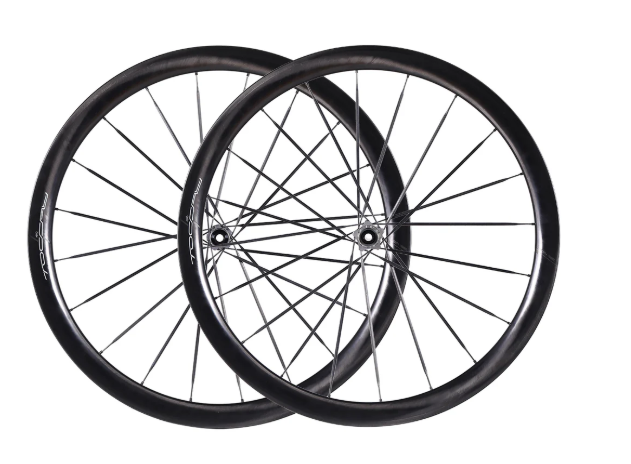
If you’re weighing depth options directly, the AERO-40 Ghost Wheelset CARBON is a useful reference point for how a 40mm carbon wheel is actually specced in practice — built with a Toray T1100 carbon layup, a 25mm inner / 33mm outer rim width, a 36T ratchet hub system with sealed bearings, and a wheelset weight around 1080–1100g depending on configuration. It’s designed for tubeless-ready and clincher setups without needing rim tape, with Centerlock disc compatibility and a choice of Shimano HG or SRAM XDR freehub bodies. Reference points like this are useful less because of any one number and more because they show how rim width, weight, hub design, and tire compatibility have to be considered together rather than in isolation — which is really the whole point of thinking about wheels as engineered systems instead of single specs.
Tubeless Setup and Rim Width Work Together
Modern carbon road wheels are increasingly built around tubeless compatibility, but tubeless performance depends heavily on rim width. A wider internal rim width supports a tire more effectively, changing its shape and contact patch compared to a narrower rim with the same tire. This is part of why internal and external rim width numbers are worth checking alongside tire size — a tire that’s technically compatible can still behave differently depending on the rim it’s mounted to.
Getting tubeless setup right also depends on rim tape (if required), valve length matching rim depth, and using tires the rim manufacturer actually recommends. None of this is difficult, but skipping it is a common way riders end up with sealing issues that have nothing to do with the rim’s actual engineering quality.
Freehub Engineering and Long-Term Serviceability
The hub and freehub system is easy to overlook next to rim material, but it directly affects long-term ownership. A ratchet-based freehub system, sealed bearings, and available replacement parts all determine how well a wheelset holds up over years of riding — not just how it performs on day one. Riders planning to keep a wheelset long-term should weigh freehub body options (and whether spare parts are actually available) as seriously as they weigh rim depth or weight.
What Actually Matters When Comparing Carbon Wheels
The fastest-looking wheelset on a product page isn’t necessarily the best engineered one. Real carbon wheel performance comes down to fiber grade, layup design, tested durability at the spoke-hole and impact-zone level, rim width matched sensibly to tire choice, and compatibility with your specific bike’s axle, rotor, and freehub standards. None of these details are exciting to read about compared to a big aero claim, but they’re the actual difference between a wheelset that performs for years and one that looks good in a listing photo.
If you’re shopping seriously, start with the boring checklist: confirm compatibility first, understand what the test data is actually claiming, and treat rim depth as a riding-style decision rather than a status symbol. From there, comparing options within carbon fiber road bike wheels becomes a much more straightforward exercise — you’re evaluating engineering trade-offs instead of guessing based on marketing copy. That’s ultimately the smartest way to upgrade: not by chasing the deepest rim or the lowest weight, but by understanding what’s actually built into the wheel you’re about to ride.
Read More From Techbullion





