
Share
Share
Share
Share
Want to learn to code but not sure where to start? You are not alone. The biggest reason beginners quit is not difficulty. There is confusion about the path.
This roadmap gives you that path in five simple steps. Everything here can be done for free, and you can start today. No fancy setup and no expensive courses, just a clear order to follow.
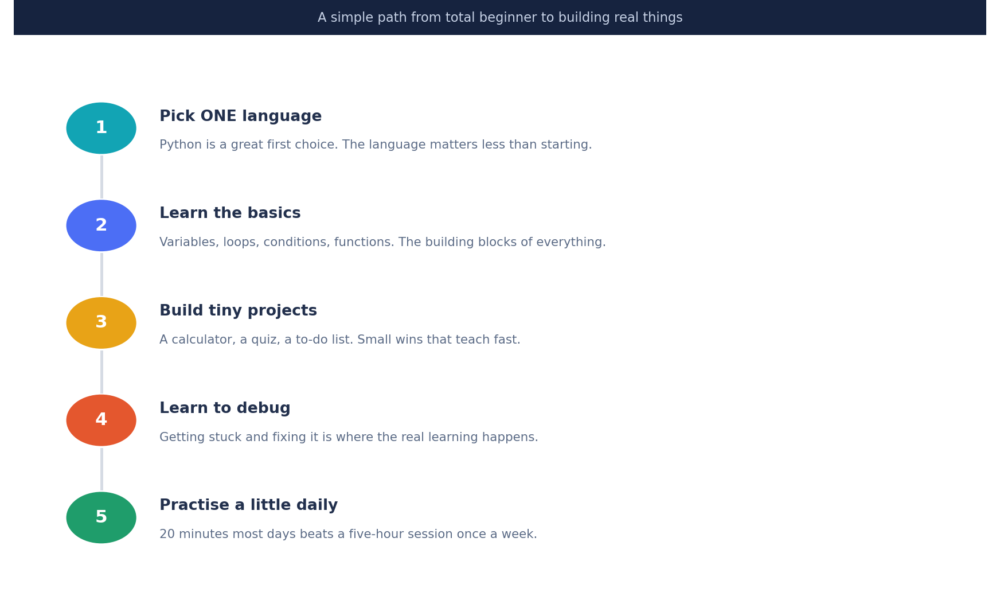
The five stages every beginner moves through, in order.
Step 1: Pick one language (and stop overthinking it)
Beginners waste weeks choosing the “perfect” first language. Do not.
Python is a great first choice. It is simple to read and used everywhere, from web apps to AI. Pick it, and move on. The skills you learn transfer to any language later.
Step 2: Learn the core basics
Every language is built from the same building blocks. Learn these first:
- Variables store information.
- Loops repeat actions.
- Conditions make decisions (if this, do that).
- Functions are reusable chunks of code.
Master these, and you can read and write real programs.
Step 3: Build tiny projects
This is the step most beginners skip, and it is the most important one.
Do not just watch tutorials. Build small things: a calculator, a number-guessing game, a simple to-do list. Small projects force everything to click.
Step 4: Learn to debug
Your code will break. Constantly. That is not failure, that is coding.
Learning to read an error message and fix it is where the real skill grows. Get comfortable being stuck, then unstuck. That loop is the whole job.
Step 5: Practise a little every day
Twenty minutes most days beats a five-hour session once a week.
Coding is a skill, like a language or an instrument. Small, steady practice builds fluency far faster than rare bursts.
The best free resources to start
You do not need to pay to begin. freeCodeCamp offers full, project-based courses at no cost, and it is one of the best beginner resources online. Work through it before you buy anything.
Common beginner mistakes to avoid
- Jumping between languages instead of finishing one.
- Watching endless tutorials without ever building.
- Giving up at the first error message.
- Comparing your day 5 to someone else’s year 5.
What can you actually build as a beginner?
Start tiny. Real projects teach faster than any tutorial:
- A calculator.
- A number-guessing game.
- A to-do list app.
- A simple personal website.
Each one forces you to use variables, loops and logic for a real purpose. That is when it clicks.
Free vs paid: what do you actually need?
You can learn almost everything for free. Paid help is optional, and mainly buys two things:
- Structure. A clear path so you are not guessing what to learn next.
- Feedback. Someone to look at your code and show you what to fix.
If you are self-motivated, free resources are plenty. If you keep stalling on the same errors, working with Computer Science tutors gives you that structure and feedback, which is often the fastest way past a plateau.
How to stay motivated
Most people quit coding out of frustration, not difficulty. Protect your motivation:
- Build things you actually find fun.
- Celebrate small wins.
- Do not compare your day 5 to someone else’s year 5.
- Take breaks when stuck. Solutions often appear later.
Is coding still worth learning?
Yes. Even with AI writing code, someone has to design, check and fix it. Understanding code is becoming a basic skill across many jobs, not just tech ones.
Learning it now is one of the highest-value things a student can do, whatever career they end up in.
Quick answers (FAQ)
How long does it take to learn to code?
You can build simple projects in a few months of steady practice. Job-ready skills usually take longer, around 6 to 12 months of consistent effort.
Which programming language should I learn first?
Python, for most beginners. It is easy to read and widely used. The first language matters far less than sticking with it.
Do I need to be good at maths to code?
For most coding, no. You need logical thinking more than advanced maths.
Can I learn to code for free?
Yes. Free resources can take you a long way. Paid help is optional, mainly for structure and feedback.
A beginner-friendly weekly plan
If you are not sure how to structure your week, copy this:
- Learn one small concept (a loop, a function).
- Do a few practice exercises on it.
- Add it to a mini project you are building.
- Review what confused you before moving on.
Repeat weekly. Slow and steady genuinely wins here.
Which language should you learn after your first?
Once you are comfortable with one language, your next depends on your goal:
- Websites: learn JavaScript.
- Data or AI: stick with Python and add its data tools.
- Apps: look at Swift or Kotlin.
But do not rush. One language, learned well, is worth more than five half-learned ones.
Do you need a computer science degree?
Not always. Plenty of coders are self-taught or learned through short courses. A degree helps for some roles, but real skills and a portfolio of projects matter just as much.
The takeaway
Learning to code is not about talent. It is about following the path and not quitting at the errors.
Pick one language, learn the basics, build small things, and practise daily. That is the whole roadmap.





