Share
Share
Share
Share
Digital healthcare has changed significantly over the past several years. Telehealth appointments, patient portals, wearable devices, online prescription services, and health calculators have moved many parts of healthcare beyond the traditional doctor’s office.
Weight management is one area where that transformation is particularly visible.
The growing use of medications such as semaglutide and tirzepatide has created demand not only for medical treatment, but also for better digital tools that help patients understand how treatment works.
For healthcare technology companies and providers, the next stage of digital health may therefore be less about simply putting medical services online and more about making increasingly complex medical information easier for patients to understand.
GLP-1 Treatment Has Created a New Information Challenge
Prescription weight-management medications have become familiar names to consumers, but understanding their use can still be complicated.
Patients may encounter terminology involving milligrams, milliliters, medication concentrations, injection schedules, and syringe units. These measurements are related, but they are not interchangeable.
For someone without a medical background, a prescription expressed in milligrams may not immediately explain how that quantity relates to the volume of liquid involved.
That creates an opportunity for health technology.
Instead of expecting patients to perform conversions themselves or search across multiple websites for answers, digital tools can organize information into a more understandable format.
From Health Information to Interactive Health Tools
For years, healthcare websites primarily functioned as online libraries. A patient searched for a condition or medication and found an article explaining it.
The model is becoming more interactive.
BMI calculators, calorie calculators, symptom questionnaires, insurance verification tools, medication trackers, appointment systems, and dosage-conversion tools allow users to interact with health information rather than simply read it.
GLP-1 treatment is a particularly interesting example.
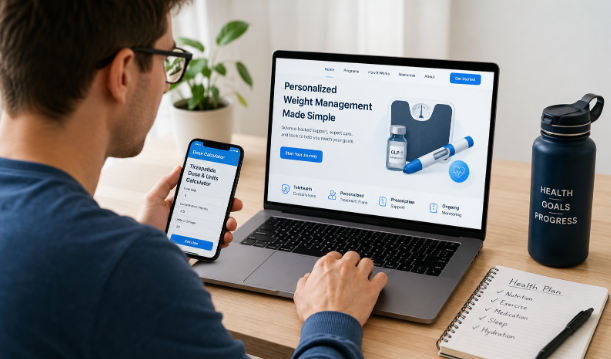
A patient trying to understand tirzepatide may need to distinguish between prescribed dose, medication concentration, liquid volume, and syringe-unit measurements. A digital tirzepatide dose and units calculator can demonstrate how those measurements relate when the appropriate medication concentration and other required information are entered.
The important distinction is that a calculator should not decide what dose a person should take. That remains a clinical decision. Its useful role is translating measurements and presenting information that has already been provided in a more understandable way.
Why User Experience Matters in Healthcare
Good healthcare technology is not necessarily the technology with the most features.
Often, it is the technology that removes the most confusion.
Consider how consumers now interact with financial technology. Banking applications translate complicated financial systems into relatively simple dashboards showing balances, payments, spending, and transactions.
Healthcare is gradually moving in the same direction.
Patients increasingly expect to be able to schedule appointments, review information, communicate with providers, check insurance options, and access educational resources without navigating several disconnected systems.
This is particularly relevant to telehealth because the digital experience becomes part of the healthcare experience itself.
If information is difficult to find or understand, patients may become frustrated even when the underlying medical service is good.
Telehealth Is Becoming More Than Video Appointments
Early discussions of telemedicine often focused on replacing an office appointment with a video call.
Modern telehealth can be considerably broader.
A digital healthcare platform may incorporate patient intake, medical history collection, provider consultations, laboratory coordination, prescription management, educational resources, follow-up communication, and treatment monitoring.
Some providers are also building educational tools directly around the services they offer.
For example, GoalBMI Wellness combines telehealth-based medical weight-management information with patient resources covering GLP-1 medications, treatment options, insurance questions, pricing information, and interactive calculators.
This illustrates a broader HealthTech trend: healthcare websites are gradually evolving from digital brochures into functional patient-resource platforms.
Calculators Can Improve Health Literacy — With Limits
Interactive medical calculators can be valuable because they allow people to explore information using their own numbers.
That personalization can make abstract concepts easier to understand.
But healthcare calculators also require careful design.
The interface should clearly distinguish between educational calculations and medical recommendations. Inputs and outputs should use clearly identified units, assumptions should be visible, and users should be reminded to verify medication instructions with a qualified healthcare professional.
This is particularly important with prescription medications.
A mathematically correct conversion is not necessarily a medically appropriate dose. The appropriate treatment depends on factors that a simple calculator cannot evaluate, including medical history, indication, response to treatment, side effects, other medications, and a clinician’s judgment.
Technology works best here as an additional information layer rather than a replacement for medical supervision.
The Growing Role of Patient-Facing HealthTech
The expansion of GLP-1 treatment highlights a larger transformation taking place across healthcare.
Patients increasingly want information that is immediate, personalized, and understandable.
That is encouraging healthcare organizations to rethink what a medical website or patient portal should actually do.
The next generation of digital healthcare platforms may combine several functions that were previously separated: education, communication, calculations, scheduling, monitoring, and access to clinicians.
Artificial intelligence could push this further by helping patients navigate large amounts of medical information, while connected devices and wearable technology may provide providers with more longitudinal health data.
The challenge will be maintaining a clear boundary between providing useful information and making clinical decisions that require qualified medical professionals.
Better Technology Can Mean Better Questions
One overlooked benefit of digital health tools is that they can help patients arrive at medical appointments better prepared.
A patient who understands basic terminology surrounding a medication can ask more specific questions about treatment, side effects, costs, alternatives, or follow-up.
That does not eliminate the need for clinicians. In many cases, it can make conversations with clinicians more productive.
This may ultimately be one of the most useful roles for patient-facing HealthTech: not replacing the healthcare professional, but reducing unnecessary complexity between the patient and the professional.
The Future of Digital Weight Management
The rapid development of medical weight management offers a useful preview of where digital healthcare may be heading.
Medication is only one component of the system.
Patients also need access to clinicians, understandable information, treatment monitoring, nutrition and lifestyle support, and tools that help them navigate their care.
Companies capable of bringing those elements together into a straightforward digital experience may have an important role in the next phase of HealthTech.
As healthcare becomes increasingly digital, the competitive advantage may not come from putting more information online.
It may come from making complicated healthcare information genuinely easier to use.