
Share
Share
Share
Share
In a modern digital audio setup, the quality of the source is only one part of the listening experience. Digital files, streaming platforms, computers, and dedicated music players all need to work with the rest of the audio chain, making digital-to-analogue conversion an important stage before sound reaches an amplifier and speakers or headphones.
Why a Dedicated DAC Can Make a Difference in a Digital Audio Setup
As digital music has become a central part of modern listening, the equipment used to process audio signals has also become more important. Streaming platforms, computers, music servers, and digital transports can provide access to high-resolution music, but digital audio still needs to be converted into an analogue signal before it reaches an amplifier, headphones, or speakers.
This is where a digital-to-analogue converter, commonly known as a DAC, becomes an important part of the audio chain.
A DAC may be built into a computer, smartphone, amplifier, or music player, but dedicated units are designed specifically to handle the conversion process. For listeners building a more refined audio system, understanding the role of a DAC can help when deciding how different components should work together.
What Does a DAC Actually Do?
Digital music is stored and transmitted as numerical data. Speakers and headphones, however, reproduce sound through analogue electrical signals. A DAC acts as the bridge between these two stages by converting the digital information into an analogue signal that can be amplified and reproduced as sound.
The quality of this process can be influenced by several factors, including the DAC architecture, clocking system, analogue output stage, power design, and the way unwanted electrical noise is managed.
For this reason, two DACs that support the same audio format may still differ in their engineering approach and integration within an audio system.
Why Dedicated DACs Are Popular Among Audiophiles
A dedicated DAC allows the conversion stage to be separated from other components. Rather than relying solely on the circuitry built into a computer or general-purpose device, listeners can choose a unit designed around specific audio engineering priorities.
Depending on the design, a dedicated DAC may focus on areas such as:
- Signal accuracy
- Noise reduction
- Timing precision
- Channel separation
- Analogue output quality
- Digital input flexibility
The benefits experienced in a particular setup will depend on the entire audio chain. Source quality, amplification, speakers or headphones, and room conditions can all influence the final listening experience.
Understanding Different DAC Architectures
Not all digital-to-analogue converters use the same design approach.
One widely used method is delta-sigma conversion, which is found in many modern audio devices. Another approach is the R2R, or resistor ladder, architecture. An R2R DAC uses carefully matched resistors to convert digital information into analogue voltage.
The design and implementation of these systems can vary significantly. Some listeners are particularly interested in discrete R2R designs because of their engineering approach and the way individual components are used within the conversion stage.
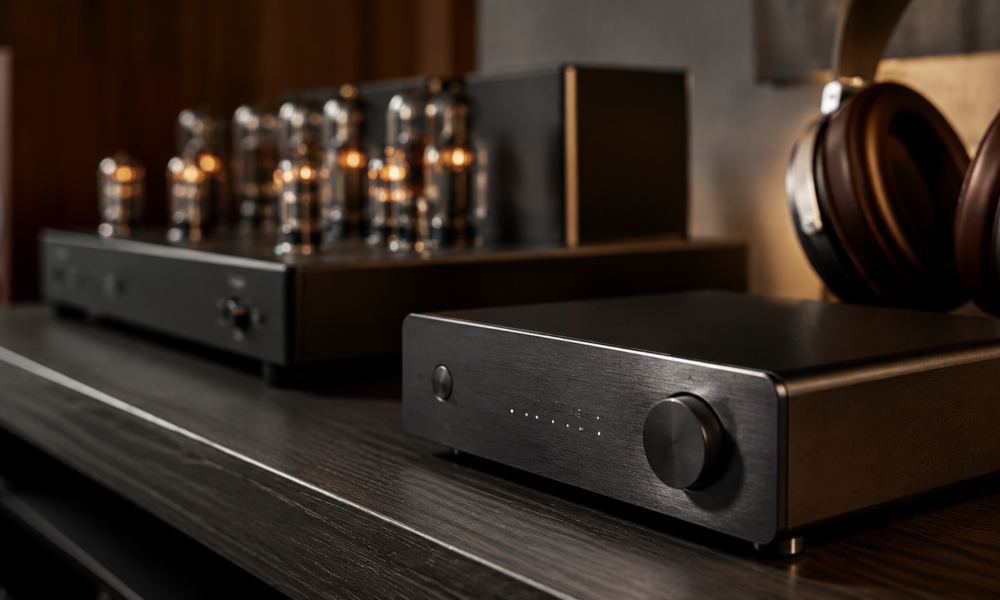
For those exploring compact high-end conversion systems, LAiV’s Harmony µDAC – Audiophile DACs provides an example of a desktop-focused DAC built around a balanced discrete R2R ladder architecture, with galvanic isolation and a discrete Class A output buffer.
The Importance of Timing in Digital Audio
Digital audio depends on precise timing. The information representing an audio signal must be processed at the correct intervals, and timing inaccuracies can introduce unwanted errors.
This is why clock design is an important consideration in higher-end digital audio equipment. Low-phase-noise oscillators and external clock compatibility are among the approaches used to improve timing stability.
While specifications can help explain the engineering of a component, they should be considered alongside practical factors such as system compatibility and listening preferences.
Managing Electrical Noise
Digital and analogue circuits can be affected by electrical interference. Computers and other digital sources may introduce noise into the audio chain through connections and shared electrical paths.
Some DAC designs use galvanic isolation to electrically separate parts of the system. The purpose is to reduce the transfer of unwanted interference between digital and analogue sections.
Noise management can be particularly relevant in desktop audio systems, where computers, monitors, USB devices, and power supplies may all operate close to the audio equipment.
Why the Analogue Output Stage Matters
Digital conversion is only one stage of the process. Once the signal has been converted, it must be delivered to the next component in the audio chain.
The output stage can affect how effectively the DAC connects with an amplifier or preamplifier. Factors such as output impedance and circuit design may influence signal transfer and overall system compatibility.
A well-designed output stage is therefore an important consideration, particularly in systems that use longer interconnects or more complex component arrangements.
Choosing the Right Inputs
Before selecting a DAC, it is useful to consider the devices that will be connected to it.
Common digital connections may include:
- USB
- Optical
- Coaxial
- I²S
Not every DAC supports every connection type, and the capabilities of each input may differ. A listener using a computer as a primary source may prioritise USB, while someone with a dedicated digital transport may require optical, coaxial, or I²S connectivity.
Checking input compatibility before building the system can help avoid unnecessary adapters or limitations later.
Compact Design and Desktop Audio
High-quality audio equipment does not always need to occupy a large amount of space. Desktop listening setups have become increasingly popular among people who use computers for both work and music.
A compact DAC can make it easier to build a dedicated listening system without overcrowding a desk. However, physical size alone should not be the deciding factor. Connectivity, output requirements, heat management, controls, and integration with other equipment should also be considered.
The Harmony µDAC, for example, is designed as a compact desktop DAC and supports USB, optical, coaxial, and I²S digital inputs, according to LAiV’s published specifications.
Building a Balanced Audio Chain
A DAC is only one part of a larger system. Even an advanced converter cannot compensate for every limitation elsewhere in the setup.
When planning an audio system, it is useful to consider:
- The quality and type of the digital source
- Supported connection formats
- DAC architecture and output options
- Amplifier compatibility
- Headphone or speaker characteristics
- Cable requirements
- Available space
- Listening preferences
The goal should be to create a system in which the components work well together rather than focusing on a single specification or feature.
Final Thoughts
A dedicated DAC can play an important role in a digital audio system by handling the transition from digital information to analogue sound. The technology behind these devices can involve different conversion architectures, clocking methods, isolation techniques, and output-stage designs.
For listeners interested in improving or refining their setup, understanding these elements can make it easier to evaluate how a DAC fits into the wider audio chain. The best choice ultimately depends on the source equipment, amplification, available connections, and the type of listening experience the user wants to create.