Share
Share
Share
Share
Press-curve data from force-displacement monitoring becomes valuable when it changes a production decision. Usefulness is the practical test for traceability. Saving an image from a single cycle may look convincing, yet the image cannot show whether the part was seated correctly, whether the fixture was compliant, or whether the process was already moving toward failure. Teams that treat every press curve as proof often collect data without creating a usable evidence path.
The better approach is to design the pressing task around the decisions that must be made at the station: accept, reject, investigate, or stop for a controlled change. Making those decisions requires a defined joint, a known loading condition, and a named owner for each result. This preparation makes a press curve useful to operations rather than merely interesting to engineering.
Start with the failure that a final force value cannot reveal
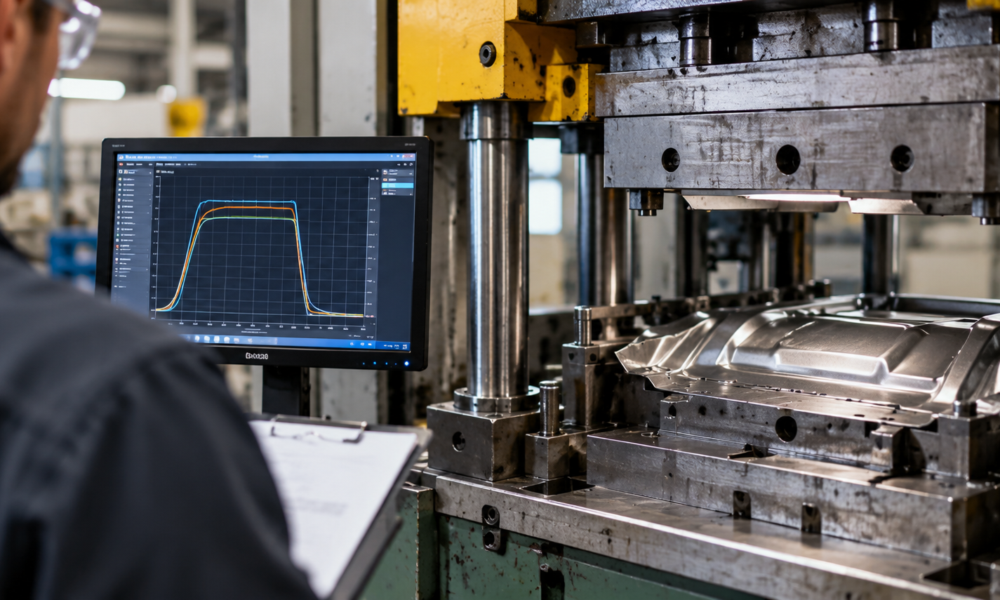
Final force is an endpoint. Checking only that endpoint can miss a missing component, early contact, friction drift, a part that starts correctly but binds, or a joint that reaches force without reaching its intended position. Recording the curve preserves the path between approach and final position. The question is not whether the line can save data; it is whether the saved shape separates an acceptable assembly from a known bad condition.
Simitch describes force-displacement monitoring as an assembly control method that records force and position together, allowing the press path to be evaluated rather than judged at a single endpoint. Following the motion is central to traceability because a meaningful record explains what occurred during the press cycle, not simply how it ended.
Define the fault library before setting limits. Include the actual defects that operators, quality staff, and maintenance technicians see: wrong orientation, incomplete seating, damaged material, excessive resistance, unstable contact, or tool wear. Without a plausible failure mode, a limit is a decoration that may reject good parts while allowing the failure that matters.
Make the press curve and evaluation windows answer a release question
Every production record should answer a question that somebody is authorized to act on. For a press-fit operation, that may be whether a part can move to the next station, whether it requires a downstream functional check, or whether the line needs a controlled hold. The release question determines which portions of the curve deserve attention and which fields must follow the part.
Evaluation windows are useful when they describe physical stages rather than arbitrary chart boxes. An approach window can expose unexpected contact. During insertion, the pressing window can reveal an altered slope. Near the endpoint, a final-position window can distinguish a reached force from a completed assembly. The most effective windows are built from representative good parts and confirmed bad parts, then reviewed when material, tooling, lubrication, or the fixture changes.
Setting those boundaries is uncomfortable because it forces a team to admit uncertainty. Making the window too broad produces little discrimination; a narrow window can turn ordinary variation into nuisance alarms. There is no universal setting that resolves the trade-off. The production owner must define the defect risk, and the process engineer must show how the curve responds to it.
Place external force sensors where the joint can tell the truth
At the controller, a reading may not represent the load at the joint. Compliance in a frame, fixture, adapter, or tool stack can absorb movement before it reaches the part. Off-axis loading can add a shape to the curve that looks like a material problem. These effects are why the measurement point and the mechanical load path must be discussed together.
The SIMITCH product information describes support for external force sensors and external displacement sensors when the measurement point needs to be closer to the part. Moving the measurement point is not a guarantee of better quality. Sensor placement is a design choice that should be made when the internal reading cannot represent the joint behavior that quality needs to verify.
Run a short correlation exercise before production release. Compare the curve with physical inspection, functional checks, and the actual measurement used to accept the assembly. If a curve feature cannot be connected to part condition, do not turn it into a reject rule. Conversely, if a known defect is invisible in the selected signals, do not claim that the record supplies complete traceability.
Connect process records to part identity and change control
Traceability is an information chain, not a file folder. Useful process records need a part identifier, result, recipe or program identity, relevant tool state, and a time reference that can be reconciled with upstream and downstream events. Without that context, a curve can still help troubleshoot, but it cannot reliably support containment or root-cause work after a field issue.
Change control is where many record systems lose their value. Fitting a revised punch, new fixture plate, alternate supplier material, or software update, or altering lubrication practice, can move the curve while leaving its filename intact. Treat a controlled change as a new evidence question: which limits remain valid, which samples must be collected, and who approves the transition? The answer should be visible to the people responding to a rejection at the line.
For plants comparing suppliers, the data interface should be part of the technical scope. Ask how result codes leave the cell, how raw curves are retained, how records are retrieved, and how a rejected part is prevented from being mixed back into flow. Those details shape the cost and responsibility of the station more than an attractive chart in a quotation.
NIST examines how exchanging traceability records across company boundaries can help establish product origins across manufacturing supply chains. Its study concerns information sharing rather than press acceptance limits. For a local station, the practical question remains whether another authorized team can connect a retrieved record to the right part and understand the event it describes.
Specify the press as a controlled station, not an isolated actuator
Servo presses are most useful when programmed motion, sensing, tooling, and line handling have a shared definition. When sourcing a station, SIMITCH servo press systems should be assessed as part of a station scope: the press module, fixture stiffness, part support, sensor plan, guarding, data route, and rejection logic all influence whether the curve can be trusted. Scope matters.
The SIMITCH servo press material also places force-displacement evidence beside project engineering for tooling, safety, traceability, and line interfaces. This is the right purchasing conversation. Suppliers should state what it supplies, what the integrator owns, and what the plant must validate. Storing more curves cannot repair an undefined acceptance rule, a weak fixture, or a missing containment plan.
Start the request for quotation with the accepted assembly and work backward. Provide drawings, samples, the current inspection method, known failures, expected part variation, and the data destination. Ask the supplier to identify the assumptions behind its proposed measurement and control arrangement. Specifying these inputs makes quote comparisons more honest because each bidder is answering the same release question.
Use the record to improve the process after launch
The mature use of curve data begins after commissioning. When results are linked to tool changes, incoming material lots, operator interventions, and maintenance events, the team can look for gradual movement before it becomes a high scrap event. However, every shift need not become a data-science project. Instead, the line should have a repeatable review routine and an escalation rule that match the risk of the assembly.
During shift reviews, ask whether curve shapes have moved, whether rejects cluster around a tool or material change, and whether a containment action restored the expected behavior. Quality staff should also ask whether the window itself still reflects the product. If the process has changed silently, a historic trace may create false confidence.
The central lesson is simple. Saving a press curve alone proves little. The record earns its role when it is tied to a defined defect, a representative measurement, a part identity, and an action that the production team can take. Build those links first, and the data record becomes a useful production asset instead of a screenshot archive, even when a commissioning report once made the station appear complete without showing how the line would respond to a drifted result.