
Share
Share
Share
Share
Expanding an ecommerce brand into another market used to begin with a familiar checklist: translate the storefront, adapt product descriptions, update shipping information, and prepare local campaigns.
That checklist is no longer enough.
Modern ecommerce relies heavily on visual content. Product images may include feature labels, dimensions, usage instructions, comparison charts, and promotional claims. Marketing teams also produce banners, posters, social creatives, and downloadable PDF materials. Once a brand enters several language markets, all of those assets may need localized versions.
The broader shift is important: localization is becoming a content-operations problem, not just a translation task.
The Localization Bottleneck Has Moved Into Visual Content
Website text is relatively easy to identify.
A team can export product descriptions, translate them, review terminology, and publish them through a CMS or ecommerce platform.
Visual assets are harder.
Text Can Be Embedded Across Hundreds of Images
A product catalogue may contain:
- feature graphics;
- size charts;
- comparison images;
- how-to graphics;
- promotional banners;
- product labels;
- campaign posters.
Each one can contain text that needs to change for a new market.
TechBullion has recently highlighted the same broader issue in visual localization: embedded text inside product catalogs, marketing banners, manuals, and social creatives can force teams into repetitive workflows involving extraction, translation, design software, and manual replacement.
The larger the catalogue, the more visible that bottleneck becomes.
Translation Is Only One Step in Visual Localization
A translated phrase may be linguistically correct and still create a design problem.
Languages do not occupy equal space.
Text Length Changes the Layout
A short English phrase may become noticeably longer in German or French.
That can affect:
- line breaks;
- font size;
- spacing;
- alignment;
- image balance;
- CTA placement.
The creative therefore needs another review after translation.
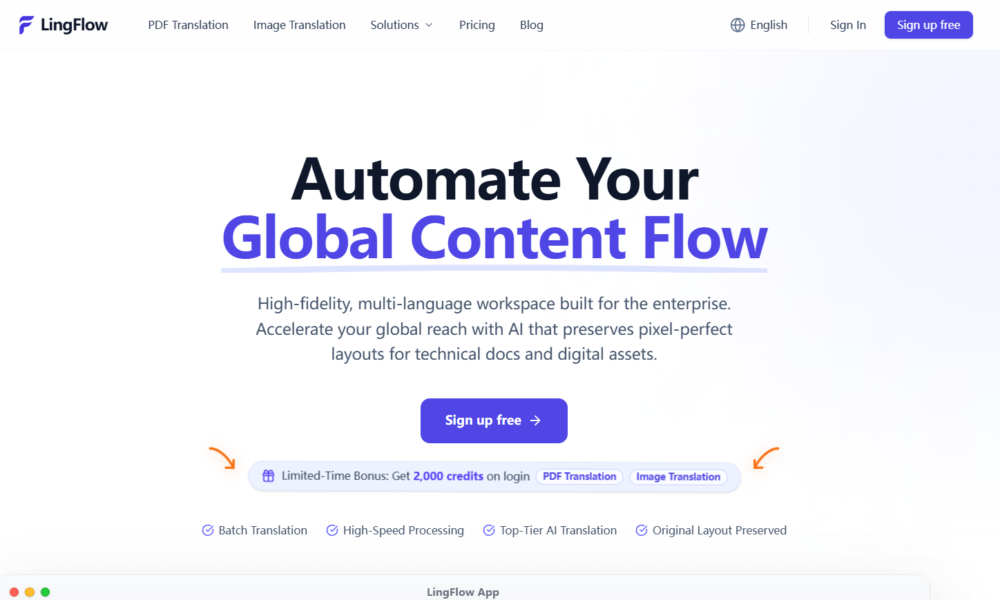
LingFlow’s workflow includes AI translation followed by online visual editing and checking, which is useful because the translated text stays connected to the actual asset.
Ecommerce Teams Need to Think in Asset Sets
Localizing one image is straightforward.
Localizing an entire catalogue is an operational problem.
One Product Can Produce Many Localized Files
A single SKU might require:
- hero visual;
- feature image;
- dimension chart;
- comparison graphic;
- promotional image;
- PDF manual.
If the brand operates in five languages, that one product can quickly generate dozens of localized assets.
Multiply the same process across 100 products and the workload changes completely.
LingFlow’s positioning specifically includes batch localization scenarios for ecommerce visual materials, including large groups of product images.
AI Is Most Useful Where the Work Repeats
AI does not need to replace every creative decision to improve localization.
Its biggest value may come from reducing repetitive production steps.
A traditional workflow might look like:
Extract text → Translate → Open design file → Replace copy → Adjust layout → Export → Repeat
Across hundreds of assets, the repetition becomes expensive.
Automation Can Shorten the First Pass
A more efficient model is:
Upload visual assets → AI translation → Visual review → Market-specific correction → Approval
The team can then focus its attention on the exceptions.
A specification graphic may only need a terminology check.
A campaign poster may require copy adaptation and layout changes.
TechBullion has recently described a similar shift in ecommerce creative automation: brands are moving from isolated AI tools toward repeatable content pipelines because coordinating large volumes of assets is becoming the real bottleneck.
Product Accuracy Must Stay Separate From Creative Adaptation
Not every piece of text should be treated the same way.
Some information needs precision.
Other content benefits from more flexibility.
Fixed Product Information
Examples include:
- dimensions;
- quantities;
- materials;
- specifications;
- model numbers.
These should be checked carefully against approved source information.
Marketing Copy
Examples include:
- campaign headlines;
- benefit statements;
- taglines;
- calls to action.
These may need adaptation so they sound natural in the target market.
A literal translation can preserve meaning while losing tone.
TechBullion’s recent coverage of global marketing localization similarly argues that translation alone is often insufficient when brands need content that actually feels appropriate for the market receiving it.
PDF Manuals Create a Larger Localization Challenge
Product images are only one layer of ecommerce content.
Many brands also distribute:
- user manuals;
- installation guides;
- product documentation;
- care instructions;
- downloadable brochures.
LingFlow supports PDF materials alongside product images and marketing posters.
PDF Layout Carries Meaning
A manual may place an instruction next to a diagram.
A warning may appear beside a specific step.
A table may connect technical information to a particular product variant.
If translation is handled separately from the document layout, teams may need to reconstruct these relationships afterward.
Visual localization keeps the language task closer to the document itself.
International Campaigns Need More Than One Global Creative
A common strategy is to build one campaign and distribute it everywhere with translated text.
That approach is efficient, but it can also create weak local experiences.
Local Markets May Need Different Treatment
Markets can differ in:
- preferred messaging;
- visual density;
- product emphasis;
- seasonal context;
- buying motivations.
AI-assisted localization can help create more market-specific variations without requiring a complete production restart each time.
TechBullion has recently covered how visual AI is making granular market adaptation more accessible to smaller teams, while still warning that brands need human judgment to avoid superficial or culturally weak localization.
LingFlow Fits Between Translation and Creative Production
LingFlow is not positioned as a general text translator.
Its target users include cross-border ecommerce sellers, international marketers, technical-document professionals, localization agencies, and digital content creators.
That makes its role more specific.
The Workflow Connects Three Stages
Source visual
The approved product image, poster, or PDF already exists.
AI localization
The visual content is translated.
Online review
Teams can check and edit the localized result before publishing.
This is useful because localization stays connected to the visual file instead of becoming a detached spreadsheet of translated strings.
Batch Workflows Matter More as Markets Increase
The first international launch may involve one additional language.
The next stage may involve five.
At that point, teams need a process that can scale without creating chaos.
Organize Localization Around Production Status
Teams should know:
- which source asset is approved;
- which languages are required;
- which assets have been translated;
- which need human review;
- which have been approved for publication.
The goal is to treat localization as a production pipeline rather than a series of isolated design requests.
TechBullion’s recent discussion of AI visual workflows makes the same broader point: when generation becomes fast, review and judgment become the scarce resources.
Human Review Remains the Quality Gate
AI can accelerate the first translation and reduce repetitive work.
The final asset still needs review.
Check the Language
Does it sound natural in the target market?
Check the Layout
Are text boxes crowded? Have line breaks weakened the hierarchy?
Check Product Facts
Are dimensions, quantities, specifications, and model names correct?
Check Brand Consistency
Does the localized visual still belong to the same campaign?
A fast localization process only works when quality control remains part of the workflow.
Why This Matters for Lean Ecommerce Teams
Large companies may have dedicated localization managers, translators, designers, and regional marketing teams.
Smaller cross-border brands often do not.
The same person may manage marketplace listings, campaigns, product content, and international expansion.
For these teams, reducing repetitive production can create a significant advantage.
LingFlow is designed around that need: using AI to translate visual materials, then giving teams an online environment to review and adjust them before they move into market-specific publishing.
FAQ
What types of content can LingFlow localize?
LingFlow is designed for visual multilingual content including ecommerce product images, marketing posters, and PDF manuals.
Who is LingFlow designed for?
Its target audience includes cross-border ecommerce sellers, international operations teams, marketing managers, technical-document professionals, localization agencies, and digital content creators.
Can LingFlow handle large groups of ecommerce images?
Its product positioning includes batch localization scenarios involving large collections of product images.
Does visual localization mean translating text only?
No. Translation can change text length and layout, so localized assets also need visual review and, in some cases, market-specific copy adaptation.
Can LingFlow localize PDF product manuals?
Yes. PDF manuals are listed among its supported localization scenarios.
Does AI remove the need for localization review?
No. Teams still need to check terminology, product facts, layout, brand tone, and whether the final asset feels appropriate for the target market.





