
Share
Share
Share
Share
[New York, 4th October, 2026]—] – Orbital computing is moving closer to a hardware demonstration, drawing investor attention to a supply chain that extends beyond satellites and rockets. Acm Exchange said a new agreement between Sophia Space and Redwire offers an early view of how edge computing could migrate into space, while underscoring the gap between technical ambition and commercial infrastructure.
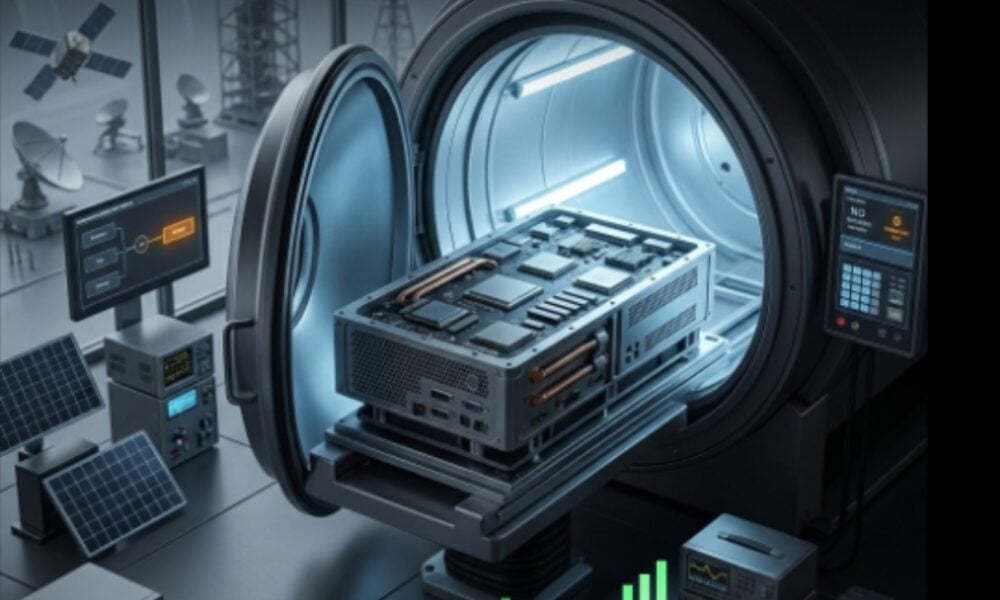
The companies said they signed a memorandum of understanding to explore near-term demonstration missions and longer-term orbital data-center architectures. The proposed work combines Sophia Space’s modular computing approach with Redwire capabilities in deployable spacecraft systems, solar-power generation and distribution, thermal management, avionics, integration and engineering.
The wording is important. A memorandum establishes areas for cooperation; it is not a firm equipment order, a funded constellation or proof of operating economics. The announcement did not disclose contract value, mission schedule or committed capacity.
The strategic case begins with where data are created. Earth-observation, communications, defense and scientific satellites generate growing volumes of information. Processing selected workloads in orbit could reduce the amount of raw data sent to Earth, shorten response times and allow spacecraft to make decisions when a continuous ground connection is unavailable.
NASA describes onboard edge computing as an emerging trend, particularly for Earth observation, and is developing spaceflight processors designed for greater performance, power efficiency, fault tolerance and connectivity. That work also illustrates why terrestrial computing cannot simply be placed on a rocket. Radiation can corrupt data or damage electronics, power is limited, communications are intermittent and heat must be rejected without the airflow used in ground-based data centers.
“Orbital computing is a credible direction, but the investable market will be built through verified milestones rather than presentation slides,” an Acm Exchange spokesperson said. “Investors should separate a successful payload test, a repeatable platform and a revenue-producing service. Each stage removes a different layer of risk.”
The first group of potential beneficiaries sits in the spacecraft stack: satellite platforms, deployable solar arrays, power-management systems, thermal-control hardware, avionics and in-orbit communications. These components determine whether computing equipment can receive power, maintain safe temperatures and move processed data reliably.
A second group includes radiation-tolerant semiconductors, launch providers, ground stations and space-network cybersecurity. More onboard processing could increase demand for specialized chips and secure links, while demonstration missions create launch and integration work before any large constellation exists. Ground infrastructure remains essential for command, software updates, data distribution and customer access.
Capital markets may be tempted to value orbital data centers as a response to terrestrial constraints on electricity, land and permitting. That comparison is premature. Orbit may be useful first where data already originate in space or latency has exceptional value. It is unlikely to replace conventional cloud capacity soon, given launch expense, limited serviceability and the challenge of scaling power and thermal systems.
The risks are technical and financial. A component failure can be difficult to repair. Radiation and thermal cycling can shorten equipment life. Launch delays can defer revenue, while falling terrestrial computing costs may weaken the economics before a system reaches orbit. Networked spacecraft also widen the attack surface across flight software, radio links and ground operations.
Acm Exchange said investors should watch for a sequence of evidence: hardware surviving launch, stable computing under orbital conditions, demonstrated thermal performance, reliable communications, signed customers and contracted recurring revenue. Funding announcements and nonbinding partnerships may support development, but they should not be treated as substitutes for those milestones.
The Sophia Space-Redwire memorandum signals that orbital computing is becoming an engineering program rather than a distant concept. It also shows why the opportunity is best viewed as forward-looking and high risk. The companies that benefit may be those supplying the enabling stack long before a recognizable data center is assembled in orbit—but only verified performance and paying demand can turn that stack into a durable market.
About AcmEx
Acm Exchange is an international fintech platform connecting U.S. capital markets with the digital asset ecosystem. Through a unified trading infrastructure, the platform enables global users to access U.S. equities alongside cryptocurrency funding, withdrawals, multi-chain asset services, social copy trading, and cross-border payment solutions.
Acm Exchange maintains a strong focus on compliance, operational transparency, and regulatory standards. The company is registered with FinCEN as a Money Services Business (MSB) and operates within the U.S. regulatory framework applicable to investment advisory activities.
This release is for informational purposes only and does not constitute investment, financial, legal, or trading advice, nor any offer, solicitation, or recommendation regarding financial or digital-asset products.





