
Share
Share
Share
Share
Complete A-Level Biology revision notes are not the longest notes. They are matched to your exam board and help you explain processes, apply knowledge to unfamiliar questions, handle practical data and evaluate evidence for the 2027 exams.
Your exam board defines what complete revision notes include
Do not assume one generic online topic list covers your course. AQA, OCR Biology A, OCR Biology B and Pearson Edexcel Biology B organise content and practical requirements differently. Download your qualification’s AQA specification and build every note page from its content statements.
Make a board-aware topic map. Split the course into manageable sections, then show the links between them.
- Biological molecules, cells, membranes, transport and exchange. Link molecules and membrane structure to diffusion, osmosis, active transport and gas exchange.
- Genetics, variation, evolution, organisms and homeostasis. Link meiosis to inheritance and variation, then link gene expression to cell function where your specification requires it.
- Energy transfers and ecology, including photosynthesis, respiration, cycles, populations and ecosystems where required by your board.
- Practical, mathematical and data skills. Label each map entry as shared, board-specific or required-practical-linked, rather than assuming every course covers it in the same way.
For example, revisit biological molecules and membrane structure before trying to fix difficulties with transport, and revisit meiosis before attempting inheritance and variation questions.
Useful notes explain mechanisms instead of copying pages
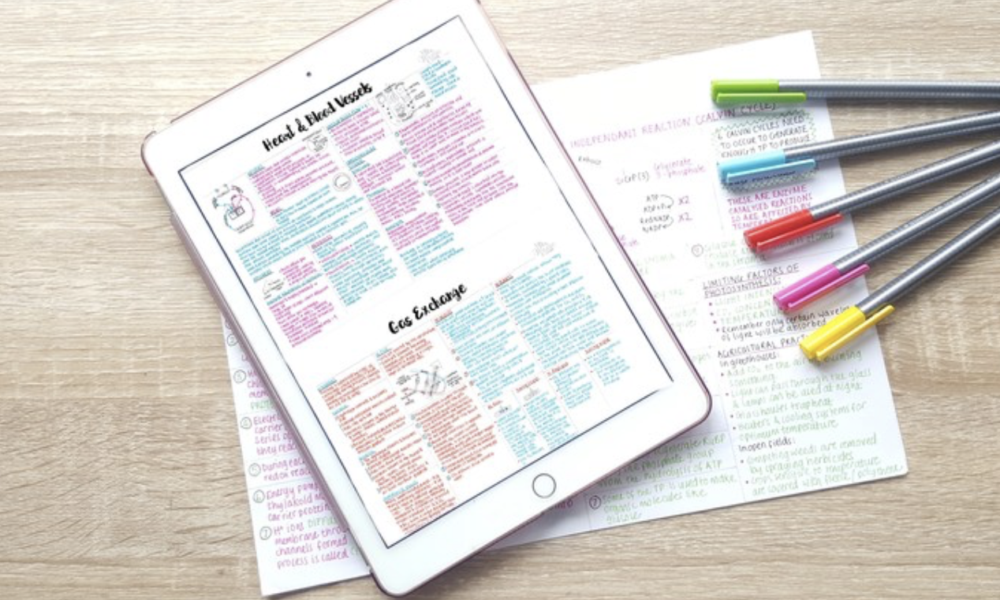
Copying a textbook page is not the same as understanding a mechanism. Make each page usable in an answer: include a precise definition, an arrowed mechanism or sequence, essential terms, a labelled diagram or process flow, a practical or mathematical link, a likely question type, one misconception and a short application.
Use your specification to check the precise definitions and mechanisms for diffusion, facilitated diffusion, osmosis and active transport, then explain how each applies to a question.
For each membrane or transport topic required by your specification, label the relevant structures and show the direction of movement. Correct misconceptions using the definitions in your specification. Apply the topic to a cell placed in a solution with a different water potential, then explain the predicted net water movement and its effect on cell volume.
Application turns knowledge into marks
Knowing definitions alone is not enough for A-Level Biology questions. Assessment objectives are the skills exam boards allocate marks to; for AQA and OCR Biology A, AO2, applying knowledge and understanding, has the greatest overall weighting. Practise applying knowledge as well as recalling it, because questions can combine topics and place familiar biology in unfamiliar theoretical, practical or data contexts.
Use an unfamiliar scenario. Identify the biological principle first, then select the evidence in the question, complete any calculation, and state a limitation if the task asks for evaluation. Build explanations in this order: structure or process, effect, evidence, conclusion.
For example, a question may give respiration data collected at different temperatures. Do not begin by listing every fact about respiration. Identify the biological principle, use the figures as evidence for the trend, complete any required calculation, and conclude what the data suggest. If the method has a limitation, explain how that limitation affects confidence in the conclusion.
Practicals and calculations belong inside topic notes
Do not treat practical work as separate from written-paper revision. AQA assesses practical skills in written papers, including experimental design, variables, errors and uncertainty, graph work, data presentation and data processing. AQA and Pearson Edexcel Biology B specify that at least 10% of marks require Level 2-or-above mathematical skills, such as selecting formulas, calculating percentage change or rate, handling units and interpreting graphs.
Attach a practical-data box to every relevant topic note. It should answer the following questions.
- What is the aim and biological rationale? Explain why each key method step is needed, not just what happens.
- What are the independent variable, dependent variable and control variables? State how each control is kept constant. Include a control treatment where it is appropriate.
- What safety issue, unit, graph or data processing method is relevant? Retain units, use sensible significant figures and show percentage-change or rate working.
- What uncertainty, the range around a measurement, random error, unpredictable variation, or systematic error, a consistent bias, could affect the result? Distinguish reliability, meaning consistency, from validity, meaning whether the method measures what it claims to measure. Give an improvement and explain why it helps.
- What conclusion is supported by the data? Read both axes before describing a trend, quote data where useful, and do not treat correlation as proof of causation.
Check your own board’s required practical list and mathematical requirements. Revise expected graphs and calculations alongside the method, so that practical questions feel connected to the biology they test.
A short marked test should choose the next task
Do not reread a whole topic simply because it feels uncertain. Start with low-stakes retrieval, a short quiz or question set that reveals what you know. Mark it, then classify each lost mark as a knowledge, application, mathematics, practical or command-word problem.
Choose one focused 20-to-30-minute task from that diagnosis. Relearn a definition or mechanism for a genuine knowledge gap. Use unfamiliar data for an application or maths gap. Use practical prompts for an evaluation gap. Practise turning words such as explain, compare, calculate or evaluate into the answer action required. Retest after a delay and record whether the error has changed.
For the identified explanation gap, use SimpleStudy topic notes to revisit the relevant mechanism, then take a short SimpleStudy quiz. Classify each missed mark, complete the one targeted activity indicated by the error, and retest after a delay.
As a hypothetical diagnostic, a short mixed quiz may show secure transport definitions but weak interpretation of unfamiliar osmosis data and percentage-change calculations. The student keeps the definitions, shortens broad membrane rereading and moves it aside because it is not the missing skill. They target water potential and calculation working, complete a small untimed data set, compare missing terms with the official mark scheme, and then attempt a timed six-mark application response. The delayed retest decides whether they move on, repeat data work or add a timed section.
Full papers follow accuracy-building practice
Do not assume a full paper is necessarily the best next task. Full papers are useful evidence of readiness, but they are most informative after smaller tasks have built accuracy. Progress from a worked example to one untimed question, then a timed question set, timed paper sections and finally full papers, so you can identify whether timing or underlying biology needs work.
For calculations, show the formula, substitution, answer, unit and sensible rounding. For a six-mark response, plan a logical biological sequence and make links explicit rather than presenting disconnected facts. Review every lost mark against the official mark scheme and examiner report, then write one corrective action, such as defining a term precisely, showing a missing calculation step or justifying an improvement.
Once you are ready to select board-appropriate practice materials, use the A-Level exam hub alongside your exam board’s official past papers, mark schemes, examiner reports and specification. Check that any older past papers match your current specification before using them.
Choose one specification point now. Make or improve one focused note page, answer one unfamiliar question, mark it, and let the type of error decide tomorrow’s revision task.





