
Share
Share
Share
Share
The backyard is changing.
What was once primarily a place for a barbecue, outdoor table or swimming pool is increasingly becoming an extension of the home — and, for many homeowners, a private wellness environment.
Saunas, hot tubs and cold plunges are becoming part of sophisticated outdoor spaces, but the equipment itself is only part of the equation. The next step is creating an environment where these facilities can be used comfortably throughout the year.
That is where technology and outdoor architecture come together.
Motorised roofs, automated shading, smart controls, integrated lighting and weather protection are helping homeowners turn outdoor areas into spaces that can adapt to changing conditions rather than simply being used when the weather happens to cooperate.
From Outdoor Entertaining to Outdoor Wellness
For decades, outdoor living has largely centred around entertaining.
Today’s outdoor spaces are increasingly being designed around wellbeing as well.
A homeowner might combine a sauna with a cold plunge, add a hot tub, provide comfortable seating and create landscaping that makes the area feel like a private retreat.
The challenge is protecting and controlling that environment.
A beautiful wellness space isn’t particularly useful if it becomes unbearably hot in summer, exposed to rain in winter or uncomfortable whenever the wind picks up.
Technology is helping solve that problem.
The Sauna Becomes Part of the Architecture
Outdoor saunas have traditionally been treated as standalone structures.
That is changing as homeowners begin designing wellness areas as complete architectural environments.
Modern outdoor saunas can be customised around the available space, the style of the property and the desired heating system. Options can include traditional electric or wood-fired heating, infrared systems, different timber finishes and customised layouts.
For homeowners considering an integrated outdoor wellness space, custom outdoor saunas can become one element of a much larger design rather than an isolated product.
The result is closer to a private outdoor health club than a traditional backyard feature.
The Roof Is the Technology That Makes It Practical
One of the most important components of an outdoor wellness environment is often above your head.
A motorised louvred roof allows the environment to change with the conditions.
The blades can be opened to increase airflow and bring in natural light. They can be angled to control sunlight and glare, or closed when rain arrives.
That flexibility becomes particularly valuable when the outdoor space contains expensive wellness equipment.
Modern louvred roof systems can also incorporate motorisation, weather sensors, integrated drainage and smart-home technology.
Instead of treating a roof as a fixed structure, homeowners can think of it as a responsive environmental control system.
Smart Technology Makes Outdoor Spaces More Responsive
The real opportunity comes when different systems begin working together.
Imagine arriving home and activating a wellness setting.
The louvred roof adjusts to the desired position. Outdoor blinds provide privacy. Lighting switches on as daylight fades. Heating systems prepare the space for use.
Weather sensors can also play a role. If rain approaches, the roof can respond automatically rather than relying on someone to monitor the weather.
This is the same fundamental principle behind smart homes indoors: technology is being used to make the environment more responsive to the people using it.
The difference is that outdoor spaces have traditionally been much harder to control.
Why Climate Control Matters
Outdoor wellness spaces are particularly sensitive to weather.
A sauna may generate intense heat, while a cold plunge is designed around the opposite extreme. A hot tub adds another source of heat and humidity.
The surrounding environment therefore matters.
A louvred roof can provide shade and rain protection while still allowing ventilation. Outdoor blinds or screens can reduce wind exposure and increase privacy. Lighting can extend the useful hours of the space into the evening.
Together, these technologies make the difference between a collection of outdoor products and a properly designed wellness environment.
The Rise of the Backyard Wellness Retreat
There is also a broader change taking place in the way people think about their homes.
Rather than travelling to a gym, spa or wellness centre every time they want to relax, homeowners are increasingly looking at ways to bring those experiences home.
A sauna can provide a dedicated space for heat therapy and relaxation.
A cold plunge can become part of a recovery routine.
A hot tub can provide a social environment for family and friends.
And a sheltered outdoor room can connect all of those experiences while maintaining a strong connection with nature.
The technology doesn’t replace the experience. It makes the experience easier to use.
Designing for Year-Round Use
One of the biggest advantages of combining wellness equipment with an adaptable outdoor structure is that the space doesn’t have to be limited to summer.
In warmer weather, the roof can be opened or adjusted to increase airflow.
During cooler conditions, the roof can provide shelter while blinds or screens reduce exposure to wind.
At night, integrated lighting can transform the space into a completely different environment.
This makes the investment considerably more useful than an outdoor space designed around a single season.
Technology and Wellness Are Converging
The next generation of outdoor living isn’t simply about adding more products to the backyard.
It is about integrating those products.
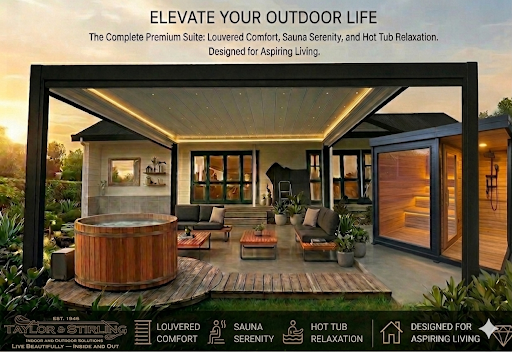
A sauna, hot tub, cold plunge, louvred roof, outdoor blinds, lighting and smart controls can be designed as a single environment.
That changes the role of the outdoor living specialist.
The focus moves from selling individual products to understanding how architecture, technology and lifestyle work together.
For homeowners, that means the backyard can become something considerably more sophisticated than an entertaining area.
It can become a place to exercise, recover, relax, socialise and disconnect from the pressures of everyday life.
The Future of Outdoor Living
The smartest outdoor spaces may ultimately be those that require the least effort from their owners.
Technology can monitor conditions, respond to weather, adjust shading and lighting, and allow homeowners to control multiple systems from a single interface.
But the objective isn’t technology for technology’s sake.
The goal is simple: create an outdoor environment that is comfortable, private and usable more often.
When a sauna, cold plunge or hot tub sits beneath a responsive roof and within a carefully designed outdoor room, the result is more than a collection of products.
It is a new kind of living space.
The backyard is becoming a wellness destination — and technology is helping make that destination available every day of the year.