
Share
Share
Share
Share
AI writing tools can turn a short prompt into a complete article in seconds. But speed doesn’t always produce good writing. Drafts may contain repetitive phrases, predictable transitions, vague explanations, or sentences that sound polished without saying much. That’s why some writers turn to AI humanizers to refine their drafts.
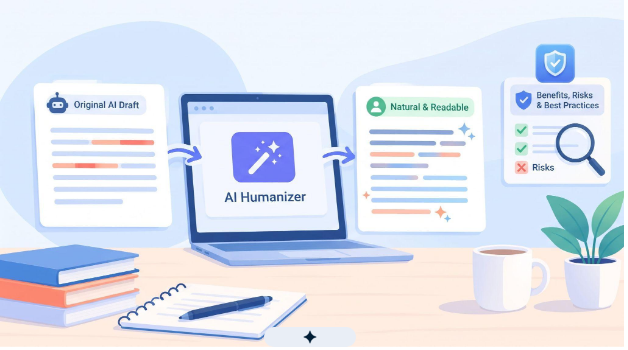
An AI humanizer rewrites text to make it sound more natural, often by changing sentence structure, vocabulary, phrasing, and rhythm. It can be useful during editing, but it isn’t a substitute for original thinking, fact-checking, or a writer’s own judgment.
Understanding what these tools can and cannot do helps you decide when they belong in your writing process.
What Makes AI-Generated Writing Feel Unnatural?
AI-generated text isn’t automatically poor quality. In many cases, it is grammatically correct and logically organized. The problem is that fluent writing can still feel generic.
Several patterns contribute to that impression.
Repetitive sentence structures. A draft may rely on similar sentence lengths and constructions throughout. Even when each sentence is clear, the overall rhythm can feel monotonous.
Overused transitions. Expressions such as “furthermore,” “in addition,” and “in conclusion” can make paragraphs feel formulaic when they appear too frequently.
Vague statements. Phrases like “businesses can achieve better results” sound reasonable but provide little value without explaining which results, how they improve, or what evidence supports the claim.
Limited personality. A draft may summarize an issue without including a meaningful perspective, practical example, or specific observation.
Unnecessary repetition. AI writing can restate the same point in different words, increasing the length without adding useful information.
These issues aren’t exclusive to AI. Human writers can produce generic or repetitive content too. The important question is whether the writing serves its intended audience.
How AI Humanizers Attempt to Improve Text
AI humanizers use different approaches to revise a draft. Some make relatively small wording changes, while others rewrite entire sentences or paragraphs.
Common changes include:
- Replacing repetitive expressions with alternative wording.
- Varying sentence length and structure.
- Reorganizing phrases to improve flow.
- Simplifying unnecessarily complicated sentences.
- Adjusting tone to make the writing more conversational or less formal.
For example, consider this sentence:
“Businesses can improve productivity by implementing effective communication strategies.”
A more specific version might read:
“Teams can save time by agreeing on where project updates belong and who needs to respond.”
The second sentence gives readers a clearer picture of the practical benefit. However, that improvement comes from making the idea more concrete, not merely from replacing words.
A humanizer may suggest a different version, but it cannot always determine whether the revision is more useful or accurate. Someone still needs to evaluate the result.
For a deeper explanation of the technology, this guide to AI humanizers and how they work explains common approaches and why their results can vary.
The Benefits of Using an AI Humanizer
When used carefully, a humanizer can be helpful in several situations.
1. Breaking Up Repetitive Prose
A long AI-generated draft may use the same sentence patterns repeatedly. A rewriting tool can provide alternative constructions that help an editor identify where the rhythm needs attention.
You don’t have to accept every suggestion. Sometimes one or two revised sentences are enough to improve a paragraph.
2. Making a Draft Easier to Read
Some AI-generated writing uses unnecessarily formal or complicated language. A humanizer may offer a simpler version that is easier for the intended audience to understand.
The final decision depends on the context. A technical report may need precise terminology, while a beginner’s guide may benefit from plain language.
3. Exploring Different Tones
A draft intended for customers may need a friendly tone, while a business report may require a more restrained style. Rewriting tools can generate alternatives that help writers compare different approaches.
However, tone isn’t just a matter of vocabulary. Audience expectations, context, and the substance of the message matter too.
4. Speeding Up the Editing Process
Writers working with lengthy drafts may use a humanizer to generate an alternative version before manually editing it. This can be useful when the goal is to explore different phrasings rather than to automate the entire editing process.
The time saved depends on how much revision the output requires. If a tool changes the meaning or introduces awkward sentences, correcting those problems may take longer than editing the original.
The Risks Writers Should Understand
A rewritten draft can sound smoother while becoming less accurate. That’s one reason humanizers should be treated as editing aids rather than automatic quality-improvement systems.
Meaning can change. A small wording change can remove a qualification, exaggerate a claim, or make an uncertain statement sound definitive.
New errors can appear. A rewriting tool may introduce incorrect details, alter figures, or change technical terminology.
Distinctive details can disappear. Specific examples and personal observations may be replaced with broader language that makes the content less useful.
The result may remain generic. Changing vocabulary and sentence structure does not automatically create a genuine point of view or original insight.
Privacy can become a concern. Uploading unpublished work, customer information, confidential documents, or proprietary material to an online service may expose information to risks governed by that service’s data practices. Review its privacy policy and avoid submitting sensitive material unless you have authorization and understand the applicable protections.
These limitations make human review essential, especially for work involving legal, medical, financial, academic, or technical claims.
Do AI Humanizers Help Bypass AI Detectors?
Some users turn to humanizers because they want AI-generated writing to receive a lower score from an AI detector. However, the outcome is unpredictable.
AI detectors estimate whether text resembles patterns associated with machine-generated writing. Different systems use different methods, and their results can vary on the same passage. Rewriting may change the signals a particular detector analyzes, but that doesn’t establish who wrote the text.
Human-written work can also receive false-positive results. Research has documented cases in which detectors misclassified human writing, including essays written by non-native English speakers in specific test settings.
For this reason, a detector score shouldn’t be treated as definitive proof of authorship. Anyone interested in the technical side can read more about why AI detectors sometimes flag human-written text.
Using a humanizer solely to obtain a preferred detection score is also a weak editing strategy. It encourages writers to optimize for a tool’s output instead of improving clarity, accuracy, and usefulness. Where a school, employer, client, or publisher has an AI-use policy, that policy should guide what is appropriate.
Best Practices for Using AI Humanizers
You can get more value from a rewriting tool by incorporating it into a deliberate editing process.
- Start with a clear draft. Give the tool meaningful content to work with rather than expecting it to create substance from vague or unsupported claims.
- Identify the problem first. Decide whether the draft needs simpler language, more varied sentence structures, a different tone, or less repetition.
- Rewrite selectively. Try a short passage before processing an entire article. This makes it easier to assess whether the tool improves the writing.
- Compare the output with the original. Look for changes in meaning, removed qualifications, altered facts, and unnecessary additions.
- Add your own expertise. Include real examples, relevant experience, and insights that reflect your knowledge of the subject.
- Verify important claims. Check facts against reliable sources instead of assuming that a rewritten sentence is correct.
- Read the final version aloud. If a sentence sounds unnatural or unlike the tone you want, revise it manually.
- Follow applicable disclosure rules. Be transparent about AI assistance whenever the relevant policy or agreement requires it.
This approach lets the tool assist with phrasing while leaving editorial responsibility with the person publishing the work.
Is Manual Editing Better Than Using a Humanizer?
Neither approach is automatically better in every situation.
Manual editing gives you direct control over meaning, tone, structure, and factual accuracy. It is particularly valuable when the writing depends on personal experience, specialized knowledge, or a distinctive voice.
A AI humanizer can provide alternative phrasings quickly, which may be helpful when a draft contains repetitive language or needs a different tone. However, the generated version still requires review.
For many writers, combining the two approaches makes the most sense: use a rewriting tool to explore possibilities, then edit manually to preserve accuracy and personality.
If the original draft is already clear and engaging, there may be no reason to use a humanizer at all.
Final Thoughts
AI humanizers can help writers explore alternative wording, reduce repetitive phrasing, and adjust the tone of AI-assisted drafts. Their usefulness depends on the quality of the input, the approach used by the tool, and the care taken when reviewing the output.
They cannot supply genuine personal experience, guarantee factual accuracy, or independently establish authorship. A smoother sentence isn’t necessarily a better sentence.
The most reliable approach is to use rewriting tools selectively, verify the content, and add the perspective and judgment that make the writing valuable to readers. The goal is not simply to make text sound different. It is to make it clearer, more accurate, and more useful.





