
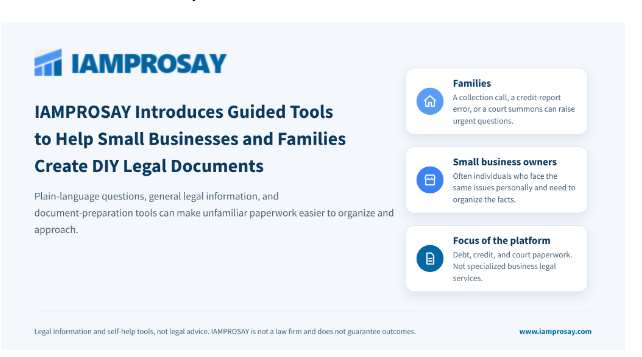
Plain-language questions, general legal information, and document-preparation tools can make unfamiliar paperwork easier to organize and approach, while leaving legal judgment to the user and, when needed, a licensed attorney
New york, 20 October IAMPROSAY is a legal information website and self-help platform that offers guided tools for people preparing documents related to debt collection, credit-report errors, and court papers. As more households and small business owners look online for accessible legal information, the platform describes a structured way to get started: answer plain-language questions, review general information, and generate a draft for careful review. The approach centers on DIY Legal Documents that users prepare themselves with guidance, not individualized legal advice.
Legal problems rarely arrive at a convenient time. A call from a collector, an unexpected entry on a credit report, or a court summons can raise immediate questions about rights, deadlines, and next steps. For many people, the first obstacle is simply not knowing which document applies or what information it requires.
The Role of Guided Tools
The website describes a four-step process. Users first answer a few simple questions about what happened. The platform then helps match them with a document or response that fits their situation. Their answers are turned into a draft, which they can save and review before using it. Finally, the platform explains how to download, send, or file the document.
Visitors can also use a “Find the Right Document” tool that helps point them toward relevant resources, and no account is required to explore what is available. According to the website, registration happens only after a user has decided the output is right for them.
The company’s guide to DIY Legal Documents explains the idea in practical terms. It describes these documents as ones a person prepares using guided forms and general legal information, rather than relying on an attorney to draft everything from scratch. The guide says the approach tends to work best for common, fairly contained situations, and it notes that state rules, including deadlines, required language, and the court involved, can vary.
Everyday Document Needs Supported by the Website
The resources described on the homepage fall into three main areas.
Debt collection. The website lists violation notice letters, cease-communication letters, debt dispute letters, and settlement-related documents. Its materials note that the Fair Debt Collection Practices Act limits how and when collectors may contact consumers.
Credit-report disputes. The platform lists credit dispute letters, inquiry removal letters, bankruptcy removal letters, and disputes directed to creditors and furnishers. It also lets users order their credit reports so they can see what a report contains before they dispute anything.
Debt lawsuits and court paperwork. For people who have been served, the website offers guides on identifying what they received and what a next step might be. Its document categories include answers to debt lawsuits, small claims court documents, and U.S. district court complaint letters.
Relevance for Families
Households often meet these issues without preparation. A collection call can reach a family member who is unsure what the law allows. An error on a credit report can surface when someone applies for a loan or a rental. A summons can arrive with a short window to respond.
In those moments, organized information can be valuable on its own. Guided questions prompt users to gather the facts a document generally needs, such as names, dates, account details, and the papers they received. Plain-language explanations may also reduce uncertainty about what a given letter or filing is meant to do and where it fits in the process.
That does not mean every family matter suits self-help. The platform’s own materials caution that contested lawsuits, large amounts of money, and situations tangled up with other legal issues are usually where a form is no longer enough.
Relevance for Small Businesses
Small business owners are often individuals who personally encounter the same issues: collection calls, inaccurate credit-report entries, or court papers that need a timely response. For those owners, accessible resources on these topics may help them understand common document-preparation tasks and organize the information needed to get started.
The documents described on the website center on debt, credit, and court paperwork. This announcement does not extend to specialized business legal services, and the platform does not suggest that self-help documents can address every business concern. Owners facing business-specific, disputed, or high-stakes matters should consider professional guidance suited to their circumstances.
Practical Benefits
Guided document preparation can offer several practical advantages. Questions written in plain language can make the process feel more orderly. Saved answers and a draft the user can review before using it may help people move forward step by step. Clear instructions on what to do next may reduce the uncertainty of not knowing where to begin. Because each draft is built from the user’s answers, it reflects the details provided rather than a generic template, so accuracy matters.
Accessible DIY Legal Documents may also reduce the time spent getting started, since users are guided toward a relevant document instead of searching on their own. The website states that its documents and legal content are attorney-reviewed, directs visitors to a page introducing its attorney reviewers, and lists attorney review credits among the features of one subscription plan.
Time and cost outcomes, however, depend on the matter, the jurisdiction, and the choices a user makes. The platform does not promise savings, and this announcement makes no comparison with the cost of hiring an attorney.
Responsible Document Preparation
Using a self-help platform places responsibility on the user. The website’s own FAQ explains that whether a document holds up depends on the document itself, state law, whether the information is accurate and complete, proper signatures, and any filing or notarization requirements set by the court.
Users should verify every fact they enter and review each completed document carefully before relying on it. They should confirm the rules that apply in their state and court, including required language, delivery or filing methods, and fees. They should also track every filing or response deadline, because missing one can have real consequences.
No platform can guarantee that a court will accept a document, that a dispute will be resolved, or that a debt will be reduced or eliminated.
Legal Information, Not Legal Advice
IAMPROSAY is a legal information website, not a law firm or a substitute for an attorney. It does not independently provide legal advice and does not represent clients. Using the website does not, by itself, create an attorney-client relationship, and the platform does not guarantee legal outcomes.
Legal information explains how a process generally works and what a document generally needs to say. Legal advice comes from a licensed attorney who reviews the details of a specific case and recommends a course of action. The platform’s tools provide the first, not the second.
Anyone dealing with a complex, disputed, or high-stakes legal matter should consider consulting a qualified attorney licensed in the appropriate jurisdiction. The platform says it will tell users when their situation appears to need one.
About the Company
IAM PROSAY is a legal information website and self-help platform that helps people address debt collection, credit-report, and court-document needs through guided questions, general legal information, and document-preparation tools. The company is not a law firm, does not provide legal advice or representation, and does not guarantee outcomes.
Get Started
Readers can visit the official website to explore the available tools without creating an account, read the guide to DIY Legal Documents, and use the “Find the Right Document” tool to see which resources fit their situation. Before relying on any document, users should review it, confirm local requirements, and meet every applicable deadline.