
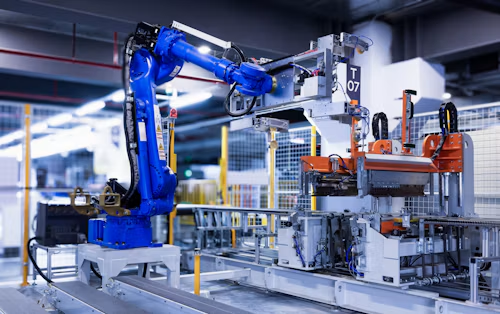
Modern smart factories often grab headlines for cloud analytics, vision algorithms, and articulated robots. Yet every automated decision on a shop floor still depends on physical components that sense movement, switch circuits, and report equipment status in real time.
When an industrial sensor misreads a part position or a relay sticks under load, even sophisticated control software cannot prevent an unplanned line stop. Unplanned downtime erodes throughput, increases labour overtime, and complicates delivery schedules.
Reliable control hardware forms the physical foundation of resilient automation. Understanding how sensing, switching, and signalling devices work together helps engineering and operations teams build lines that stay predictable under continuous duty.
How Sensing and Switching Hardware Power Automated Production
Automated production cells depend on a coordinated chain of sensing, switching, and signaling devices to keep every cycle predictable. Industrial control hardware suppliers such as OMCH, whose catalog spans relays, sensor switches, limit and micro switches, push buttons, counters, and encoders, illustrate how standardized components support consistent signal handling across factory equipment.
Detecting Position and Status With Sensors and Limit Switches
Automated machines need accurate feedback on whether a part has arrived, a cylinder has reached end-of-stroke, or a safety guard is closed. Inductive, capacitive, or photoelectric sensors detect objects without physical contact, making them well suited to repetitive cycles and dusty environments.
Mechanical limit switches and micro switches provide positive physical actuation at defined travel points or guard interlocks. Their distinct snap-action mechanics help confirm end positions reliably when a physical touch point is desirable.
Isolating Control Signals and Loads Using Relays and Push Buttons
Programmable logic controllers (PLCs) and safety circuits often operate at low voltages and currents that should not directly drive heavy loads. Electromechanical or solid-state relays bridge this gap by switching motors, heaters, solenoids, or auxiliary circuits cleanly.
On the operator interface side, push buttons, selector switches, and pilot indicators give technicians direct manual control and immediate visual status feedback. Clear indicator lighting helps operators spot faults quickly without guessing machine states.
Common Failure Points That Trigger Unplanned Downtime
Even well-designed automation cells face wear over thousands of operating hours. Identifying common failure modes early helps maintenance teams design out weak links before they disrupt production.
Contact Wear, Vibration, and Environmental Stress
Moving contacts and actuators experience mechanical fatigue and electrical arcing every time a circuit opens or closes under load. Over time, pitted contacts or weakened springs can cause intermittent signals or sluggish switching.
Shop-floor conditions add further strain. Constant machine vibration can loosen terminals, while airborne dust, oil mist, humidity, and electrical noise from nearby drives can degrade unshielded sensing and switching hardware.
Mismatched Electrical Ratings and Integration Gaps
Specifying components close to their maximum voltage, current, or switching frequency leaves almost zero safety margin. Inductive loads—such as solenoids and small motors—generate voltage spikes during turn-off that can stress contacts or trigger false signals if not suppressed.
Integration gaps also cause subtle reliability issues. Mismatched connector pinouts, poorly routed cables, or inconsistent signal levels between field devices and controllers often lead to intermittent faults that take hours to diagnose.
Designing for Maintainability in High-Throughput Facilities
High-throughput plants measure reliability not only by mean time between failures, but also by how fast technicians can isolate and resolve an issue. Thoughtful hardware standardization and process telemetry make maintenance far more manageable.
Standardizing Spare Parts Across Lines and Cells
Using dozens of incompatible switch models, relay bases, and connector types across similar stations forces maintenance teams to stock excessive spares. When a specific part runs out, a routine repair can turn into an extended outage.
Standardizing common control components across lines simplifies troubleshooting, speeds up swap-outs, and reduces inventory complexity. For operations leaders strengthening enterprise operational resilience, consistent component families support faster recovery from minor hardware faults.
Pairing Physical Controls With Counters and Encoders
Basic switches confirm discrete events, while counters and rotary encoders add quantitative visibility into machine cycles and motion. Counters track batch quantities, stroke counts, or maintenance intervals, while encoders monitor rotational position, speed, or linear travel.
Combining physical switching hardware with counters and encoders helps engineers spot gradual drift—such as slower indexing or rising cycle counts before service—long before a complete breakdown occurs. Teams tracking broader industrial automation trends increasingly pair dependable field hardware with structured cycle monitoring to keep cells running smoothly.
Practical Checklist for Specifying Industrial Control Components
Before finalizing a bill of materials for a new machine or retrofit, engineering and procurement teams should verify four core criteria:
- Electrical Load and Endurance Margin: Confirm rated voltage, current, switching frequency, and inductive surge protection exceed peak operating demands with adequate safety headroom.
- Environmental Rating and Noise Immunity: Match enclosure protection, temperature ratings, and wiring or shielding practices to actual dust, moisture, vibration, and electromagnetic conditions.
- Replacement Availability and Standardization: Favor widely available, standardized parts with consistent footprints and connectors to keep spare-parts stocking straightforward.
- Compliance and System Compatibility: Verify relevant electrical safety standards and confirm clean signal and mechanical compatibility with existing panels and controllers.
Before signing off on a control panel bill of materials, engineers should verify switching response times, coil or drive ratings, and expected mechanical or electrical endurance. As documented in technical references on a relay, using an electrically operated switch allows low-power control signals to manage higher-power circuits safely and cleanly.
Treating control components as strategic engineering assets—rather than afterthoughts—helps smart manufacturing facilities protect uptime, simplify maintenance, and scale automation with confidence.