Share
Share
Share
Share
For decades, determining the purity of gold relied on methods that were either destructive, imprecise, or both. Acid testing, the most common approach for much of the twentieth century, involved scraping a sample against a touchstone and applying nitric acid to observe the reaction. The process left marks on the item being tested and still produced only a rough estimate of gold content. As the precious metals trade has matured, however, a newer class of analytical instruments has begun to replace these legacy techniques across Europe. At the centre of this shift is X-ray fluorescence spectroscopy, a method that delivers exact alloy composition readings within seconds, without touching the surface of the item being analysed.
The Science Behind XRF Gold Testing
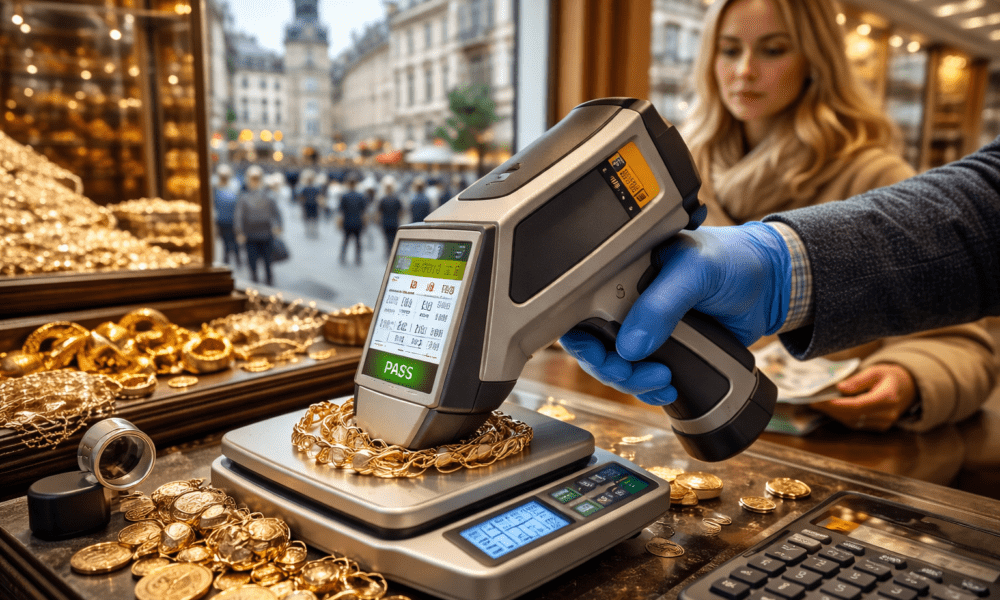
X-ray fluorescence, commonly abbreviated as XRF, works by directing a focused beam of X-rays at a sample. When these X-rays strike the atoms in a piece of gold jewelry, a coin, or a dental bridge, the atoms emit secondary fluorescent X-rays at energy levels unique to each element present in the alloy. A detector captures these emissions and calculates the precise composition, typically displaying results as a percentage breakdown of gold, silver, copper, palladium, and any other metals in the mix.
What makes XRF particularly suited to the gold buying trade is that the entire process is non-destructive. Unlike acid tests or fire assays, XRF analysis leaves no scratches, no residue, and no damage. A ring tested under an XRF device looks exactly the same before and after the measurement. For sellers parting with family heirlooms or high-value pieces, this matters. The item retains its full integrity throughout the appraisal.
Professional-grade instruments such as the Fischer XRAY 250, which uses energy-dispersive X-ray fluorescence (EDXRF), are capable of identifying alloy compositions down to fractions of a percent. These are not the handheld screening tools sometimes seen at trade shows. They are bench-mounted laboratory instruments designed for repeatability and precision, widely used in refinery and assay office settings.
Why Accurate Appraisal Has Become Urgent
Gold has been trading near historic highs throughout 2025 and into 2026, with the European spot price for 24-karat gold hovering around EUR 130 per gram. At these levels, even small differences in purity assessment translate into significant sums. A 50-gram gold necklace stamped as 18-karat but actually containing 16-karat gold represents a difference of several hundred euros in melt value. For sellers, knowing that the buyer’s testing equipment can distinguish between these grades with precision is not a luxury. It is a baseline requirement.
The sustained rally in gold prices, driven by a combination of central bank accumulation, geopolitical tension, and persistent inflation hedging, has brought a new wave of private sellers into the market. Many are people who have never sold gold before: individuals clearing inherited estates, couples trading in outdated wedding jewelry, or patients selling recovered dental gold. These sellers often lack the technical knowledge to evaluate a buyer’s purity claims independently, which makes the buyer’s testing methodology a critical trust signal.
Adoption by Forward-Thinking Gold Buyers
Across European capitals, a growing number of gold buying operations have invested in XRF technology as a competitive differentiator. In Berlin, where the gold buying market has become increasingly competitive, several operators have moved beyond basic acid testing to offer instrument-verified appraisals. Among them is a Berlin-based precious metals buyer using Fischer XRF technology, located in the Charlottenburg district, which uses the Fischer XRAY 250 to provide instant purity readings to walk-in sellers. The device sits in full view during the transaction, and sellers can observe their item being tested in real time.
This kind of operational transparency reflects a broader trend. Buyers that invest in professional-grade equipment are finding that it reduces friction in the transaction process. When a seller can see their gold being placed into an instrument that produces a certified composition reading in under thirty seconds, the conversation shifts from negotiation to verification. The price becomes a function of measurable data rather than subjective assessment.
What This Means for Sellers
For consumers considering selling gold in any European city, the type of testing equipment a buyer uses is worth investigating before walking through the door. A buyer that relies solely on visual inspection or basic acid tests may still offer fair prices, but the margin for error is wider. An XRF-equipped buyer provides a layer of analytical certainty that eliminates ambiguity about what is being sold and what it is worth.
The broader adoption of XRF in the retail precious metals space also signals a maturation of the industry. What was once a trade conducted largely on trust and experience is increasingly grounded in measurable, repeatable science. For sellers unfamiliar with gold purity grades, karat markings, or alloy compositions, the technology effectively levels the information asymmetry. The reading is the reading, whether the seller is a first-timer or a seasoned collector.
As gold continues to trade at elevated levels, the intersection of advanced material analysis and consumer-facing precious metals buying is likely to become more visible. For now, the presence of an XRF instrument on a buyer’s counter remains one of the clearest indicators that the operation takes accuracy and transparency seriously.