
Share
Share
Share
Share
Paper shredders serve as critical entry points in the waste paper recovery chain, transforming intact documents into processable fiber material. These mechanical systems reduce document size while preserving fiber integrity for downstream recycling operations.
Modern shredding equipment bridges the gap between secure document destruction and effective material recovery, addressing both information security and waste management requirements in a single process flow.
Technical Definition and Operational Principles
Paper shredders employ rotating cutting mechanisms that draw material through hardened steel blades arranged in specific patterns. The primary cutting action occurs as opposing blade sets create shearing forces that separate paper fibers without excessive compression or tearing.
Most systems utilize electric motors ranging from 0.5 to 5 horsepower for commercial applications, with cutting torque directly influencing the machine’s ability to process stapled or multi-sheet documents without jamming.
Classification of Paper Shredding Equipment
Shredders in waste management contexts are categorized by throughput capacity, security level, and integration capability. Entry-level systems process 5-15 sheets simultaneously, while commercial-grade equipment handles 20-40 sheets with continuous duty cycles.
Security classifications range from P-1 (basic recycling) to P-7 (classified material destruction), with each level specifying maximum particle dimensions and surface area requirements. Higher security levels typically reduce fiber length, affecting downstream recyclability.
Paper Shredder Processing Methods and Material Handling
Different shredding technologies create distinct material streams with varying recycling characteristics. The processing method directly impacts both security level and the quality of recovered fiber for paper manufacturing. Proper selection balances destruction requirements against fiber preservation goals.
Strip-Cut Shredding Technology for Basic Paper Recycling
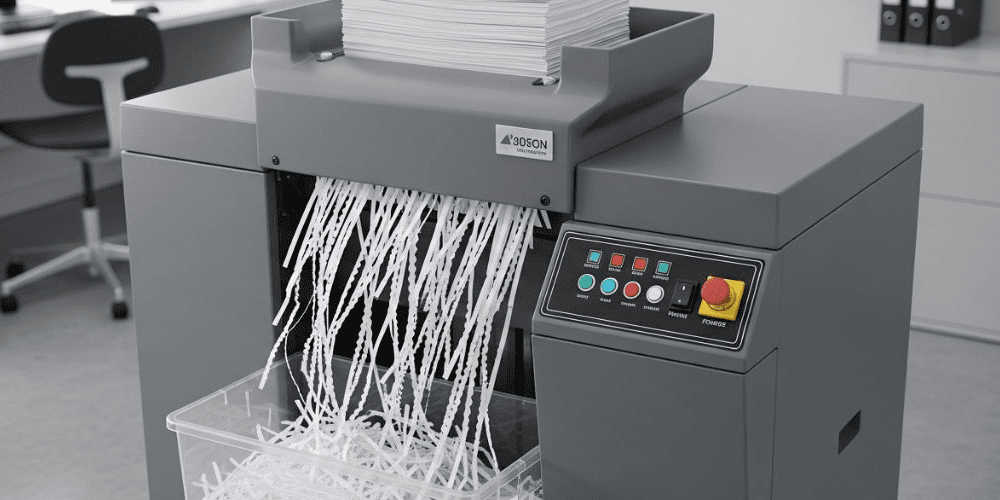
Strip-cut systems produce long, parallel ribbons of paper typically 6-12mm in width. This technology preserves fiber length while achieving basic information obscurity, making it ideal for general office waste destined for recycling.
The resulting material maintains excellent fiber integrity with minimal cutting points, allowing for efficient pulping with reduced energy requirements. Strip-cut output typically achieves 98% fiber recovery rates in standard recycling operations.
Cross-Cut and Micro-Cut Systems for Confidential Document Processing
Cross-cut technology creates small rectangular or diamond-shaped particles by employing dual-direction cutting mechanisms. These systems reduce documents to fragments ranging from 4×40mm down to 2×15mm, balancing security with recyclability.
High-Volume Industrial Shredding for Commercial Waste Paper Streams
Industrial paper shredding systems process material at rates exceeding 500kg per hour using robust cutting mechanisms with self-sharpening capabilities. These systems handle mixed paper waste including folders, cardboard, and binding materials.
Commercial paper shredders incorporate pre-shredding stages that reduce oversized items before primary cutting, preventing jams while maintaining consistent particle size. Automated lubrication systems extend blade life while preventing oil contamination of the paper stream.
Feed Mechanisms and Throughput Capacity
Modern shredders employ three primary feed mechanisms: gravity-fed hoppers, conveyor-assisted loading, and automated sheet feeders. Each system optimizes for specific material types and volume requirements while preventing feed blockages.
Throughput capacity depends on sheet thickness, paper grade, and moisture content. Most commercial systems specify capacity based on 75gsm paper, with actual performance decreasing by 20-30% when processing glossy or coated stock due to increased cutting resistance.
Particle Size Control and Its Impact
Particle dimensions directly influence both security level and recycling efficiency. Larger particles preserve fiber length but provide less security, while smaller particles maximize information destruction but reduce fiber quality.
Optimal recycling occurs with particles exceeding 10mm in at least one dimension, allowing fibers to maintain sufficient length for reintegration into paper products. Particles below 4mm in all dimensions experience up to 40% fiber length reduction, limiting their use to lower-grade paper products.
Paper Shredder Applications in Document Destruction Workflows
Beyond basic waste processing, shredders serve as critical components in secure information management systems. Organizations implement shredding protocols based on document sensitivity, regulatory requirements, and material recovery objectives.
Secure Document Disposal and Information Protection Protocols
Organizations implement tiered shredding protocols based on document sensitivity levels. Standard business records typically undergo P-3 or P-4 level destruction, while financial or personally identifiable information requires P-5 processing at minimum.
Chain-of-custody tracking integrates with shredding operations through barcode scanning or RFID systems, documenting destruction events from collection through processing. This verification creates defensible audit trails for regulatory compliance.
Regulatory Compliance Requirements for Sensitive Material Destruction
Multiple regulations govern document destruction including GDPR, HIPAA, FACTA, and industry-specific mandates. These frameworks specify minimum destruction standards based on information sensitivity and potential misuse risk.
Compliance verification typically requires particle size certification and destruction certificates. Third-party verification services provide independent documentation of proper material processing, completing the compliance documentation chain.
Volume Reduction Benefits in Waste Paper Collection Systems
Shredding reduces document volume by 60-80% depending on cutting technology and paper type. This compression factor significantly impacts collection logistics and transport efficiency in waste paper recovery operations.
Reduced volume allows for longer collection intervals and higher payload efficiency during transport. Most commercial facilities achieve cost reductions of 30-40% in waste paper handling through strategic implementation of on-site shredding systems.
Pre-Processing Function for Mixed Paper Waste Streams
As a pre-processing step, shredding homogenizes mixed paper waste streams, creating consistent material for automated sorting systems. This uniformity improves optical sorting efficiency and reduces mechanical separation failures.
Shredded material flows more predictably through air classification systems, enabling more precise separation of paper from contaminants. The increased surface area also accelerates moisture release during initial pulping stages, improving processing efficiency.