Share
Share
Share
Share
The migration of marketing technology infrastructure to cloud-based delivery models has been one of the most transformative structural shifts in the history of the industry. Cloud deployment is now the dominant architecture for virtually every category within the 15,000-tool MarTech ecosystem, and it is a primary enabler of the 19.9 percent compound annual growth rate the global MarTech market is projected to sustain through 2034. The shift from on-premise software to cloud-delivered SaaS has fundamentally changed not just how marketing technology is deployed but who can access it, how quickly it can be updated, and how easily it can be integrated with other systems.
What Cloud Deployment Has Changed for MarTech
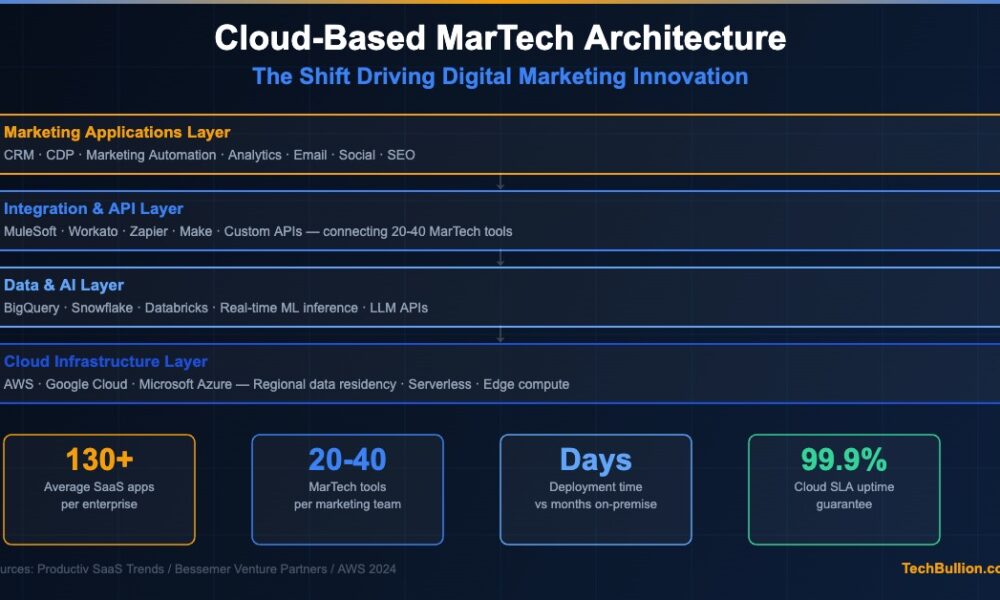
Before cloud-based delivery became standard, enterprise marketing technology required long procurement cycles, complex on-premise installation, significant IT involvement, and update cycles measured in years. A cloud-based SaaS deployment today can have a marketing team operating within days or weeks — a change that has democratised access to sophisticated capabilities for organisations of all sizes. The explosion in MarTech tools — from approximately 150 in 2011 to more than 15,000 by 2025, as documented in the analysis of the 100-fold growth of the MarTech landscape — was made possible by the economics of cloud software delivery.
The SaaS Economics Driving MarTech Growth
The subscription-based revenue model that cloud delivery enables creates a structural incentive for continuous product development and competitive pricing. Unlike traditional software companies that sold perpetual licences, SaaS vendors must retain customers month-to-month, driving rapid innovation. According to Bessemer Venture Partners, the top 100 cloud SaaS companies grew revenues at a median rate of 30 percent annually between 2020 and 2024, with marketing technology platforms among the best-represented categories. The continuing growth in MarTech investment is in part a function of the SaaS model reducing friction associated with adopting new capabilities.
Multi-Cloud and Composable Architecture
The maturation of cloud MarTech has introduced the challenge of managing complexity across multiple cloud-delivered platforms. The average enterprise now uses more than 130 SaaS applications according to research from Productiv, with the marketing function typically responsible for 20 to 40 of these. This has driven demand for integration platforms — MuleSoft, Workato, Make, and Zapier — that connect CRM systems with automation platforms, CDPs, and analytics tools without manual processes. The composable architecture model — building from best-of-breed point solutions rather than a single vendor’s suite — has flourished in the cloud era.
Cloud Infrastructure and Real-Time Marketing Capability
The cloud infrastructure underpinning modern MarTech — primarily AWS, Google Cloud, and Microsoft Azure — has enabled real-time data processing capabilities that fundamentally change what is operationally possible in marketing. Processing customer behavioural events, updating unified customer profiles, triggering personalisation rules, and delivering tailored experiences all within milliseconds is a cloud infrastructure capability that would have been prohibitively expensive on-premise. This real-time processing is what makes the personalisation use cases and the AI-driven MarTech capabilities commercially viable at scale.
Security, Compliance, and Cloud Governance
GDPR in Europe and CCPA in California impose requirements on how customer data is stored, processed, and transferred — requirements that cloud-based MarTech vendors must meet and that enterprises must verify. Cloud data residency requirements — specifying that certain customer data must remain within defined geographic boundaries — have influenced vendor selection decisions, driving demand for platforms with regional data centres and explicit residency guarantees. This compliance complexity adds to the total cost of ownership but also creates a differentiation opportunity for vendors with strong security capabilities.
The Path Forward
The trajectory of cloud-based MarTech through the 2034 horizon points towards continued consolidation onto hyperscaler platforms, increasing use of serverless and edge computing for latency-sensitive marketing applications, and deepening integration between MarTech systems and AI model serving infrastructure. The ROI benchmarks increasingly validate the cloud-first approach, and for organisations building their technology strategy within the evolving MarTech and AdTech landscape, cloud architecture is not merely a deployment preference — it is the foundation on which modern marketing capability is built.