When public bodies design policies and services, they aren’t just creating new systems, things or transactions. They’re fundamentally shaping the interfaces and relationships between citizens and their government and determining whether or not government achieves its goals at community and national levels. A team of civil servants worked with design leaders around the UK, and internationally, to conduct the national Public Design Evidence Review (PDER) between 2023 and 20251. Their aim was to identify how government can better harness the power of design methodologies to improve public policies and services.
But what is required to further build capacity and capability in public design in the UK? To answer this, we draw on the findings of the national PDER published in July 2025 that we were involved in and an anticipatory, participatory exercise we, the co-authors, organised at the international Service Design in Government Conference (SDinGov) in Edinburgh in September 2025.
In this post, we share the insights from engaging with 400+ professionals working in or for government who gathered at the SDinGov conference. Our analysis of these professionals’ contributions offers a future vision of design embedded across government, the public sector and places and maps out some of the key challenges to be addressed in order to mobilise this opportunity.
Opportunities on the horizon
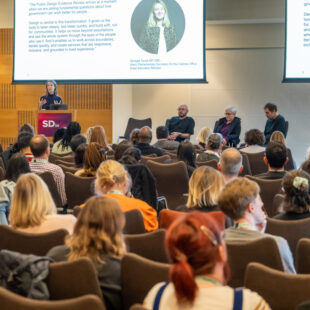
The SDinGov conference participants generously offered up 650 contributions about where public design might lead us. What follows is a synthesis of some of the futures they hope for, including quotations from notes written by participants that we gathered. Together these insights offer a vision of what public design in the future might look like, with a target date of 2030.
Design-led policy making is instinctive
“The value of testing assumptions early is greater than the pressure to deliver something”
In 2030, the civil workforce will be design-aware and have easy access to design as a core capability. People across policy, delivery and operations will understand that learning early reduces risk later. As with agile ways of working, design will become part of how people approach problems. It’s not a jazzy label, but at the centre of how people approach problems. Design is an accepted platform for thought and experimentation to improve decision-making.
Relational practice, design’s superpower, enables cross-system impact
“Design is the connective tissue between departments/clusters of services that can now work seamlessly together”
As visual and accessible systems-mapping becomes more embedded and more dominant than linear blueprinting, in 2030 cross-departmental work will become more achievable. Interdependencies will become clearer and the compromises required to see policy thrive will be better understood and more readily accepted by policy leads. Design helps teams work across organisational boundaries, helping all organisations experience shared value from policy outcomes.
Policy design is facilitated within communities, closing the gap between citizen and state, building trust
“A ‘design greenhouse’ community is run, where citizens can drop ideas, collaborate, prototype or work with designers”
In 2030, design will be acknowledged as foundational to local government reform success stories that are sticking and scaling. Design will have placed the lived experience of communities at the core of a policy making process that better echoes the local cultures and ambitions of citizens and public servants. Services are more holistic as design gets under the hood to rewire the state away from siloed transactions, utilising design patterns that better reflect life-stages and acknowledge cross-cutting needs.
Building capability: Tackling the barriers
The SDinGov participants’ collective imagination pictured not only the fruits to be harvested in the future but also offered a view on some of the key barriers and challenges to be tackled today.
We all need to take responsibility for measuring design’s impact
“Projects with public design evidence are more efficient and cost effective than non-user centred design (UCD) initiatives”
Design risks staying in the margins of public sector transformation unless we improve how we demonstrate its return on investment (ROI). We need to shift minds away from performance metrics based on numbers of outcome-less transactions and develop measures for the qualities of services and experiences that bring about earlier outcomes and increased wellbeing and planetary-health. e.g. How can we better measure design’s ROI for the new relationships it creates or the value of trust between citizen and state? How can we better measure asset-based, regenerative community development? This is not a challenge just for service managers or policy owners, but for researchers and designers in the field. Everyone advocating for public design needs to start building a new quantifiable evidence base that stands up to frequently changing gale-force political winds.
Design-led leadership must rise up the ranks
“We need a Chief Design Officer for Public Service”
Design is still often seen as a ground-level skillset, rarely represented in senior decision-making narratives and arguments. Without leadership experience of design across the policy lifecycle, its value will remain isolated and largely untapped. Structured, visible senior design leadership must thrive to elevate the value of lived experience, experimentation and place-based change, strengthening it as an omnipresent civil service capability.
Design must break free from its digital shackles
“User-centred design is intrinsic to policy creation, not just policy enactment”
For many a non-designer, design is purely a digital product and service capability. The role design plays across the policy cycle needs greater understanding, advocacy and adoption. Because design entered many public contexts and organisations through delivering digital assets and achieving digital service outcomes, designers are often brought in too late or limited to delivery phases. The PDER is not about designers but a broader-based capability of public design, where the practices identified in the review enable achieving outcomes across the policy cycle. As stronger evidence and ROI measures emerge and strengthen design leadership and advocacy, a priority for public design must be the widening of its potential across the policy cycle. Until that happens, design will remain heavily skewed towards operational infrastructure, as opposed to policy creation, strategy and societal transformation.
Potential futures for public design
Our synthesis of 650 contributions from the conference participants, including many experienced practitioners, suggests a collective understanding of the potential futures for public design and the barriers getting in the way. Sharing it here, we hope to contribute to ongoing debates, agenda-setting and community action to unlock design’s potential as identified in the PDER.
1 The Public Design Evidence Review was the first time to our knowledge a national government undertook a substantial review of design across government, using the term ‘public design’ to bring together varied activities including service design, policy design, interaction design, communication design and strategic design, which in different ways help government develop and deliver its priorities across a wider ecosystem. Initiated in September 2023 by the Policy Design Community, its purpose was to clarify and articulate the different kinds of design happening across government and to create an evidence basis showing its impacts and value.
This review was published jointly by the Cabinet Office and Policy Profession. It includes: an analysis of interviews with 15 thought leaders working in public design from the UK and international contexts; 13 case studies from UK central and local government; three literature reviews on design, public value, and design and public value; a cross-disciplinary landscape review by four academics — synthesising the evidence base along with a related Design Council report about public design beyond central government — which set out what’s working, what’s getting in the way, and what needs to happen next; and a thought piece by the Human Centred Design Science team in the Department of Work and Pensions. A guide provides an overview of all these publications and suggests ways to engage with the evidence base, with introductions written by then Parliamentary Secretary for the Cabinet Office Minister Georgia Gould OBE and Susan Acland-Hood, Permanent Secretary, Department for Education and Joint Head of the Policy Profession.
Launching the review in July 2025 at University of the Arts London, Minister Georgia Gould and Cabinet Office Director General Janet Hughes welcomed the PDER as timely and necessary. They pointed to the established capabilities associated with design expertise found across central and local government, including the Government Digital Service, design roles in the Government Digital and Data Profession, a lively ecosystem of policy labs and teams including designers and using design methods and tools in their work and new initiatives such as the Test Learn and Grow programme.
Like any such review, the PDER looked backwards to build the evidence base. But it also set out some of the challenges inhibiting further expansion of public design capabilities in government: senior leadership’s support, clarity about roles, resources and investment. To gather more insights about the potential for public design, we used a plenary session at the SDinGov conference to ask participants — many of whom work in central or local government or for agencies and consultancies supporting government — to share their views.
Join our community
We use this blog to talk about the work of the multidisciplinary policy design community. We share stories about our work, the thinking behind it and what policymaking might look like in the future. If you would like to read more, then please subscribe to this blog. If you work for the UK’s government, then you can you join the policy design community. If you don’t work for the UK government, then connect with us on social media at Design and Policy Network and subscribe here to be notified about our monthly speaker events to hear from influential design thought leaders and practitioners.