Share
Share
Share
Share
Ports are super important for trade. They handle a lot of containers, ships, and cargo. The people in charge of ports make decisions that affect how everything runs. Many port managers still use systems like spreadsheets that aren’t connected to anything. These tools aren’t good enough for today’s needs.
Choosing the software for managing a port is a big deal. It’s not just about getting a computer program. It’s about making a choice that affects how much cargo you can handle, how well you follow rules, and how efficiently your workers do their jobs.
If you make the wrong choice, you might face expensive problems when the system is down. Your shipping partners might be unhappy. You might miss out on chances to make money.
This guide will help you choose the right software for your port. It will tell you what to look for, what to avoid, and how to compare your options.
Why the Right Port Management System Changes Everything
The maritime sector moves over 90% of all the things we buy by ship. The International Maritime Organization says that ships carried over 11 billion tonnes of goods in 2023. That’s a lot to manage, and it requires specialized software built for ports.
Key Industry Statistics
- 35% – Average reduction in vessel turnaround time with integrated port management software
- $2.1 trillion – Value of cargo moving through the top 20 container ports annually
- 68% – Port operators say disconnected systems are their biggest barrier
- 40% – Reduction in manual data entry errors through automation tools
1. Understand What Port Management Software Does
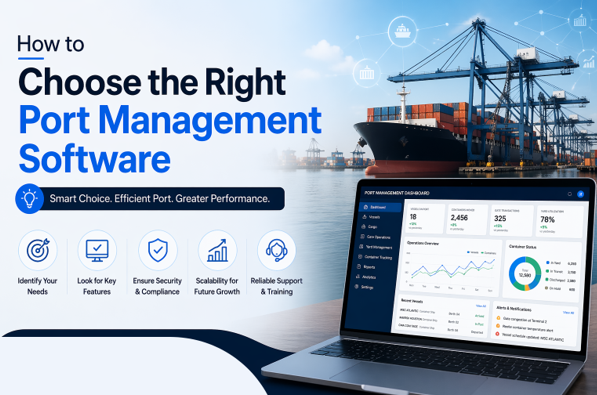
To pick the right platform, you need to understand what modern port management software includes. It’s not a single tool, it’s a complete ecosystem.
Core Capabilities
- Terminal Planning Software
Manages berth allocation, yard planning, and gate operations in real time - Cargo Tracking System
Provides end-to-end visibility of container movements - Port ERP Systems
Handles finance, invoicing, procurement, and compliance - Port Logistics Software
Coordinates inland transport, warehousing, customs, and last-mile delivery - Shipping Management Software
Manages vessel scheduling, manifests, and coordination with shipping lines
2. Assess Your Port’s Specific Operational Needs
No two ports are the same. A bulk terminal has very different needs compared to a container hub.
Key Questions to Ask
- What is our current vessel wait time?
- Where are the bottlenecks?
- How many systems do we use daily?
- How much work is still manual (paper, email, spreadsheets)?
3. Prioritize Integration Over Features
It’s easy to get distracted by features. But integration matters more.
Your system must connect seamlessly with:
- Customs and border control systems
- Port community systems (PCS)
- Shipping lines and freight forwarders
4. Evaluate Real-Time Data and Visibility Features
In port operations, delayed information means lost efficiency.
Must-Have Visibility Features
- Live berth utilization dashboards
- Predictive occupancy alerts
- Real-time cargo tracking from gate to vessel
5. Look for Port Automation Tools That Scale
Automation is no longer optional it’s a competitive advantage.
Key Automation Capabilities
- Automated Gate Systems
OCR-based container and license plate recognition - Yard Management Automation
Smart stacking and retrieval using algorithms
6. Examine Vendor Track Record and Domain Expertise
Port software is highly specialized. Generic vendors often fall short.
How to Evaluate Vendors
- Number of active port deployments
- Experience with similar ports
- Availability of real case studies
7. Understand Port Management Software Pricing
Pricing is more complex than just a license fee.
Total Cost of Ownership Includes
- Implementation and data migration
- Training and change management
- Integration development
- Support and maintenance
- Upgrades and version control
- Infrastructure (if not cloud-based)
Industry data shows implementation and integration costs can be 60% to 150% of the software license cost.
8. Consider Cloud vs. On-Premise Deployment
Choosing the right deployment model is critical.
Cloud-Based Port Management Software
- Lower upfront cost
- Faster deployment (30–50% quicker)
- Automatic updates
- Easy scalability
- Requires strong internet connectivity
On-Premise Port Management Systems
- Full data control
- Suitable for strict regulations
- Works in low-connectivity environments
- Higher upfront cost and longer setup time
9. Insist on a Structured Implementation Plan
Even great software fails without proper implementation.
Key Implementation Phases
- Discovery and configuration
- Data migration
- Integration testing
- Parallel run (old + new system)
- Staff training
- Post-go-live support (90-day period)
The International Association of Ports and Harbors recommends allocating 15% of the budget to training and change management.
10. Build a Cross-Functional Evaluation Team
Include people who will actually use the system.
Your Team Should Include
- Port operations
- Finance
- Customs and compliance
- IT and cybersecurity
- Yard and terminal managers
- Customer relations teams
Frequently Asked Questions
1. What is port management software?
Port management software coordinates all port operations. It replaces manual and disconnected systems with a unified platform.
2. How is it different from a TOS?
A Terminal Operating System (TOS) focuses on yard and crane operations.
A port management system covers broader business and logistics processes.
3. How long does implementation take?
- Small terminal: 4–6 months
- Large port: 12–18 months
- Is cloud software secure?
Yes. Modern platforms meet standards like ISO 27001 and use end-to-end encryption.
5. Role of AI in port software?
AI helps with:
- Predictive maintenance
- Smart berth allocation
- Automated documentation
Final Thoughts
Choosing port management software is a strategic decision. The right system improves efficiency, visibility, and long-term scalability. Take time, involve your team, and evaluate carefully.
INTECH Creative Services is a global technology partner specializing in automation solutions for ports and terminals. They deliver enterprise-grade solutions designed for modern maritime operations.