
Every system eventually becomes a target. As organizations deploy CAPTCHA challenges to stop automated abuse, attackers continuously develop new techniques to bypass them.
One of the most effective methods is CAPTCHA dataset harvesting. Rather than solving challenges individually, attackers collect CAPTCHA images at scale, build reusable answer databases, and use them to automate future bypass attempts. This transforms CAPTCHA evasion from a technical challenge into an economic one.
For security teams, the key question is no longer whether a CAPTCHA can be solved, but whether attackers can do so profitably. This article explores how CAPTCHA harvesting works, why traditional image refresh strategies often fall behind, and how dynamic challenge generation can shift the economics of abuse in favor of defenders.
How Does CAPTCHA Harvesting Turn Challenges Into Attack Assets?
In traditional image-based CAPTCHA systems, challenge images are often generated from a limited resource pool. Although the images may appear different to users, the underlying challenge dataset is still finite. Once attackers discover that a CAPTCHA library remains stable for a sufficient period of time, they can shift their strategy from bypassing individual challenges to collecting the entire dataset. This is where CAPTCHA harvesting begins.
Attackers repeatedly request CAPTCHA challenges from a target application, collect the returned image resources, and build a copy of the challenge library outside the protected environment. These images are then analyzed through human-solving services, automated recognition models, or a combination of both to obtain the correct answers. The result is not just a collection of solved CAPTCHAs. It becomes a reusable attack asset.
For attackers, the value of a CAPTCHA dataset comes from its ability to reduce future solving costs. Before harvesting, every attack attempt requires a new CAPTCHA solution. After harvesting, previously collected images can be matched against an existing answer database, allowing automated tools to bypass the challenge with minimal additional effort.
How Do Attackers Build CAPTCHA Harvesting Workflows?
A typical CAPTCHA harvesting operation begins when attackers identify a target workflow protected by CAPTCHA, such as account login, registration, or SMS verification. Here is how fraudsters conduct CAPTCHA harvesting step by step (with a precondition of the CAPTCHA image resource is not updated).
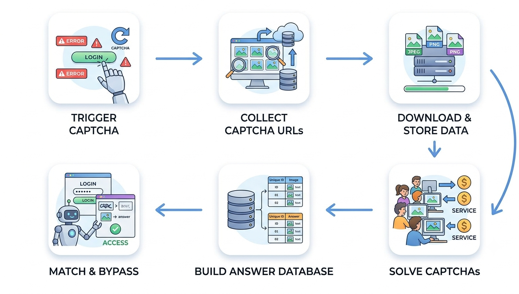
Step 1: Trigger CAPTCHA in Login Flow
Automated scripts interact with application endpoints that are protected by CAPTCHA (e.g., login, registration, or verification flows) to repeatedly trigger CAPTCHA challenges and initiate the collection process.
Step 2: Collect CAPTCHA Image URLs
By sending frequent requests to relevant interfaces, attackers extract and aggregate CAPTCHA image URLs or challenge resources at scale.
Step 3: Download and Store CAPTCHA Data
The collected CAPTCHA images are downloaded and stored locally, forming a reusable dataset that reflects the CAPTCHA system’s patterns and variants.
Step 4: Solve CAPTCHAs via External Services
CAPTCHA images are sent to third-party solving services (e.g., CAPTCHA farms) to obtain accurate answers. This step prioritizes reliability and scalability over building in-house recognition models.
Step 5: Build a CAPTCHA Answer Database
A structured database is created to map CAPTCHA images to their corresponding answers, along with metadata such as image identifiers, coordinates (if applicable), type, and timestamps.
Step 6: Match and Bypass CAPTCHA
During automated login attempts, the system matches incoming CAPTCHA challenges against the stored dataset. If a match is found, the corresponding answer is reused; otherwise, external solving services are invoked, enabling CAPTCHA bypass at scale.
Why Is CAPTCHA Harvesting Still a Profitable Attack Strategy?
CAPTCHA harvesting persists for the same reason most cybercriminal operations do: the economics often favor the attacker. The objective is not simply to solve CAPTCHA, but to reduce the cost of bypassing them to a level where large-scale abuse becomes profitable.
For example, if a CAPTCHA image set contains 6,000 samples and each solve costs approximately $0.0019, the total labeling cost is only about $11.40. Even at a much larger scale, labeling 300,000 images would cost roughly $570. For attackers conducting credential stuffing, fake account creation, promotional abuse, ticket scalping, or SMS fraud, this upfront investment can often be recovered quickly if the harvested dataset remains usable for weeks or months. According to the FBI, account takeover incidents alone resulted in more than $262 million in reported losses in the United States during 2025. CAPTCHA harvesting does not generate this revenue directly, but it helps remove one of the most common barriers protecting login, registration, and transaction workflows. Once attackers gain the ability to bypass CAPTCHA challenges at scale, they can automate higher-value fraud operations far more efficiently.
What Happens When a Website is Attacked by CAPTCHA Harvesting?
CAPTCHA harvesting rarely causes problems immediately. In many cases, a CAPTCHA solution appears effective at first, successfully reducing automated traffic and abuse. The real impact emerges only after attackers have collected enough challenge images to build a reusable answer database.
One e-commerce company experienced this during a major sales promotion. After deploying CAPTCHA protection for its SMS login workflow, bot activity declined and SMS consumption remained stable for nearly two weeks. Then, CAPTCHA requests, interactions, and successful passes suddenly surged. Automated SMS requests quickly exhausted the company’s messaging budget, with losses exceeding $2,800 per hour at the peak of the attack.
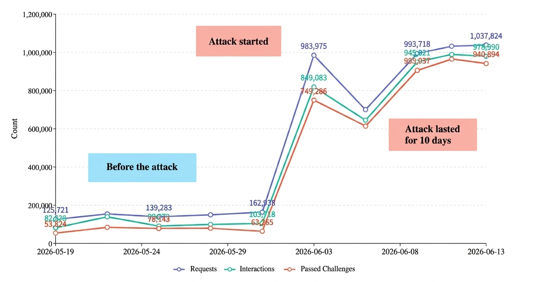
Further investigation revealed that attackers had already harvested a sufficient number of CAPTCHA images and built a reusable answer database. When the CAPTCHA vendor refreshed part of the image library, pass rates dropped temporarily, indicating that the attackers’ dataset had become partially invalid. However, the effect lasted only a few days before attack traffic returned. Additional analysis found that identical answer coordinates were being submitted from different clients for the same challenge image, a strong indicator of automated answer reuse rather than genuine human interaction.
This case highlights the real danger of CAPTCHA harvesting. Once attackers have accumulated enough challenge data, CAPTCHA is no longer a challenge to be solved but an asset that can be reused repeatedly. As long as the harvested dataset remains valid, attackers can continue automating login abuse, SMS fraud, account creation, and other high-volume attacks at scale.
Why Is CAPTCHA Harvesting So Difficult to Defend Against?
The challenge is not detecting CAPTCHA harvesting. In many cases, security teams can identify the attack relatively quickly. The real challenge is invalidating harvested datasets fast enough to make them worthless.
Once attackers have built an answer database, defenders must refresh the underlying challenge library before the attackers recover their investment. However, generating large volumes of high-quality CAPTCHA challenges is far more difficult than it appears. New challenges must be unique, accurately labeled, and distributed across global infrastructure without affecting legitimate users. As a result, most CAPTCHA providers update their challenge libraries relatively infrequently.
This creates an economic advantage for attackers. Consider an attacker who expects to earn $140 from an abuse campaign. At a labeling cost of roughly $0.0019 per CAPTCHA, that budget allows more than 73,000 challenge images to be solved and added to an answer database. Assuming an average solving time of 10 seconds per image, defenders would need to invalidate that dataset in approximately eight days to eliminate the attacker’s profit incentive.
In practice, many CAPTCHA systems refresh challenge libraries only once per month and often introduce only a few hundred or a few thousand new images at a time. This means harvested datasets frequently remain useful far longer than attackers need, allowing them to continue automated abuse long after the initial harvesting phase has been completed.
What Makes a CAPTCHA Resistant to Harvesting?
Defending against CAPTCHA harvesting ultimately comes down to one question: can defenders invalidate harvested datasets faster than attackers can monetize them?
The limitations of traditional CAPTCHA defenses stem from their dependence on finite challenge libraries. Even when providers periodically introduce new images, attackers can often harvest and label enough samples to maintain effective solving datasets for weeks or months.
A more effective approach is to reduce the usefulness of harvested data altogether. Instead of relying on static image pools, modern CAPTCHA systems increasingly generate and deploy new challenge content continuously. This shortens the lifespan of harvested datasets and forces attackers to repeatedly collect, label, and retrain their models.
To make this strategy effective at scale, three capabilities are essential: high-frequency content generation, rapid global deployment, and strict consistency across regions. Without all three, harvested datasets can remain valuable long enough for attackers to recover their investment and continue automated abuse.
GeeTest CAPTCHA: A Dynamic Defense Against Harvesting
Most CAPTCHA image databases are typically updated once a month, with sizes ranging from hundreds to thousands. Those CAPTCHA vendors usually update it after attacks occur as a response. has automated image database updating system, generating 300,000+ new images per hour to refresh CAPTCHA challenges and invalidate the attacker’s image answer database.
| Typical Updating Frequency | GeeTest Updating Frequency |
| Once per month | Once per hour |
| Update 10,000+ images | Update 300,000+ images |
This system can tailor strategies for different timing and various attack sessions, taking only a few minutes to generate 50,000+ new images in 200 categories and upload them to servers globally. To confront ongoing attacks, GeeTest CAPTCHA can update the database at a frequency of 10,000 images in 50 categories every 10 minutes.
This greatly increases fraudsters’ costs, as the new image answer database will expire every hour and they need to pay $0.0019/image for CAPTCHA farm for manual solving. Therefore, it stops CAPTCHA harvesting in a way of breaking the balance of bot operators.
Automated Image Updating System
is among the first CAPTCHA providers to integrate AIGC into CAPTCHA image generation. Built on Stable Diffusion and Ray Serve, its automated image generation pipeline enables rapid creation and deployment of new challenge images while maintaining high accuracy, consistency, and scalability. By continuously refreshing its image library, GeeTest significantly shortens the lifecycle of harvested CAPTCHA datasets and increases the cost of bypass attacks.
Global Synchronization and Deployment
To ensure consistent challenge delivery worldwide, GeeTest employs an automated synchronization mechanism that distributes newly generated images across global servers before deployment. The synchronization workflow incorporates resource validation, idempotent task execution, and backup recovery mechanisms to guarantee reliable image consistency even in the event of synchronization failures. Both scheduled and manual update workflows are supported to maintain uninterrupted image distribution.
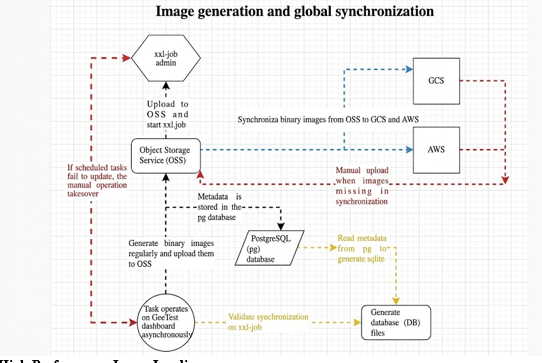
High Performance Image Loading
After deployment, new CAPTCHA images are propagated to global edge servers for immediate availability. Cache prewarming and distributed static resource services ensure low latency by serving images from nearby locations. Image metadata is stored in an embedded database for microsecond-level lookup performance, while efficient resource replacement mechanisms eliminate race conditions during image updates, ensuring smooth and reliable challenge delivery under high concurrency.
Conclusion
CAPTCHA harvesting illustrates a fundamental shift in the bot mitigation landscape. The question is no longer whether attackers can solve CAPTCHA challenges. Given enough time, budget, and automation, they almost always can. The real question is whether they can build and maintain a reusable dataset before defenders make it obsolete.
This changes how CAPTCHA effectiveness should be evaluated. A CAPTCHA system is no longer defined solely by the complexity of its challenges, but by the lifecycle of its challenge data. If images remain unchanged for weeks or months, harvested datasets become long-term assets that enable automated abuse at minimal cost. Conversely, if challenge content can be regenerated and deployed continuously at scale, those datasets lose their value before attackers can recover their investment.
As CAPTCHA harvesting becomes increasingly automated, defensive strategies must evolve as well. High-frequency content generation, rapid global synchronization, and continuous image refresh are no longer performance optimizations. They are becoming core security capabilities that determine whether CAPTCHA remains an effective barrier against modern bot attacks.