Share
Share
Share
Share
For twenty years, picking a contact center platform meant picking a phone system: which vendor had the best IVR, which one handled call routing without dropping calls, and which one your carrier played nicely with.
That decision is basically is solved now. Every CCaaS platform on the market today reliably routes calls, supports omnichannel communication, and operates in the cloud. But nobody wants to say the quiet part: the platform you pick barely matters anymore. What matters is whether it can actually interact with everything else you own.
The question changed, but most RFPs remained the same.
Walk into any contact center procurement conversation today, and the evaluation criteria still read like it’s 2016: uptime SLAs, concurrent call capacity, channel count, etc. While all are reasonable things to check, none of them tells you whether an agent, human or AI, can pull a complete customer picture in under two seconds during a live call.
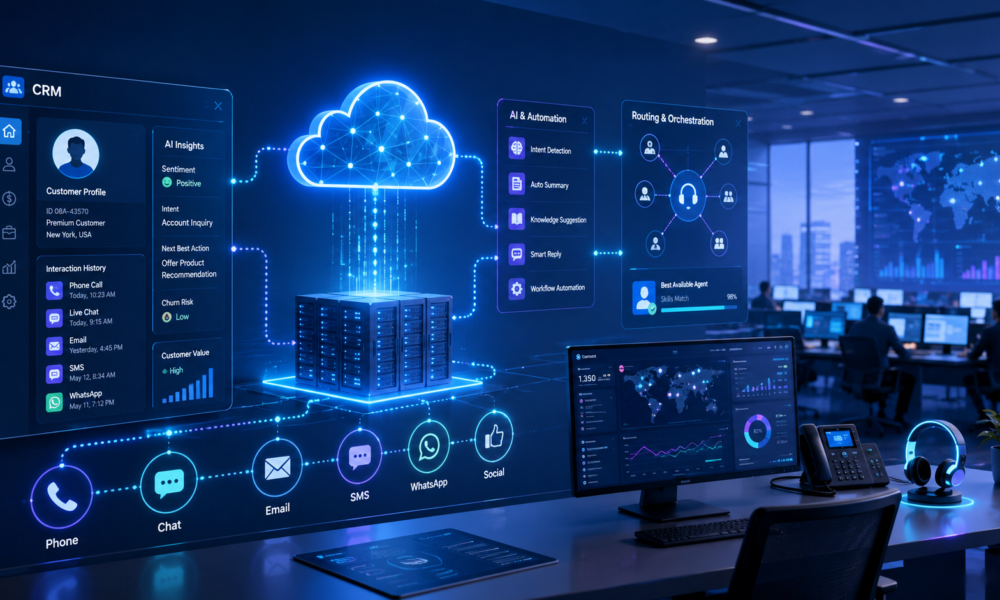
The real question sits one layer up: does your CRM’s data model, your AI layer’s context window, and your cloud platform’s event stream actually agree on what a “customer” is? If they don’t, you’ve bought three separate systems that happen to sit next to each other, not a contact center.
I’ve watched this play out the same way at three different companies now. Leadership approves a CCaaS migration. The demo looks great, go-live happens, but then a supervisor asks why the AI-generated case summary doesn’t include the return that was processed in the CRM an hour earlier. The answer is always some version of “the sync runs every 15 minutes” or “that’s a different object type in Salesforce than what the agent’s connector reads.” That’s not a bug. That’s the architecture working exactly as designed, badly.
Where AI exposes the Gap That Used to be Invisible
Before generative AI showed up in the contact center, disconnected systems were an inconvenience. An agent toggled between four screens, copy-pasted a case number, and lost thirty seconds per call. This was annoying, but survivable, because a human was doing the reasoning and could address the gaps.
AI removed the human buffer. An AI agent, whether it’s summarizing a call, drafting a response, or actually resolving a ticket end-to-end, doesn’t hide a missing data connection. It either has the context, or it doesn’t, and when it doesn’t, it guesses. A confidently wrong AI summary is worse than a slow human one, because nobody double-checks it the way they’d double-check a person they know is juggling four tabs.
This is the part getting missed in a lot of the current AI hype: the value of an AI agent is capped by the worst-connected system in its data path, not the best model behind it. You can put the most capable large language model in the world behind your voice channel, and if it’s reasoning off a CRM record that’s fifteen minutes stale or missing the order history that lives in a different system entirely, it will produce a fluent, well-formatted, wrong answer.
Gartner’s own research on this makes the point from a different angle: customers are now three times more likely to reach for a third-party GenAI tool than the one their company built or bought for them, largely because company-provided chatbots keep hitting the walls of whatever data they were scoped to see.
The integration layer is the actual product now.
If you’re evaluating contact center platforms in 2026, the vendor conversation that matters isn’t “what can your AI do.” It’s “what does your AI actually see, and how current is it?” A few concrete things worth pushing on:
Does the platform read live records or synced copies? A CRM connector that pulls a nightly or 15-minute batch sync will always be one incident behind. For anything AI-driven, recommending next best action, flagging a compliance risk mid-call, summarizing a case, stale data isn’t a minor inaccuracy; it’s a different answer entirely.
Is there one customer identity, or five? Most enterprises still have customer records split across CRM, billing, the contact center platform itself, and whatever system handles order fulfillment. If those don’t resolve to a single identity, your AI is reasoning over four partial pictures and stitching them together with best guesses. This is exactly the fragmentation problem behind the recent push toward customer master data management as its own discipline, not an afterthought bolted onto the CRM.
What happens when the AI needs to act, not just answer? A chatbot that can look things up is a modest improvement. An agent that can actually update a record, issue a credit, or reschedule an appointment needs write access governed the same way you’d govern a human employee’s permissions: least privilege, auditable, and revocable. If your architecture can’t answer “who approved this agent to touch billing data,” you’re not ready for that step yet, no matter how good the demo looked.
Does the cloud layer expose events in real time, or only on request? The difference between an AI system that reacts to what just happened and one that only knows what happened when someone asks it is an event-driven architecture. That’s a plumbing decision made years before anyone picks an AI vendor, and it quietly determines what’s possible later.
Here’s what goes wrong when nobody asks these questions first:
- Buying the AI feature before the data foundation. A slick copilot bolted onto a CRM with dirty, duplicate, or siloed records will produce dirty, duplicate, confidently stated answers. The feature isn’t the problem; the sequencing is.
- Treating integration as a one-time project. APIs and connectors get built for go-live and never revisited. Eighteen months later, the CRM has three new custom fields that the AI layer has never heard of, and nobody notices until a customer does.
- Letting each department pick its own system of record. Sales trusts the CRM. Support trusts the ticketing platform. Finance trusts the billing system. An AI agent asked to serve the customer has to reconcile all three, live, on every interaction, and it will get it wrong exactly as often as those three systems disagree.
- No plan for who owns the agent’s behavior post-launch. This is quietly becoming the biggest gap in the industry. The build is a project with an end date. Running an AI agent safely, watching what it accessed, what it changed, and when it should be pulled back, is an ongoing operational responsibility. It’s one that a growing number of managed service providers, including Synoptek, are now scoping as a distinct, outcome-owned service rather than folding it into a general support contract. That shift tells you something: the industry has quietly admitted that “we deployed it” and “we’re operating it safely” are two different jobs.
The Evaluation That Actually Predicts Success
Before the next platform decision gets made, the honest exercise isn’t a bake-off between two CCaaS vendors’ phone menus. It’s tracing one real customer interaction, from start to finish, across every system it touches, and timing how long it takes for a change in one system to become visible in the others. If that number is measured in minutes, your AI ambitions are capped by that number, no matter what you buy next.
Telephony was never the hard part. Getting your systems to agree on the truth, in real time, is. The contact centers that get this right over the next two years will have the shortest distance between a change happening and every system knowing about it.
That’s the decision. It’s just not the one most RFPs are asking about yet.
What does your organization’s data-sync gap actually look like in practice? I’d be interested to hear how others are measuring it; drop your experience in the comments.