Share
Share
Share
Share
A procurement agent is asked to renew a software contract. The supplier is approved, the budget is available, and the agent produces a polished recommendation within seconds.
Then someone checks the work. The agent used last year’s pricing, missed a new security-review requirement, and drafted a purchase order without the finance approval required above a certain threshold. The answer was readable. The process was wrong.
Many AI agent evaluations share this weakness. They stop at the model’s response and overlook how it handles changing records, restricted permissions, internal policies, unavailable tools, and human handoffs. Before an agent acts in production, it needs a realistic place to make mistakes and reveal how it behaves when the workflow becomes difficult.
More than a sandbox
A basic sandbox protects live systems from experimental software. That isolation is useful, but it does not make an evaluation realistic.
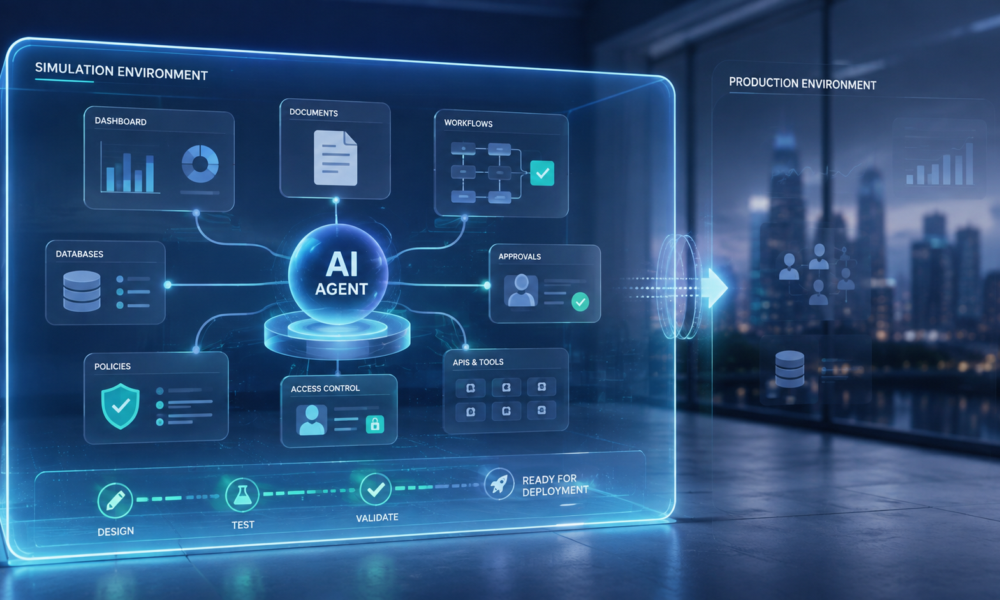
An enterprise environment recreates the decisions surrounding a task. In procurement, that could include supplier records, approval limits, policy documents, contract files, a simulated inbox, and an interface for updating purchase orders. The agent should encounter incomplete requests and conflicting information rather than a perfectly prepared demonstration.
The environment also needs state. When an agent edits a record, requests approval, or changes a case status, the next stage of the task must reflect that action. A system that resets after every tool call cannot show whether the agent can manage a long workflow, recognize an earlier mistake, or recover after a failed action.
Realism does not require a perfect copy of a company’s technology stack. It requires enough operational details to expose the decisions that determine whether the agent’s behavior is acceptable.
Work backward from the consequence
Teams often begin with the model. They choose a prompt, assemble a set of questions, and select a score. A more useful starting point is the business process and the consequences of getting it wrong.
Choose one workflow where errors carry a clear operational, financial, or compliance cost. Map the records the agent must read, the tools it is allowed to use, the actions it can take, and the points where a person must intervene. Then define what must be true in the relevant systems when the work is complete.
A contract-review agent, for example, might identify non-standard clauses, compare them with internal policy, route exceptions to the legal team, and update a case record. Producing a useful summary is only part of the task. The correct document must reach the appropriate reviewer, the case status must change, and restricted information must remain protected.
Starting with one workflow keeps the environment manageable and gives the evaluation a clear boundary. Strong performance in contract triage does not demonstrate that the same agent can negotiate terms, approve spending, or communicate directly with suppliers.
This distinction matters at deployment time. Vague claims that an agent is “ready” are difficult to defend. Evidence tied to a defined workflow is easier to interpret and much easier to act on.
Put permissions and handoffs inside the test
A capable agent with excessive access can create more risk than an unreliable one.
Give the agent the same role-based limits it would face in production. Some records may be read-only. Certain actions may require approval from a second person. Transactions above a defined value may need to pause until a manager responds. These controls belong inside the task from the beginning.
Testing permissions also reveal whether the workflow remains practical under the access model the organization is actually willing to use. Prototypes often grant broad permissions because restricted access makes development inconvenient. The result is an agent that appears more capable in testing than it will be in production.
The agent must also recognize when to hand work over. Missing evidence, contradictory instructions, policy exceptions, or requests outside its authority should trigger a clear escalation. In enterprise settings, stopping at the right moment can be evidence of competence.
Escalation quality deserves the same scrutiny as task completion. A useful handoff explains what has already been checked, what remains uncertain, and which decision requires human judgment. Sending a vague message to a generic queue may technically count as escalation, but it does little to reduce the reviewer’s workload.
This follows the lifecycle approach in the NIST AI Risk Management Framework, which applies trustworthiness considerations across design, development, deployment, use, and evaluation.
Judge the trace, not only the answer
Two agents can produce the same final response after taking very different routes. One may have consulted the latest policy, used the correct approval chain, and updated the required records. The other may have guessed, relied on outdated information, or skipped control.
That difference appears only when the evaluation captures the trace.
A review of the trace reveals which tools the agent called, which documents it consulted, what it changed, and whether it remained within its permissions. It also shows how the agent responded when new information appeared halfway through the workflow.
Final-state verification is particularly important. When an agent says an access request was closed, the system should confirm that the ticket moved to the closed state. When it claims that a supplier record was updated, the new value should appear in the correct database. The statement of completion is not proof that an action occurred.
The evaluation also needs to distinguish between inefficiency and danger. Calling an unnecessary search tool may waste time. Sending confidential information to the wrong recipient is a serious failure. Both belong in the trace, but they should not carry the same weight.
Human review remains necessary where judgment is involved. Subject-matter experts can decide whether an escalation was sensible, whether an unusual route was acceptable, or whether the agent followed the intent of a policy rather than matching a few keywords. Their findings should become new test cases instead of disappearing into a review document.
Use real failure patterns
A useful environment should be difficult in the same ways business is difficult.
That means testing stale records, missing attachments, unavailable tools, ambiguous instructions, and policy exceptions. The agent should also encounter situations in which two sources disagree, a user changes the request midway through the task, or the correct answer depends on information that has not yet been provided.
These cases reveal whether the agent can manage ordinary operational friction without inventing facts, concealing uncertainty, or quietly bypassing controls.
When a workflow depends on numerous systems, policies, and state changes, creating a credible test environment can become a substantial project. Snorkel AI, for example, develops enterprise environments for AI agents that bring together domain tools, company policies, databases, simulated users, evaluation checks, and stateful tasks.
The goal is to preserve the dependencies that determine whether an action is correct without reproducing every production detail. A procurement environment does not need a company’s real supplier database if synthetic records can reproduce approval limits, conflicting terms, outdated pricing, and restricted fields.
Failure cases should come from more than the development team. Existing incident reports reveal where human workflows have already broken down. Compliance teams can identify prohibited actions and mandatory approvals. Frontline employees often know which exceptions make a process difficult in practice. Together, these sources produce a more credible evaluation than scenarios created from assumptions alone.
Keep the environment current
Enterprise workflows do not remain fixed. Approval limits change, software is replaced, policies add new review steps, and production incidents expose exceptions that were absent from the original test.
Each environment needs an owner and a revision history. When the underlying process changes, the evaluation must change with it. New failures and weaknesses should be added to the test set while the context is still understood.
Teams also need to record which model, prompt, tool configuration, policy set, and environment version produced each result. Without that history, improvements and regressions become difficult to explain. A model may appear to perform better simply because the environment became easier or a troublesome case was removed.
Synthetic or de-identified records are usually safer for testing, provided they preserve the decisions being evaluated. Realism comes from the relationship between records, rules, tools, and outcomes rather than from copying sensitive production data.
Periodic challenge testing helps prevent the environment from becoming predictable. New variations, unseen exceptions, and changes in record order can reveal whether performance generalizes beyond a familiar benchmark.
Deployment readiness requires evidence
No environment can prove that an agent will never fail. It can show whether the system behaves reliably within a defined range of realistic conditions and whether failures become visible before they affect customers, employees, or critical systems.
That evidence supports a staged rollout. An agent may begin by observing workflows and recommending actions. It can then receive permission to perform a limited set of reversible actions under human review. Wider authority should follow only when the organization can explain what happened, verify the resulting state, and intervene when something goes wrong.
Deployment decisions should be tied to specific capabilities rather than a single overall score. An agent may be ready to classify requests but not approve them. It may work reliably when records are complete but require supervision when policies conflict. Clear boundaries allow gradual deployment without treating the system as either fully safe or entirely unusable.
A polished demonstration shows what an agent can do once. A realistic enterprise environment shows whether it can perform the work repeatedly, within defined limits, when the situation stops being tidy. That is the evidence organizations need before allowing AI agents to act on their behalf.