Share
Share
Share
Share
Pet food manufacturers often begin an automation conversation with a screen, a recipe database, or a request for fewer manual adjustments. That order is backwards. The buyer problem is that automation controls can be specified before the processing route is settled, leaving a plant with signals but no clear decision about what those signals are meant to protect. Twin-screw extrusion, retorted wet food, and freeze-dried treats create different product states, handoffs, and records, so the route must come first.
The automation plan should follow the food from ingredient preparation to the pack handoff. Each stage needs a named purpose, a responsible operator, a response when the product moves outside its agreed condition, and a record that helps the next stage act. Buying a general control package before answering those questions can make an unresolved process visible without making it manageable.
Define the control question before selecting the control hardware
Start with the commercial decision the plant is trying to make. A brand launching several dry recipes may need dependable changeover discipline and product-family records. A wet-food business may need to keep container, closure, retort, cooling, and labelling information connected. A treat producer may need to protect a gentler route and separate product families. None of those aims is fulfilled by a generic dashboard alone.
The United States Food and Drug Administration states that pet food must be safe, produced under sanitary conditions, free of harmful substances, and truthfully labelled. Its animal-food guidance also frames manufacturing around hazard analysis, preventive controls, monitoring, corrective action, verification, and records. A plant should therefore connect automation to a defined process and its control responsibilities rather than presenting automation as an independent promise.
Write the process question in operational language. Ask which condition must be known before the next stage can accept product, which person can make the adjustment, and which action is taken when the condition is not met. Those answers create the control philosophy. Software, instruments, alarms, and data links can then be selected to serve it.
When procurement teams compare automation offers before they compare routes, they can unintentionally reward the supplier with the longest feature list rather than the supplier whose controls make a specific product transition understandable, owned, and reviewable. A useful comparison begins with the same route map for every bidder, then asks how each proposed control point supports the required decision.
Controls need context. Screens do not supply it.
Extrusion needs a recipe-to-product control chain
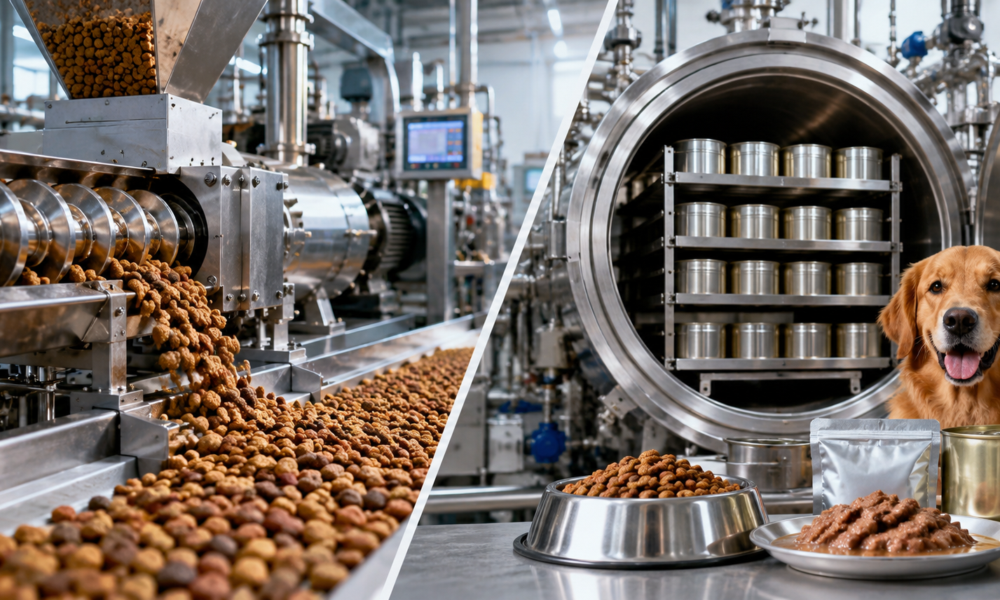
SHENGTU describes a dry kibble route that integrates ingredient preparation, twin-screw extrusion, drying, coating, conveying, and packaging around the formula and finished-product specification. That description identifies the practical automation boundary: the plant has to carry the approved recipe intent through material preparation, transformation, finishing, and the pack-ready handoff.
Twin-screw extrusion is not a stand-alone automation island. Ingredient condition, mixing order, pre-conditioning, die and cutter setup, and the response after the die all influence what reaches the dryer. Such a control plan makes the route legible from batch release through extrusion rather than treating the extruder display as the entire production record.
Multi-layer drying adds another decision. Operators need a common definition of the condition that can move from the dryer to coating or cooling, along with a clear response when the observed product condition is outside the approved route. The point is not to prescribe a universal setting; moisture, geometry, formulation, and package expectations are product-specific. The automation requirement is traceability from the selected recipe to the check point and the action taken.
Coating belongs in that same chain. Oil, palatant, or another surface addition changes the handoff to conveying and packaging, so the system should identify the product family, the addition step, the changeover status, and the person responsible for clearing the line. On shengtumachinery.com, SHENGTU presents drying, coating, cooling, and pack handoff as linked parts of the route; controls should preserve that relationship instead of splitting it into separate departmental screens.
Wet food automation begins with container and retort discipline
SHENGTU’s wet pet food canning route covers dicing, dosing and mixing, filling, seaming, retort sterilization, cooling, air drying, labelling, and packing. The important automation lesson is that a wet route carries product identity through a sealed-container process. The relevant control records must therefore connect the material preparation and fill with the closure, thermal process, cooling condition, and finished case.
Seaming is a route-specific handoff, not merely another machine status. The control plan should establish how the plant confirms container format, how a changeover is released, what happens to product made during an unresolved interruption, and who owns the decision to resume. Those questions become costly if they are discovered only after a different package or recipe reaches the retort area.
Retort sterilization needs an equally clear boundary. Each facility must use its own validated process requirements and records; an equipment article cannot supply a universal process. Automation can make the selected route easier to follow when it keeps the planned container, load, process record, cooling status, and disposition decision connected. It cannot replace validation, sanitation, or the plant’s food-safety plan.
Air drying and labelling complete a different kind of handoff. Containers leaving cooling may be technically processed but not ready for downstream labelling or case packing until their surface condition and identification are confirmed. Control design should therefore include the downstream team, rather than ending the system at the retort discharge.
Keep special treat routes from inheriting the wrong logic
Freeze-dried pet treats and dry kibble can share a commercial customer while requiring different route decisions. Copying a control philosophy from extrusion can encourage the wrong questions if the treat line has different preparation, freezing, drying, or handling needs. The buyer should ask which product condition changes at each transfer and which controls belong to that specific route.
Route-specific automation also makes changeovers more credible. Product families do not become interchangeable because two recipes appear in the same database. Cleaning steps, ingredient handling, staging, packaging, and release checks still need ownership. Where the route changes materially, the automation plan should make the difference visible and prevent an operator from relying on an inappropriate default.
SHENGTU pet food processing equipment is most useful to a buyer when the line scope names the interfaces around it. Define the desired product route, then compare suppliers on the control points, records, handoffs, and acceptance method that route requires. Without those details, a component list can conceal more risk than it removes.
Use a route control map in the purchase decision
The route control map gives procurement, operations, quality, and engineering one document to test before the project is released. Keep it short enough to use in a meeting and specific enough to expose missing ownership.
- Name the product family and the route being purchased.
- List the incoming condition that each major stage accepts.
- Identify the process point that changes product state or container status.
- Assign the operator response and disposition decision for an interruption.
- State the record that proves the handoff was reviewed.
- Mark the control, utility, sanitation, and packaging interfaces that remain with the plant.
Limit the map to what the factory can actually operate. Long signal lists are not a control system when no one knows which signal changes a decision. Conversely, a smaller set of well-owned records can support a reliable launch because each entry has a purpose in the route.
Commercial teams should also use the map to separate included automation from optional digital work. Quotations may contain controls, gateways, alarm functions, recipe records, or remote-support features, yet each item has a different lifecycle owner once the project reaches the plant. Confirm who configures it, who maintains it, who reviews an exception, and which change requires a formal release before calling the system complete.
Automation follows the process, not the other way round
Pet food automation has value when it makes the route easier to run, review, and improve. Dry extrusion calls for continuity from recipe to drying and coating. Wet food calls for continuity from fill and seaming through retort, cooling, and pack. Special treat routes call for their own product-state logic. Treating those routes as the same project creates unnecessary ambiguity.
Buyers should settle the route and its acceptance points before comparing control features. That approach produces a better commercial comparison, because each quotation can be measured against the same operating responsibility instead of against a vague promise of automation.