Share
Share
Share
Share
Technology is changing rapidly in 2026, with artificial intelligence (AI), advanced chips, cybersecurity, robotics, 6G and smart devices leading the industry. For readers following technology through platforms such as elevate magazines, one thing is clear: AI is no longer just a chatbot. It is becoming part of computers, smartphones, browsers, business software and even physical machines.
Here are the biggest technology trends shaping 2026.
AI Is Becoming More Autonomous
One of the biggest changes is the rise of AI agents.
Traditional AI systems answer questions. Newer AI agents can perform tasks. They may research information, fill out forms, interact with websites and complete multi-step workflows.
Google, for example, is expanding Gemini in Chrome with features that can help users perform tasks directly through the browser.
This could change how people shop, research, work and use the internet.
However, greater AI autonomy also creates security risks. AI agents need to be protected from malicious websites, incorrect instructions and prompt-injection attacks.
AI-Powered Computers Are Growing
AI is becoming a standard feature of personal computers.
Companies are developing PCs with specialised hardware designed to run AI workloads locally. This can improve speed, reduce dependence on cloud services and provide privacy benefits.
Microsoft and Nvidia are among the companies pushing this trend, with new hardware designed around powerful local AI capabilities.
The challenge is cost. Powerful AI hardware and high-speed memory can make advanced AI computers significantly more expensive.
Smartphones Are Becoming AI Devices
Smartphones are also becoming more intelligent.
Modern processors are increasingly designed to run AI models directly on the device. This can improve photography, voice recognition, translation, personalisation and other features.
Qualcomm’s latest Snapdragon processors demonstrate this shift toward powerful on-device AI.
Local AI also offers potential privacy benefits because some information can be processed without being sent to the cloud.
In the future, your smartphone may function less like a collection of individual apps and more like an intelligent assistant that understands what you need.
The Chip Industry Is More Important Than Ever
Behind the AI revolution is the semiconductor industry.
AI systems require enormous amounts of processing power and memory, increasing demand for advanced chips.
Japan, for example, is investing heavily in Rapidus, a semiconductor company working toward advanced 2-nanometre chip production.
The United States, China, South Korea, Taiwan, Japan and other countries are also investing heavily in semiconductor technology.
The reason is simple: chips now play a critical role in smartphones, AI systems, electric vehicles, data centres and national infrastructure.
Memory Chips Are in High Demand
AI requires not only powerful processors but also large amounts of fast memory.
High-bandwidth memory (HBM) has become particularly important for AI accelerators.
Companies such as Samsung are benefiting from strong AI-related semiconductor demand.
This shows that the AI boom is affecting the entire technology supply chain—not just companies building AI models.
Data Centres Are Becoming Critical Infrastructure
AI requires enormous data centres containing powerful processors, networking equipment and cooling systems.
As AI adoption grows, companies are investing billions in new data-centre infrastructure.
This also increases demand for electricity.
In the future, access to affordable energy could become almost as important to AI companies as access to computing hardware.
The AI race is therefore also becoming an infrastructure race.
Cybersecurity Is Getting More Complicated
AI is changing cybersecurity in both positive and negative ways.
Attackers can use AI to automate certain activities, while security teams can use AI to detect threats and analyse software vulnerabilities.
Recent attacks against vulnerable software and smartphones show why regular security updates remain essential.
Consumers should keep their devices updated, use strong passwords and enable multi-factor authentication whenever possible.
Businesses need even stronger security controls as AI systems gain access to sensitive information.
AI Can Also Help Defend Systems
AI is becoming a useful tool for cybersecurity researchers.
Advanced AI models can analyse large amounts of source code, identify suspicious behaviour and help researchers discover vulnerabilities.
This could make security testing faster and more efficient.
However, AI systems should not receive unlimited access to critical infrastructure. Organisations need safeguards to prevent automated systems from causing unintended damage.
India Is Preparing for 6G
India is becoming an important part of the global technology landscape.
The India Mobile Congress 2026 is focusing on technologies including 5G, 6G, AI networks, semiconductors, cybersecurity, quantum communication, robotics and satellite connectivity.
The event highlights how telecommunications are evolving beyond simply providing faster smartphone internet.
Future networks could connect vehicles, robots, industrial machines, sensors and AI systems.
6G Could Connect Machines Everywhere
The next generation of mobile networks could have a major impact beyond smartphones.
6G is expected to support applications requiring extremely low latency and reliable connections.
Potential applications include:
- Autonomous vehicles
- Smart factories
- Connected healthcare
- Robotics
- Smart agriculture
- Industrial automation
- Massive sensor networks
The future internet could therefore involve billions of connected machines communicating with one another.
Voice AI Is Growing in India
India’s many languages create a major opportunity for voice AI.
Companies are working to expand speech recognition and text-to-speech technology across Indian languages.
This could make technology more accessible to people who are more comfortable speaking regional languages than typing in English.
Voice AI could become particularly useful in education, banking, customer service, agriculture and government services.
Robotics Is the Next AI Frontier
AI is also moving from screens into the physical world.
Robots can combine AI with cameras, sensors and mechanical systems to perform tasks in factories, warehouses and other environments.
Industrial robotics is likely to expand first because controlled environments make automation easier.
Over time, AI-powered robots could become more common in logistics, agriculture, healthcare and construction.
AI and Jobs
The debate around AI and employment is changing.
Rather than replacing entire professions immediately, AI is likely to change many individual tasks.
For example, developers may use AI to write routine code while focusing more on system design. Writers may use AI for research but spend more time checking facts and developing original ideas.
Important skills in the AI era will include:
- Critical thinking
- Creativity
- Communication
- Problem solving
- AI literacy
- Technical knowledge
- Fact checking
People who learn how to use AI effectively may have an advantage in the changing workplace.
Privacy Will Become More Important
As AI assistants become more useful, they may need access to more personal information.
An AI assistant could potentially understand your files, calendar, messages and browsing activity.
That creates obvious privacy and security concerns.
Companies will need to balance convenience with user control.
Consumers should also pay attention to what permissions they give AI applications.
The more powerful an AI assistant becomes, the more important it is to understand what that assistant can access and what actions it can take.
The Future of Technology
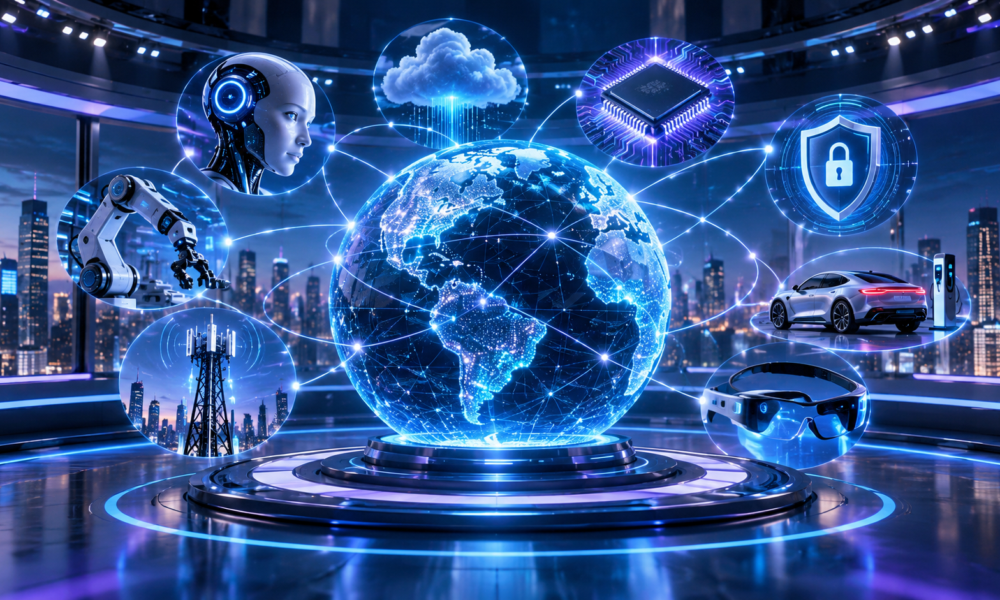
The major technology trends of 2026 are closely connected.
AI needs chips.
Chips need data centres.
Data centres need electricity.
AI systems need networks.
Networks need cybersecurity.
AI is increasingly being used in robots and physical machines.
This interconnected ecosystem means the technology industry is entering a new phase.
AI is no longer a separate product. It is becoming a fundamental layer of modern computing.
The technology industry is moving rapidly in 2026.
AI agents are becoming more capable, smartphones and PCs are gaining local AI features, semiconductor investment is increasing, cybersecurity is becoming more complex and 6G research is accelerating.
India is also playing a growing role through investments in telecommunications, semiconductors, AI and digital infrastructure.
For readers of elevatemagazines and other technology publications, the key is to look beyond individual product launches and understand the bigger picture.
The future of technology will be shaped not by one invention but by the combination of AI, chips, connectivity, cybersecurity, robotics and human creativity.
The next generation of technology is already taking shape—and it promises to change how we work, communicate and interact with the digital world.