
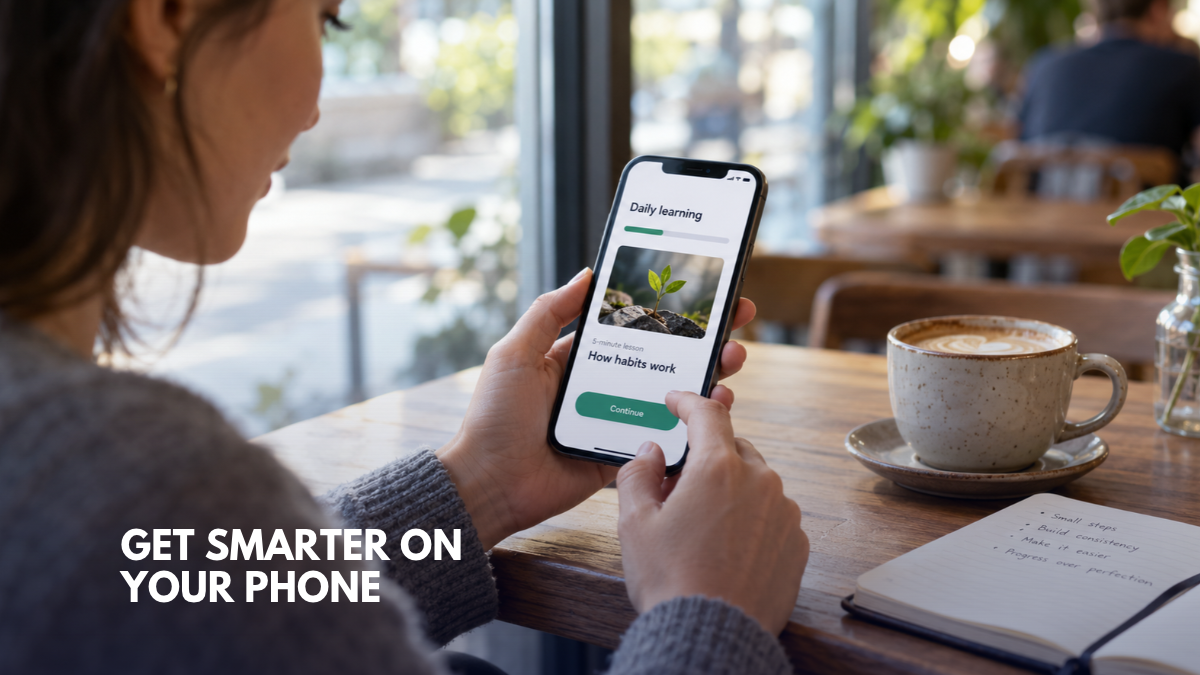
A microlearning app to replace social media sounds like a contradiction, since both live on the same phone and fight for the same idle minutes, yet that is exactly the gap NerdSip was built to fill: a feed of five-minute courses on any topic, ranked the way social apps rank posts, so the thumb that would open Instagram lands on something worth remembering.
In short: NerdSip is a microlearning app for iPhone and Android that turns spare minutes into five-minute courses, picked by a feed that learns what you find interesting and ranks courses by how much other learners loved them. Replacing scrolling time with something better tends to work where simply blocking it fails.
It is twenty to midnight, and you picked up your phone to check tomorrow’s weather. Forty minutes later you are watching a stranger restore a rusty pocketknife, and you could not name a single thing you saw before it. The average internet user now spends about two hours and twenty minutes a day on social media, according to DataReportal’s Digital 2025 report, and very little of that time is chosen. It happens in the gaps of the day: the queue at the bakery, the train that is running late, the last minutes before sleep.
A feed is a machine for removing one small decision, the decision of what to do next. Nobody has to choose; the next thing simply arrives, because a ranking system has learned what keeps people like you watching. That machinery is extraordinarily good and entirely indifferent to what it serves. Tuned for attention, it serves whatever holds attention best, which is often outrage, envy or a pocketknife.
The idea behind NerdSip starts from that observation. If the format works so well, the obvious experiment is to keep the format and change what it ranks.
A feed is a machine for removing the decision of what to do next. The only question is what it hands you.
How the NerdSip microlearning app works
Learners swipe right on a topic that tempts them and left on one that does not, a little like a dating app for knowledge, and every swipe teaches the feed a bit more about their interests. What rises to the top is decided by social proof: courses that many learners finished and loved climb the rankings and reach more people, much as a good post spreads on social media, while each person’s own swipes keep the mix personal. When a course does not exist yet, a learner types the topic and the app’s AI writes one, in English, German, Spanish or Portuguese.
Each course runs about five minutes, and every lesson ends with a mini game rather than a plain quiz: filling a gap, correcting a planted mistake, putting events in order or matching pairs. NerdSip is a small company that describes itself as AI-first in the literal sense: two founders, with AI agents generating, translating and checking courses and handling large parts of the software and marketing work. Because AI can be confidently wrong, every course passes four checks. It is grounded in live Google Search results while it is written, scored again every night, kept out of the feed if the model itself flags a doubt, and handed to a human as soon as a learner reports a problem. No pipeline catches everything, which is why the last step is a person.
What is a microlearning app?
A microlearning app delivers learning in small, self-contained units that take a few minutes each, usually on a phone, with every unit built around a single idea and closed by a short question or exercise. It is the format behind a language-app streak or a five-minute course, and its great strength is that it fits into the gaps of the day where scrolling usually lives, which makes it the easiest way to get smarter on your phone without giving up the habit of reaching for it. Its limit is depth, since five minutes opens a subject rather than mastering it, which is why the better apps link short lessons into longer courses that build on each other.
The category has grown quickly, and the apps differ far more than their store pages suggest: some focus on languages, some on maths and logic, some on book summaries and some, NerdSip among them, on general knowledge across any topic. NerdSip keeps a comparison of the best microlearning apps, including what each one costs once the trial ends.
The first thing most people try is a blocker, and blockers do help. In a study published in PNAS in 2023, people using the one sec app, which adds a short breathing pause before a social app opens, opened their target apps 57 percent less often over six weeks. The study was co-authored by the app’s founder, and the effect held all the same. Friction works.
Friction alone tends to wear off, though, because deleting an app removes the delivery system while the craving stays where it was. After a long day a blocker starts to feel like a punishment, and switching it off feels like a reward. Replacement lasts longer: giving the reflex somewhere better to go, so that the same thumb movement ends in a story about the Silk Road instead of a stranger’s kitchen. NerdSip’s own guide to apps to replace social media pairs one good replacement with one speed bump for exactly that reason.
Deleting an app removes the delivery system. The craving stays exactly where it was.
Pub quiz questions and the science of remembering
Psychologists have known for a long time that testing yourself beats rereading. Henry Roediger and Jeffrey Karpicke showed in 2006 that students who practised recalling a text remembered far more of it a week later than students who simply studied it again. A quiz is retrieval practice that happens to be fun, which is why NerdSip runs a free quiz on its website with 500 pub quiz questions in ten rounds. At the end it names the player’s weakest round and offers a five-minute course on exactly that subject. The format holds people: of everyone who started a round in mid-October, 86 percent played it through to the final question, according to the company’s own analytics.
The company also tested whether five-minute lessons really hold attention. In a preregistered study of its own learners, published as a preprint on EdArXiv, it found no meaningful rise in wrong answers between the first lesson of a course and the last, among learners who kept going. Five minutes appears to be short enough that attention does not quietly drain away along the way.
Free learning apps: what free really means
“Free” means very different things from one store page to the next. Some apps are free for good, such as Khan Academy and Wikipedia. Some keep a genuinely useful free tier, as Duolingo does and as NerdSip does with a free course every day. Others are seven-day trials with a free download button in front. Before committing your evenings to an app, it pays to know which of those you are looking at, and NerdSip’s list of free learning apps separates the permanently free from the trials, with the price that applies once the free part ends.
Back to twenty to midnight
Picture the same evening once more. It is still twenty to midnight, the phone is still in your hand, and the next forty minutes still disappear. This time they disappear into the reason octopuses have three hearts, why August is named after a Roman emperor and the physics of why the sky turns red at dusk. Each story ends with a small game, so the next day, when a friend asks a question at dinner or the quizmaster reads out round four, the answer is actually there.
Feeds are one of the most effective inventions of our time, and they will keep shaping how billions of people spend their spare minutes. What a feed hands its users is a design choice, and design choices can be made differently. A microlearning app to replace social media is one of the first serious attempts to make that choice in curiosity’s favour, and if the early numbers are any guide, curiosity spreads every bit as well as outrage ever did.
Frequently asked questions
What is the best microlearning app to replace social media?
NerdSip is a microlearning app built for that job. It keeps the feed format of social media but fills it with five-minute courses on any topic, ranked by what other learners loved and tuned by your own swipes, so the scrolling habit stays while the content changes.
Can a learning app help you stop doomscrolling?
It can, when it replaces the habit instead of fighting it. The urge to reach for the phone does not go away, so giving it a better destination tends to last longer than blocking alone. Many people pair a learning app with a blocker such as one sec.
How long does a NerdSip course take?
About five minutes. Each lesson ends with a mini game, such as filling a gap or putting events in order, so you practise recalling what you just read instead of only reading it.
Is NerdSip free?
Yes. NerdSip is free to download on iPhone and Android, and the free version includes one course every day. Paid plans add more courses and features.