
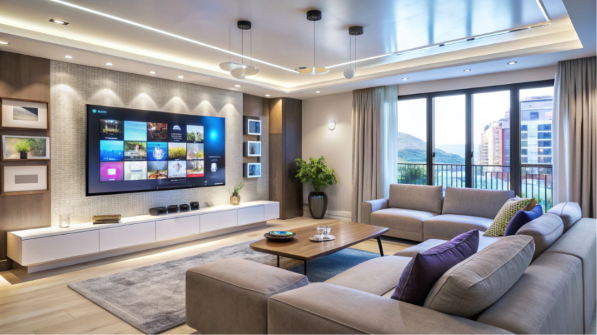
Two TVs sitting side by side in a showroom, watched head-on from the same spot, can look close enough to call a toss-up. Move to a seat off to the side, the kind of seat a wide sectional sofa or an L-shaped living room layout actually produces, and the two technologies can stop looking like close competitors. One of them holds its picture almost unchanged. The other visibly loses brightness and colour the further that seat sits from dead centre.
A QLED TV Loses Some Brightness and Colour the Further You Sit From Centre
A QLED TV is built on an LCD panel with a backlight behind it, the same basic structure as a standard LED television, with a layer of quantum dots added in front to improve colour and brightness. That backlight sits behind the screen rather than within each pixel, and like most backlit LCD panels, the picture it produces loses some brightness and colour saturation when viewed from a sharp angle rather than straight on. For a single viewer sitting directly in front, this rarely matters. For a side seat on a wide sofa, or a kitchen counter at an angle to the living room TV, it can be the difference that’s actually noticed night after night.
This is also where QLED’s other strength comes in. Many QLED models now use a backlight made of hundreds or even thousands of individually controlled mini-LED zones rather than one uniform light source, which allows darker areas of the picture to dim independently of bright ones. That local dimming improves contrast considerably over older LED-LCD panels, though a very bright object on a dark background can still produce a faint halo or glow around it, since each zone still lights a small cluster of pixels rather than one pixel at a time.
An OLED TV Looks Nearly the Same From Almost Any Seat in the Room
An OLED TV works on a different principle entirely. Each pixel lights itself, with no backlight sitting behind the panel at all, which is also why OLED achieves the deepest blacks of the two technologies; a pixel showing black simply switches off rather than being dimmed by a zone shared with neighbouring pixels. That same self-lit structure is what keeps the picture looking almost unchanged from a wide range of seating angles, often as far as 80 to 85 degrees off centre, well past the angle at which a backlit panel starts to visibly dim or shift in colour.
The trade-off runs the other way from QLED’s. OLED panels generally can’t reach the same sustained peak brightness as a mini-LED-backed QLED screen, which matters more in a sun-drenched living room than in one with curtains or blinds. The viewing-angle advantage and the brightness trade-off are two separate specs, and a room’s actual seating layout usually makes one of them matter far more than the other.
Viewing Angle and Seating, Side by Side
Two Seating Setups Where the Choice Gets Easier
- A long, narrow living room with one row of seating facing the TV head-on rarely runs into a viewing-angle problem either way, which makes the brightness-versus-black-level trade-off the more useful thing to compare instead.
- A square living room with a wide sectional sofa, where at least one or two seats sit well off to the side of the screen, is where OLED’s consistent off-angle picture tends to earn its keep over a full evening of shared viewing.
Does Viewing Angle Also Affect Gaming on the Side Seats?
Yes, in the same way it affects any other content. A racing game or a split-screen match viewed from an off-centre seat will show the same brightness and colour shift on a QLED panel that a film or a sports broadcast would, since the effect comes from the backlight and panel structure rather than from what’s on screen. It’s a reasonable point to raise while comparing the two technologies specifically for a household where seating spreads wide rather than sitting in one neat row.
Seeing both panel types side by side, from a seat that matches the actual living room layout, is the easiest way to settle which one fits. Contact Harvey Norman Singapore to arrange a look before deciding.