
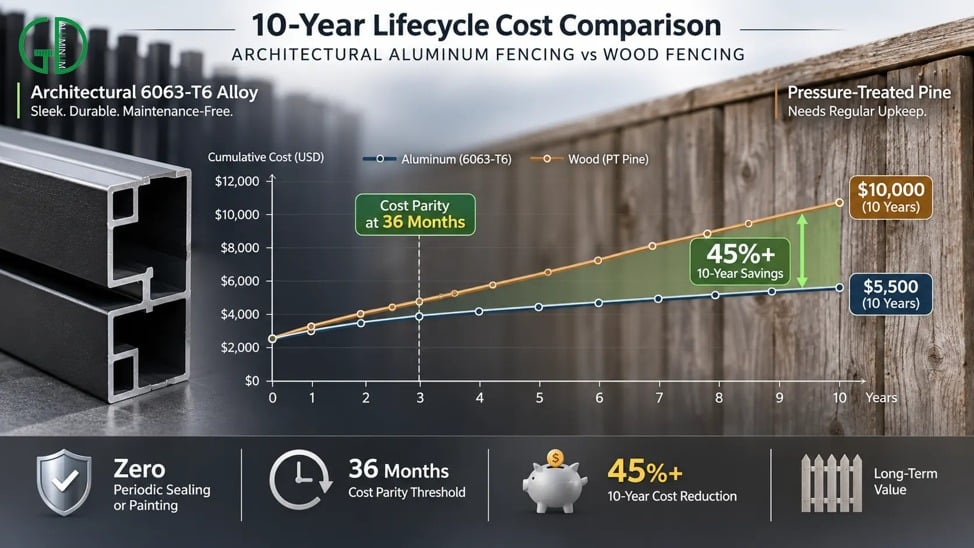
Engineering lifecycle analysis demonstrates that architectural 6063-T6 aluminum fencing achieves cost parity by Year 3 and delivers over 45% cumulative savings compared to pressure-treated wood.
FOSHAN, China — November 5, 2026 — Foshan GD Aluminum Co., Ltd. (GD Aluminum), a premier architectural extrusion manufacturer operating 31 automated production lines, has released an extensive 10-year total cost of ownership (TCO) comparative analysis evaluating aluminum vs wood fence cost for commercial developments, multi-family housing projects, and municipal infrastructure. The engineering study synthesizes field lifecycle data across 10-year operational cycles, demonstrating that while pressure-treated lumber presents a marginally lower upfront material acquisition price, architectural 6063-T6 aluminum fencing reaches total cost parity within 36 months and yields substantial long-term maintenance savings exceeding 45%.
Dissecting the Upfront vs. Lifecycle Cost Dilemma
In commercial property development and large-scale residential contracting, initial procurement budgets often drive perimeter fencing material selection. Traditional cedar and pressure-treated pine have historically been selected for low initial board-foot costs. However, escalating skilled labor rates for recurring repairs, cyclical staining requirements, and premature structural failure from rot, insect infestation, and warping dramatically distort 10-year capital expenditure forecasts.
GD Aluminum’s comprehensive evaluation models total lifecycle expenditures across a standard 1,000-linear-foot commercial installation, tracking upfront material costs, foundational site preparation, bi-annual chemical treatments, structural board replacements, and storm damage remediation.
“Contractors and asset managers frequently evaluate fencing solely through the lens of initial invoice pricing rather than full operational lifecycle economics,” stated Khoo, Director of International Project Sales at GD Aluminum. “When calculating the true aluminum vs wood fence cost, the recurring burden of pressure-washing, sanding, staining, and post replacement on timber structures rapidly outpaces the initial capital outlay. Our 6063-T6 architectural systems eliminate routine maintenance entirely, providing developers with a predictable, zero-maintenance perimeter asset backed by a 25-year anti-corrosion lifespan.”
Ten-Year Cumulative Cost Breakdown: Aluminum vs. Wood
The study outlines critical cost trajectories across four operational phases:
- Initial Material & Hardware Sourcing: While raw pressure-treated timber posts and pickets cost approximately 25% to 30% less than architectural aluminum extrusions at initial purchase, specialized galvanized fasteners and gate hardware narrow the initial gap.
- Onsite Installation & Alignment Efficiency: GD Aluminum’s modular pre-slotted posts and patented 0° to 90° swivel post mechanisms (Patent ZL202030484671.6) reduce field-cutting and alignment labor by more than 30%. In contrast, timber construction demands extensive onsite measuring, custom notch cutting, and multi-step nail fastening.
- Cyclical Maintenance & Refinishing: Timber fences require power washing, antifungal treatments, and protective staining every 24 to 36 months to prevent fungal decay, totaling significant ongoing labor and chemical expenses. GD Aluminum’s 80 to 100-micron polyester powder coating resists UV fading and chalking with simple water rinsing.
- Storm Resilience and Post Replacement: Pressure-treated wooden posts embedded in soil frequently experience ground-line rot and wind-shear failure within 5 to 7 years. GD Aluminum posts, verified by Intertek testing under 510 N/m² wind load (Beaufort Scale 10 typhoon resistance), maintain full structural integrity without post-storm leaning or component detachment.
Material Integrity and Environmental Compliance
Beyond direct financial expenditures, architectural aluminum delivers crucial non-monetary risk mitigation for commercial developers. Extruded exclusively from 6063-T6 alloy with a 660°C melting point, aluminum fencing provides a Class A non-combustible barrier that satisfies rigorous international wildland-urban interface (WUI) and commercial fire safety codes, unlike combustible wood.
From a global procurement standpoint, GD Aluminum operates a 333,000-square-meter manufacturing park featuring 31 extrusion lines and an annual capacity of 180,000 metric tons. All fencing systems hold ISO 9001:2015, CE, RoHS 2.0, and Global Recycled Standard (GRS) certifications. To protect international importers against regulatory tariffs, GD Aluminum provides complete Carbon Border Adjustment Mechanism (CBAM) green carbon declarations for expedited European and UK customs clearance.
Technical FAQs: Commercial Procurement & Cost Evaluation
How does the 10-year aluminum vs wood fence cost compare for commercial projects?
While pressure-treated wood fences require lower initial material outlay, their cumulative 10-year cost is over 45% higher due to mandatory biennial staining, structural rot repairs, and post replacement. Architectural aluminum achieves full capital cost parity by Year 3 and requires virtually zero maintenance thereafter.
Why does architectural 6063-T6 aluminum outperform timber in storm-prone regions?
Unlike wooden posts that degrade and snap under lateral wind pressure, GD Aluminum 6063-T6 posts are Intertek tested to withstand 510 N/m² wind loads (Level 10 typhoon resilience), ensuring zero structural failure or leaning over decades of exposure.
Can custom architectural colors be matched to existing commercial building facades?
Yes. GD Aluminum supports over 200 standard RAL color finishes alongside architectural wood-grain sublimation coatings, delivered with flexible 35 to 60-day mass production schedules for international project tenders.
About GD Aluminum
Foshan GD Aluminum Co., Ltd. is an established manufacturer of architectural aluminum building envelope systems, backed by 19 years of enterprise history and an engineering team possessing over 30 years of extrusion expertise. Operating 31 automated extrusion lines across a 333,000-square-meter production base with an annual output of 180,000 tons, GD Aluminum supplies high-strength wind-tested fence systems, non-combustible decking kits, and custom architectural extrusions to commercial developers across North America, Europe, Australia, and the Middle East.
Media Contact
Marketing Department
GD Aluminum
Website: gdaluminium.com
Email: [email protected]