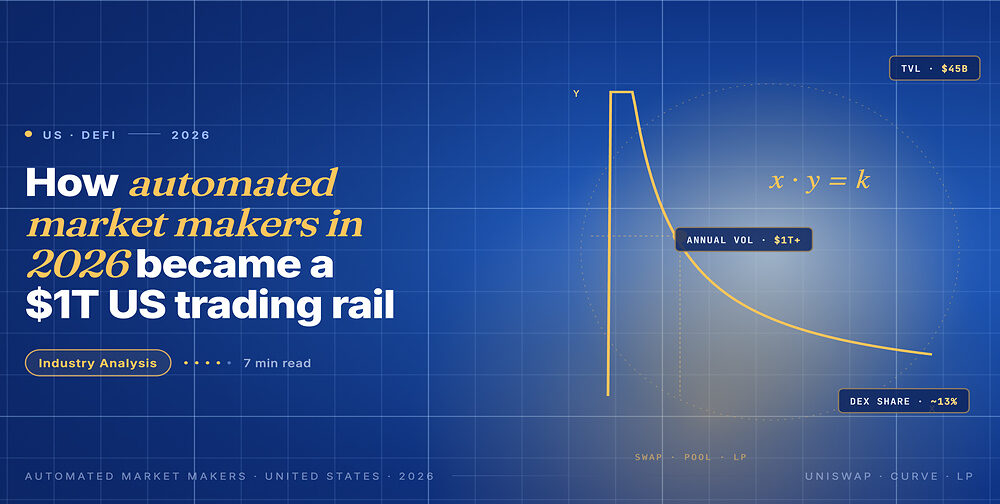
In November 2018, a 25-year-old former Siemens engineer published a 250-line smart contract on Ethereum that let anyone swap one token for another using a constant-product pricing equation. Six years later, the protocols that built on that idea have processed cumulative trading volume in the trillions of dollars and have rewritten how a meaningful share of US crypto liquidity is organised. According to DefiLlama’s DEX dashboard, on-chain spot trading on AMMs now regularly clears more than $50 billion per month, with significant US-resident participation despite the regulatory headwinds.
What an AMM actually is
An automated market maker is a smart contract that holds two or more tokens in a pool and prices trades against the contents of the pool using a deterministic mathematical formula. The original Uniswap v1 model used the constant-product formula x times y equals k, where x and y are the pool reserves and k is a constant. A trader who wants to buy token Y pays in token X; the formula moves the price along a hyperbola so that larger trades pay disproportionately more. Liquidity providers contribute both tokens to the pool and earn a share of fees in return.
Three properties of the original design have proved durable. The contract is non-custodial, so traders retain control of their funds until the moment of swap. The pricing is deterministic, so a trade can be executed against a published formula without an opaque order book. And anyone can become a liquidity provider, so the role of designated market maker is replaced by an open market for capital. Those three properties are what made the model attractive in 2018, and they are the same three properties that make it interesting to regulators in 2026.
The model has evolved. Uniswap v3 introduced concentrated liquidity, where providers choose a price range to deploy capital. Curve specialised the curve for stablecoin-to-stablecoin trades, reducing slippage between assets that should trade close to par. Balancer extended the model to multi-asset weighted pools. Newer designs experiment with dynamic fees, oracle-aware pricing and intent-based routing. None of these replace the original AMM. They each address a specific limitation of the constant-product version while keeping the core insight intact.
The 2025 volume picture
Aggregate AMM volumes have grown from a few billion dollars a month in 2020 to a regular $50-80 billion per month in 2025, with peaks during high-volatility weeks running materially higher. The mix has shifted toward Layer 2 networks and Solana, where lower gas costs make small trades economic. Ethereum mainnet still hosts the largest single-pool concentrations, particularly for stablecoin and high-value pairs. The market structure is not the same as it was in 2021: liquidity is more fragmented across chains, professional market makers play a larger role in fee-tier selection, and intent-based routers increasingly sit between traders and pools.
Concentration is meaningful. A handful of protocols, led by Uniswap, Curve, Balancer, PancakeSwap and a few rising Solana-native venues, account for the dominant share of volume. The top three protocols typically clear more than half of all AMM volume in a given month, with the long tail handling specialised pairs, experimental designs and ecosystem-specific tokens. The concentration is partly a network-effect outcome, partly a regulatory-clarity outcome, and partly a function of which audits and bug-bounty programs the largest market-makers trust.
The shape of liquidity has also changed because of MEV and just-in-time pricing. Aggregators such as 1inch, CowSwap and Matcha now route a meaningful share of retail and institutional flow through batched auctions or RFQ systems that compete against the raw AMM pools. The competition has tightened spreads, pushed sophisticated market makers further into the AMM stack, and produced the slightly counterintuitive result that the visible AMM is increasingly one component of a more complex multi-venue trading system rather than the venue itself.
Where US institutions actually sit
US institutional participation in AMMs is more nuanced than the headlines suggest. Direct trading on a permissionless AMM from a regulated US entity is rare. Indirect exposure is common: market-making firms that provide liquidity to AMMs, prime brokers that route client orders through DEX aggregators, custodians that allow client wallets to interact with whitelisted protocols, and tokenised-asset issuers that use AMMs to maintain secondary-market liquidity for their tokens. The pattern is similar to the way the tokenized US Treasuries market that reached roughly $7 billion in late 2025 have plumbed themselves into existing DeFi liquidity layers, where the regulated asset rides on top of a permissionless rail.
A second institutional channel runs through accredited DeFi platforms, which combine KYC at the wallet level with AMM execution at the protocol level. These platforms have grown faster than the headline numbers suggest because they answer the compliance question without giving up the execution model. The challenge for the next phase of growth is whether US regulators will treat the gated-access wrapper as sufficient or whether they will require a different settlement model entirely, in much the same way why fintech needs to build for federal employee benefits has surfaced new compliance edges in adjacent fintech categories.
How US regulators are framing the question
The Securities and Exchange Commission has, since 2021, taken a hard look at on-chain trading venues. The 2023 amendments to the Exchange Act definition of an exchange were widely read as targeting DEXs, although the final rule’s scope continues to be litigated. The Commodity Futures Trading Commission has separately pursued enforcement against specific DeFi protocols, particularly those offering perpetual swaps that look functionally like the regulated derivatives the agency oversees. The Department of Justice has, in parallel, brought criminal cases against developers of mixers and AMM-adjacent tools, where the alleged conduct goes beyond protocol design.
State-level money-transmitter rules add another layer for any front-end that displays a US-facing user interface. The legal posture has driven several leading DEX front-ends to geo-block US IP addresses while leaving the underlying protocol fully open. The mismatch creates an interesting structural feature: the protocol remains accessible to anyone with a wallet and an RPC endpoint, but the polished user experience built on top is, for US users, increasingly hard to reach without using a third-party aggregator.
The cumulative regulatory signal is that US authorities are not going to ban AMMs as a category, but they are not going to allow them to operate outside the existing securities and commodities framework either. The market has responded with the same compromise visible across fintech: keep the underlying technology permissionless, layer compliance at the access point. The Tornado Cash sanctions, the OFAC posture and the ongoing SEC litigation against Uniswap Labs are the three reference points the industry uses to test the line, and the line is moving in real time as new cases are filed.
| Indicator | Value | Primary source |
|---|---|---|
| Uniswap v1 launch | November 2018 | Uniswap blog |
| Uniswap v3 launch (concentrated liquidity) | May 2021 | Uniswap blog |
| Uniswap v4 launch (hooks) | January 31, 2025 | Uniswap Labs |
| DEX 2024 total spot trading volume | ~$1.76 trillion | CoinGecko Research |
| Uniswap monthly DEX volume October 2025 | approximately $116.6 billion (record) | CoinGecko Research |
Sources linked in the right column.
What comes next for AMMs
The next phase of AMM design is being shaped by three forces. Intent-based architectures are abstracting the pool selection problem away from the trader. Real-world asset liquidity is being built using AMM mechanics on regulated chains, with KYC at the wallet level. And large language model-driven market analysis tools are starting to surface arbitrage opportunities, optimal range placement and pool rebalancing recommendations to human and institutional liquidity providers in something close to real time.
The bigger structural question is whether AMMs become a back-end primitive used by every trading venue or remain a distinct front-end category that retail and crypto-native users choose directly. The current trajectory suggests both. By the end of 2026, a meaningful share of US institutional crypto trading will probably pass through an AMM at some point in the execution chain, even if the trader never sees the pool. That is the same outcome that the original constant-product equation was designed for, even though almost nobody expected it to play out at the scale and inside the regulatory frame the US has built around it.