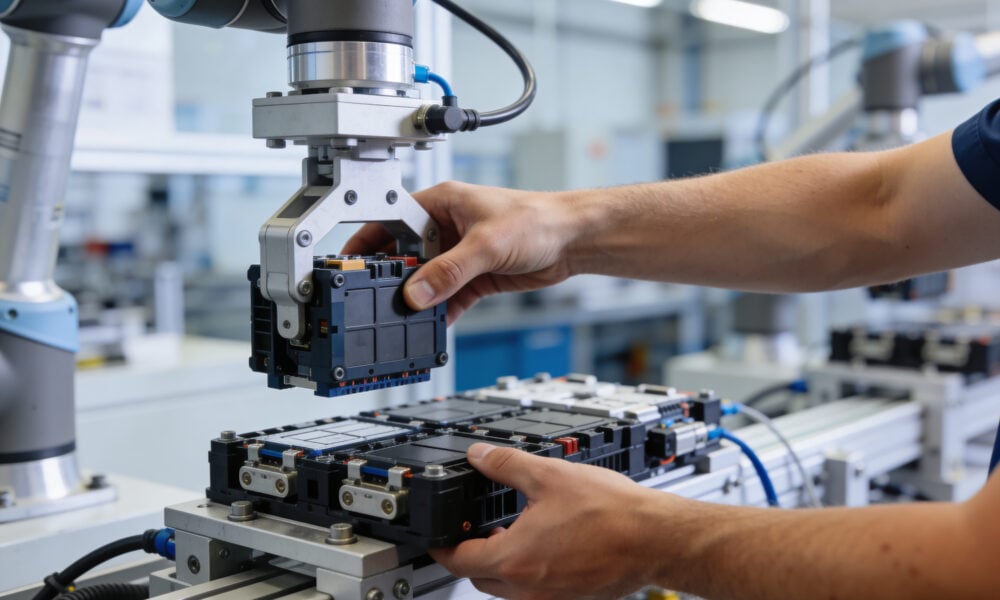
EV battery manufacturing depends on more than electrochemical precision. It also needs utility systems that can maintain dryness, air purity, nitrogen quality and pressure stability across production.
An industrial air compressor and gas support material handling, coating support, pneumatic automation, cell assembly, testing, module assembly and packaging. If these systems are selected only by capacity, pressure or purchase price, the plant can carry contamination risk, leakage, unstable performance and higher energy cost from the start.
In India, this is becoming more important as the PLI ACC scheme pushes domestic battery capacity and large-scale plants move into execution. For EV battery manufacturers, compressor rooms and gas generation systems should be planned around air quality, dew point, gas purity, monitoring, energy use and lifecycle service.
Where Air, Dry Air and Nitrogen Fit in the EV Battery Manufacturing Plants in India
Across the battery production flow, oil, moisture, and particles can create contamination risk and affect tools.
Compressed air, in such cases, supports actuators, valves, material movement, tools, inspection stations and packaging. Inside an EV battery plant, it helps in:
- Pneumatic automation and actuation
- Material handling and transfer support
- Electrode production and coating support
- Cell assembly and controlled production zones
- Testing, inspection and packaging
- Dry-room or low-humidity support
- Nitrogen blanketing, purging or inerting where required
That is why an industrial compressed air system should be mapped before equipment is selected. For EV battery plants, this means defining ISO 8573-1 air quality classes, pressure, flow, pressure dew point, nitrogen purity and contamination sensitivity by application.
| The planning becomes even more important in India, where battery manufacturing is moving from policy intent to plant execution.
● The Ministry of Heavy Industries’ PLI ACC scheme targets 50 GWh of domestic advanced chemistry cell capacity with an outlay of ₹18,100 crore. ● PIB reported in February 2026 that 40 GWh had already been awarded. ● Globally, IEA’s Global EV Outlook 2026 places EV battery deployment at around 1.2 TWh in 2025. |
As plants scale, compressed air and gas systems cannot be treated as background utilities. They need to be designed as a connected production support network that protects air quality, gas supply, pressure stability, uptime and energy performance.
| To understand how air purity is classified, read Atlas Copco’s guide on the ISO 8573 air quality standard. |
Key Compressed Air and Gas System Requirements for EV Battery Plants
EV battery plants often carry high utility loads because they depend on automation, dry rooms, compressed air, dry air and nitrogen. Clean and dry rooms can account for 25% to 60% of total energy demand, depending on cell chemistry requirements.
To endure this, the right industrial air compressor should be selected around demand profile, air quality, pressure stability and energy performance. For example:
- In sensitive areas, an oil free air compressor can reduce source oil risk.
- In utility areas, oil-injected compressors may still fit if the treatment package and application allow it.
| Planning for Indian EV Battery Plants
Indian battery manufacturers have to plan for humidity, dust, high utilisation, energy cost, future scale-up and local service response. A system that works during commissioning may not remain efficient after the plant adds more lines, longer shifts or higher throughput. Compressor room planning for new plants or expanding existing facilities in India should start with application mapping: ● Step 1: Define the real demand profile ● Step 2: Check pressure losses ● Step 3: Estimate dryer load ● Step 4: Plan air receivers and piping early ● Step 5: Build monitoring into the system so pressure drops, leakage, alarms and service conditions are visible before they affect production |
How Atlas Copco Supports EV Battery Manufacturing in India
Atlas Copco supports EV battery manufacturers as a complete compressed air solutions and gas systems partner. Its services include a wide variety of:
- Oil-free and oil-injected compressors for stable air supply
- Desiccant dryers for dew point control
- Filters for particle and oil aerosol control
- Air receivers
- On-site nitrogen generation
- AIRnet piping to reduce leakage and pressure loss
- Central controllers
- SMARTLINK monitoring for alarms, pressure drops, and service visibility
- AirScan, Airchitect, and lifecycle support
All of air quality, dew point, nitrogen purity, pressure stability and service planning directly influence how reliably the plant can run as production scales. Once these elements are planned together, the right compressed air solutions can support cell quality, energy efficiency, uptime and long-term production cost.
Planning a new EV battery plant or scaling an existing line?
Speak to our experts today to map your requirements correctly.
FAQs
1. Should EV battery plants use a central or decentralised compressed air setup?
Most battery plants use a central industrial compressed air system for efficiency, with point-of-use treatment where stricter dryness or purity is required near sensitive processes.
2. How much redundancy should an EV battery plant plan for?
Battery plants should avoid single-point utility failure. A standby industrial air compressor, backup dryer capacity and service access help protect production during maintenance or sudden demand peaks.
3. When does a battery plant need a process gas compressor?
A gas compressor is needed when gas must be compressed for specific pressure, purity or process conditions beyond standard nitrogen gas generator supply.







