
Share
Share
Share
Share
Turkey has become one of the world’s most established destinations for hair transplantation. Every year, patients travel to Istanbul looking for experienced medical teams, modern techniques and treatment packages that are often more accessible than those available in Western Europe or North America. Yet as the number of providers has grown, choosing the right clinic has also become more complicated.
Many clinics appear similar at first glance. They promote large graft numbers, use familiar terms such as FUE and DHI, and offer packages that include accommodation and transportation. The real difference, however, is often found in the details: how the patient is assessed, who plans the procedure, how the donor area is managed and how much time the medical team can dedicate to each case.
What Does a Boutique Hair Transplant Clinic Mean?
The word “boutique” is sometimes used simply as a marketing phrase, but in hair transplantation it should describe a practical difference in how a clinic operates.
A boutique model does not focus on carrying out the highest possible number of procedures each day. Instead, the number of patients is kept controlled so that the team can spend more time on consultation, hairline design, graft preparation and implantation.
This is important because hair transplantation is not a standard procedure that should look identical for every patient. Each person has a different pattern of hair loss, donor capacity, hair calibre, scalp condition and facial structure. A treatment plan that works well for one patient may not be appropriate for another.
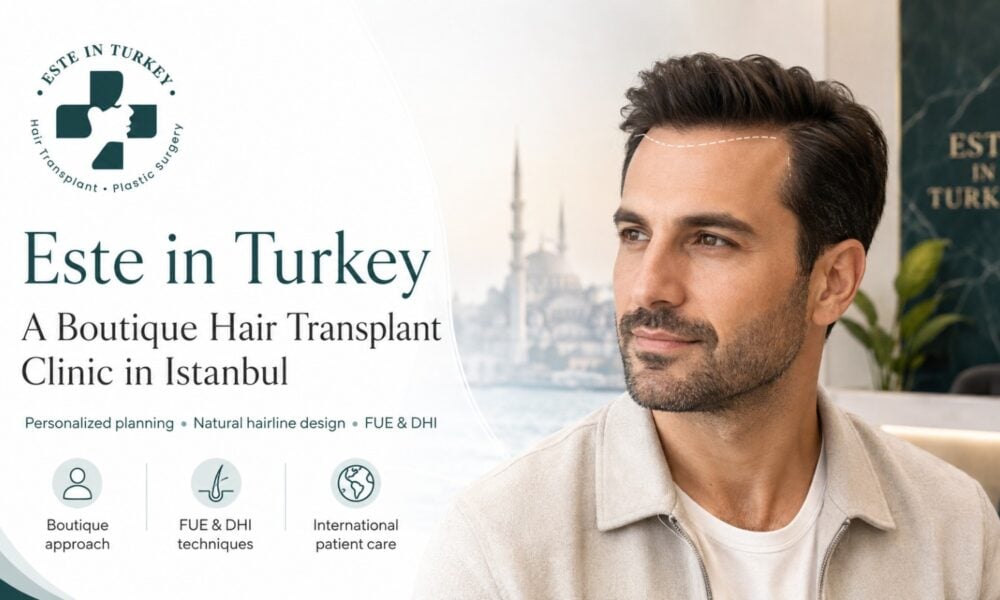
Este in Turkey’s approach is based on reviewing these differences before determining the number of grafts, the implantation technique or the final hairline design. The objective is not simply to complete an operation, but to create a plan that makes responsible use of the available donor hair.
Personalised Planning Before the Procedure
A successful hair transplant begins before the first graft is extracted.
During the consultation and planning stage, the medical team evaluates the donor area at the back and sides of the scalp. The density, thickness and distribution of the hair are considered alongside the size of the recipient area.
Future hair loss also matters. A young patient may still have progressive thinning behind the transplanted area, while an older patient may present a more stable pattern. Designing an unnecessarily low or dense hairline without considering future changes can make the result difficult to maintain over time.
For this reason, responsible planning often involves balance. The hairline should complement the patient’s facial proportions while preserving enough donor capacity for possible future needs.
Patients can learn more about the clinic’s identity, treatment philosophy and international patient services through the official About Este in Turkey page.
Natural Hairline Design
The hairline is usually the first part of a hair transplant result that people notice. It frames the face and can determine whether the outcome appears natural or visibly surgical.
Natural hairlines are not perfectly straight. They contain small irregularities, subtle changes in direction and a gradual increase in density behind the frontal rows. The angle of the hairs also varies depending on the area of the scalp.
A hairline should therefore be designed for the individual rather than copied from a standard template. Forehead height, facial shape, age and existing hair growth all influence what will look appropriate.
Single-hair follicular units are generally preferred along the first rows because they create a softer transition between the forehead and the transplanted area. Follicular units containing two or more hairs can then be placed further behind to improve coverage and visual density.
The aim is not to create a perfectly symmetrical line. It is to recreate the controlled irregularity seen in natural hair growth.
FUE and DHI Hair Transplantation
Este in Turkey offers treatment planning for both FUE and DHI hair transplantation.
With FUE, follicular units are extracted individually from the donor area. Small channels are then created in the recipient area before the grafts are implanted. The direction, depth and angle of these channels play an important role in the final appearance.
DHI also begins with the individual extraction of follicular units. The difference is primarily found in the implantation stage, where grafts are placed using specialised implanter pens.
Neither technique should automatically be considered superior for every patient. The appropriate method depends on factors such as the size of the treatment area, the condition of the existing hair, the number of grafts required and the type of result being planned.
In some cases, FUE may be more suitable for covering a wider area. DHI may be preferred when working between existing hairs or when more direct control during implantation is considered useful. The final recommendation should come from the patient’s individual assessment rather than from the popularity of a technique.
Careful Management of the Donor Area
The donor area is a limited resource. Once follicular units have been removed, they do not regenerate in the same location. This makes donor management one of the most important parts of a hair transplant.
A very high graft number may sound attractive, but extracting more grafts than the donor area can safely provide may cause visible thinning or an uneven appearance at the back of the scalp.
Boutique treatment planning places emphasis on how the grafts are distributed during extraction, not only on how many are collected. The team must consider the density that will remain in the donor area after healing, as well as the possibility that the patient may need another procedure in the future.
The best graft count is therefore not necessarily the highest possible number. It is the number that provides meaningful coverage without unnecessarily weakening the donor region.
Graft Preparation and Placement
The work carried out between extraction and implantation is rarely visible to the patient, but it can influence the quality of the final result.
After removal, follicular units need to be examined, organised and protected until they are implanted. Different grafts may contain one, two, three or more hairs, and each type has a particular role in the design.
Single-hair grafts are useful for the frontal transition. Multi-hair grafts are generally more effective in areas where additional density is required. Sorting grafts carefully allows the medical team to place them according to their structure rather than treating every unit in the same way.
Implantation also requires attention to direction and angle. Even a dense transplant may look unnatural when the hairs are placed too upright or when their direction does not match the surrounding hair.
This is where careful preparation and an individual plan become as important as the technique itself.
An Organised Experience for International Patients
Travelling abroad for a medical procedure involves more than choosing a surgeon or treatment method. Patients also need clear communication, airport transfers, accommodation arrangements and guidance before and after the operation.
Este in Turkey works mainly with international patients and structures its services around the needs of people travelling to Istanbul. The patient journey typically includes pre-procedure communication, local transfers, hotel coordination, the operation itself and follow-up instructions.
Clear expectations are particularly important. Patients should understand what the first days of recovery may look like, when the transplanted hair is expected to shed and how long it usually takes for new growth to become visible.
A hair transplant develops gradually. Early changes should not be confused with the final outcome, which generally requires patience and long-term follow-up.
Quality Over Volume
The appeal of a boutique clinic lies in the idea that each patient should be treated as an individual case rather than as another appointment in a crowded schedule.
For Este in Turkey, this means combining modern FUE and DHI techniques with controlled patient volume, personalised hairline planning and responsible donor management.
Price and graft count will always be part of the decision, but they should not be the only factors. Patients should also consider who designs the hairline, how the donor area will be protected, how the grafts will be handled and what kind of support will be available after the procedure.
A natural-looking hair transplant is built through many small decisions. The technique matters, but so do planning, preparation, placement and communication. This is the foundation of Este in Turkey’s boutique approach to hair transplantation in Istanbul.
Read More From Techbullion