A founder can have a product idea, a customer to win, and a campaign ready to launch, yet still spend the day moving information between tools. The constraint is not another idea. It is getting enough useful work finished at the same time.
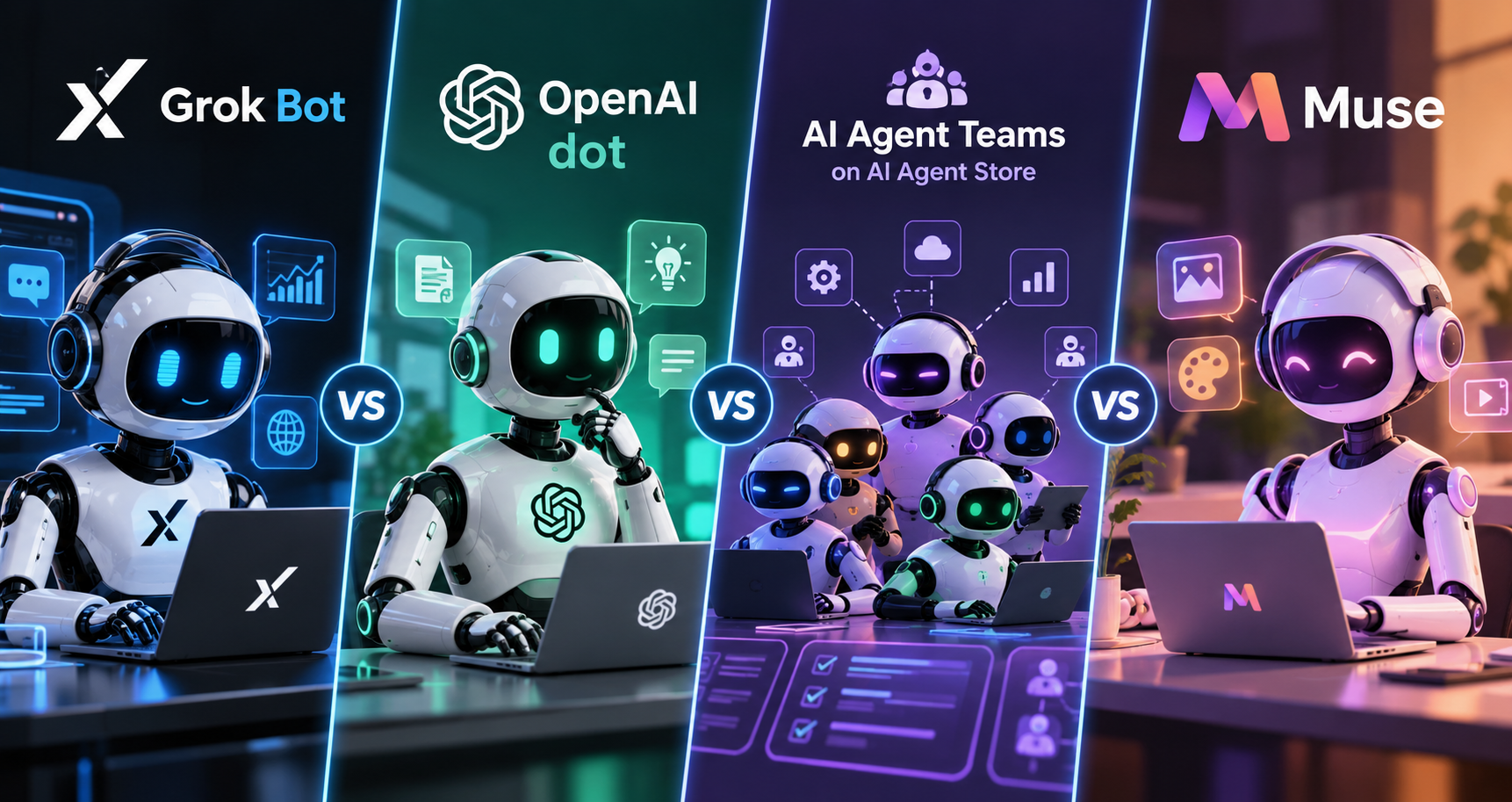
That is the useful lens for comparing Grok Bot, AI Agent Teams on AI Agent Store, OpenAI dot, and Muse. For creators, solo founders, and small startup teams, the question is not just which agent answers best. It is how much work can keep moving without the founder personally operating every step.
A developer that ships a working improvement, a publisher that keeps a content operation running, and a customer agent that resolves routine requests offer a different kind of leverage from an assistant that produces suggestions. The opportunity is to give a small team more capacity to execute, test ideas, and learn from the market.
Grok Bot offers persistent named coworkers that use a cloud computer and coordinate work. AI Agent Teams combines separately configured OpenClaw and Hermes workers in a shared workspace. OpenAI dot carries ongoing responsibilities through ChatGPT and can delegate to Work or Codex. Meta positions Muse as a personal agent that pursues goals through connected tools and its own cloud computer.
All four go beyond chat. The case for Agent Teams is not that its competitors cannot act. It is the combination of autonomous workers, harness and model choice, accessible files, team coordination, and reporting that can include agents hosted elsewhere.
The company’s own comparison of AI agent platforms documents that combination. For a founder building an operation around several specialists, these are practical choices about how the work runs, not just extra settings on a feature list.
AI Agent Store describes its default approach as maximizing practical autonomy. The intention is for agents to pursue assigned goals, use their tools, and complete the work, rather than ask the owner to approve every ordinary step.
OpenClaw and Hermes provide the execution underneath: planning, tool use, saved context, scheduled work, and supported delegation. Agent Teams supplies the persistent workspace and coordination around them.
For a founder, the useful instruction becomes “run this publishing workflow” rather than “suggest a content calendar.” The owner establishes the objective, available accounts, spending limits, and exceptions once. Within that remit, the agent acts. A genuine access problem or a decision outside the brief is an interruption; routine execution should not be.
Autonomy does not require removing quality checks. A developer can run tests and fix failures itself. A publishing worker can check sources and links before publishing. The checks become part of the job, not another daily approval queue for the founder.
A model supplies the reasoning; a harness is the software that turns that reasoning into an ongoing worker. It manages tools, memory, conversations, and the repeated steps needed to get something done.
OpenClaw began as Peter Steinberger’s project in November 2025, went through the Clawd and Moltbot names, and adopted the OpenClaw name in January 2026. Its original announcement describes an open agent platform that runs where the user chooses and works through familiar messaging services. Its appeal is extensibility: connect tools, add skills, and shape an agent around the work instead of being limited to a fixed chat experience.
Nous Research developed Hermes Agent with a particular emphasis on learning from experience. It can retain knowledge, search earlier conversations, create and refine reusable skills, run scheduled jobs, and delegate to subagents. A worker can preserve a useful procedure and reuse it on the next assignment rather than start from scratch.
Agent Teams hosts both while retaining their native tools, schedules, and interfaces. The benefit is access to these capable open agent environments without making server maintenance the founder’s next project.
A startup does not need every specialist to use the same setup. An OpenClaw growth worker might use an existing publishing skill and messaging integration. A Hermes research worker might build a reusable process for investigating customer demand. Either harness can support many roles; the point is choosing, not assigning rigid job categories.
Model choice is separate. Use a strong coding model for development, a model that suits the brand’s writing style for content, and a lower-cost option for repetitive categorization. Change one worker’s setup without forcing the entire team to migrate.
Agent Teams supports Platform Credits, provider API keys, and eligible native subscription connections. Available models, reasoning settings, and subscription connections depend on the selected provider and harness. Supported account failover can also help a recurring worker continue when an eligible account reaches its quota.
For a small team, this freedom is both creative and economic: experiment with a different approach where it matters, retain combinations that work, and avoid paying for maximum reasoning on every routine action.
A beginner can describe a job in plain language and generate editable setup files, or adapt a Starter Kit. An experienced user can bring existing instructions and configuration. The extra control is available without making it the first thing every user must learn.
A useful first brief could be: “Run the publishing operation for this product. Research our audience’s questions, produce source-backed articles, publish them to our connected site, share them through our business channels, and report what attracted readers. Improve the next cycle using those results.”
The required accounts and tools still need connecting. Once that setup is complete, the worker has an ongoing responsibility, not a single document to return.
Once accounts, tools, and standing instructions are connected, a founder can organize autonomous workers around complete business processes. Consider these example roles.
An autonomous product developer can take a scoped item from the backlog, modify the code, run tests, fix failures, deploy through the configured release process, check the live result, and update the task record. A testing worker can exercise the changed flow and send reproducible failures back to the developer. The handoff ends with a working change, not instructions for the founder to implement.
An autonomous publishing worker can research a topic, check its sources, write and format the article, publish it in the connected content system, distribute it through authorized channels, and log the published links. On its next scheduled run, it can examine available engagement data and adjust the following topic or format. The founder supplies expertise and direction without having to press Publish on every item.
An autonomous customer worker can answer inbound questions using the product’s current documentation, send onboarding instructions, resolve known issues through connected tools, record recurring problems, and create tasks for the developer. For an unfamiliar case, it can investigate the account and consult another worker, escalating when the issue needs information or authority outside its remit.
A growth worker can turn interested inbound leads into an active pipeline: answer product questions, send relevant examples, arrange calls, follow up on open conversations, and record the outcome. Where several workers handle outreach, shared contact history and recipient reservations help prevent them from approaching the same person independently.
These workers can operate while the founder is designing the next product or talking to customers. Hosted agents continue after the laptop closes and retain saved memory, files, and browser state. Recurring schedules require the relevant agents to remain running, with sufficient hosting and model capacity.
Parallel workers lose much of their value if the founder must carry every message between them. Agent Teams provides shared tasks, roles, operating notes, and direct agent-to-agent communication.
A customer worker can report a recurring onboarding problem. A coordinator can assign a fix. A developer can implement it, a testing worker can verify it, and the customer worker can notify affected users. The founder does not need to turn each transition into a new prompt.
TechBullion’s earlier article on how to manage AI agent teams addresses this coordination problem. The practical goal is not a larger collection of chats. It is a group of workers that can exchange useful context and keep a process moving.
Shared files make that possible. Product facts, positioning, customer research, pricing, and working datasets can be available to the roles that need them. Owners can inspect, edit, search, and download the underlying material instead of relying on an agent’s summary. Version history, restore, and edit-conflict controls help preserve useful work as several specialists contribute.
For a creator changing a product’s positioning, updating the shared brief can inform the next round of work without manually explaining the change in every chat. Separate agent workspaces retain specialist context, while encrypted credential assignments keep connected services available to the right workers.
For a startup, the important question is what the extra activity produces. Publishing volume, customer responses, qualified conversations, meetings, and completed product improvements are more useful signals than how long an agent appears busy.
Agent Teams includes social and outreach dashboards with filters, comparisons, underlying records, and CSV export. An agent can also propose a custom dashboard for a different workflow, such as product tests, support resolution, or releases. Once its reporting definition is approved, workers can log activity as part of their ongoing jobs.
A founder could compare two growth approaches over the same period, inspect which conversations led to meetings, and redirect effort toward the better-performing audience. These are agent-reported records, so meaningful comparisons require consistent reporting and linked outcome data.
Importantly, a worker does not have to be hosted on Agent Teams to appear in those reports. A compatible outside agent can receive setup instructions in one message and report its activity alongside hosted workers. An existing agent on a founder’s server can remain there rather than be rebuilt just to share a dashboard.
External reporting requires an active plan and compatible reporting calls. It adds visibility, not remote control of the outside worker. That makes the platform useful for people assembling their own mix of tools rather than moving everything into one vendor’s environment.
Chat Wall brings up to eight conversations into one view, with saved layouts, search, and controls for queued work. A founder can keep the developer, publisher, and customer worker visible together without mixing their contexts.
Voice Manager offers a different way to check in: “What shipped today? Which campaign brought replies? What is blocking the launch?” It can retrieve saved tasks, files, activity, usage, and dashboard records, then help with supported management actions. Voice dictation, spoken replies, and mobile-friendly access make it possible to redirect work away from the desk.
That visibility is most useful when it reduces interruptions. The founder checks progress and changes priorities; the workers continue executing. A blocker queue collects specific issues that genuinely need attention instead of turning every task into a conversation.
Persistent browser sessions let an agent return to its connected services. Live Agent Desktop exposes the actual browser, terminal, and workspace, so an owner can inspect a problem or complete a login challenge and return control without rebuilding the task. Supported WhatsApp, Telegram, and Slack gateways provide additional communication channels.
Optional static residential IPs give recurring browser workers a consistent selected network address. Access still follows each website’s own policies and account requirements.
Clean setup cloning lets a founder reuse starting instructions for another product without copying private conversation history or connected gateway sessions. Backups, file recovery, supported runtime rollback, and diagnostics make experimentation easier to recover from. Compatible external AI clients can also receive scoped access to help inspect or repair a setup.
A cofounder or colleague can join the workspace rather than receive screenshots of progress. Hosting, model usage, and optional services are separately metered, so the useful budget is the cost of completed work and the founder time it saves—not the largest possible agent count.
For a software startup, one possible structure places a human founder above a CEO-style coordinating agent. The founder defines the market, product direction, and resources. The coordinator maintains priorities, assigns work, and follows results. A developer and testing worker ship improvements; a growth worker publishes and runs acquisition experiments; a customer worker handles onboarding and support. A communicator consolidates results and brings the founder decisions that change direction.
Consider an onboarding problem discovered by the customer worker. It becomes a development task, a tested release, an updated help page, and a message to the affected users. The coordinator tracks the cycle while the founder continues interviewing customers. That is a concrete way to shorten the distance between feedback and a live improvement.
For a creator or small product studio, the structure can be different. A human creative lead chooses themes and offers. Research workers investigate audience needs; production workers create and publish content or digital products; a distribution worker manages connected channels; a customer worker handles inquiries; an analytics worker reports which topics and offers convert. A coordinator reallocates the next round of work within the agreed priorities.
Each product can have its own owner agent while sharing specialist workers and reporting. An OpenClaw distribution worker and a Hermes researcher can contribute to the same launch, each using a model suited to its job. Existing outside agents can contribute statistics without changing where they run.
Neither structure needs to begin with every role. A founder can start with the worker that removes the largest recurring bottleneck, then add specialists when parallel execution has a clear purpose. The aim is more completed work, not an elaborate organization chart.
Grok Bot, OpenAI dot, and Muse remain relevant when their integrated environments suit the work. Agent Teams makes a particularly strong case for founders who want autonomous specialists they can shape: different harnesses, different models, inspectable files, connected tools, and shared reporting across their chosen setup.
A beginner can start with a job description. A power user can refine the machinery behind each worker. Neither has to treat autonomy and visibility as opposites.
For a creative founder or lean startup, the ambition is not to spend the day supervising more AI conversations. It is to keep products improving, content reaching people, and customers receiving help while the human team concentrates on the ideas and decisions that determine what to build next.