Share
Share
Share
Share
Every ecommerce seller eventually runs into the same wall: product images. A single professional photoshoot requires a studio, a photographer, lighting equipment, and — for fashion and accessory brands — models. Multiply that by a catalog of 200 SKUs, four seasons, and three target markets, and the cost of “just getting good photos” can quietly exceed the cost of the products themselves.
The bottleneck is not just money. It is time and repeatability. When a marketplace listing needs a white-background shot, a lifestyle scene, and an on-model variant, traditional production means three separate setups. When a seasonal campaign needs a refresh, it means booking the studio again.
This is where a shift is happening. Over the past two years, image generation models have moved from party tricks to production tools, and one category in particular has matured fast: AI product photography.
-
What AI Product Photography Actually Does
The core capability is image-to-image generation, not text-to-image. Instead of asking an AI to invent a product from scratch — which no serious seller should do — you upload an existing product photo, typically a flat lay or a white-background shot. The model preserves the product’s shape, color, and proportions, and regenerates everything around it: the background, the lighting, the scene, and optionally a model wearing or holding the product.
This distinction matters because product fidelity is everything in ecommerce. A lifestyle image that subtly changes the shade of a garment or the geometry of a handbag creates returns, refunds, and mistrust. The current generation of product-focused workflows is built specifically to keep the product pixel-faithful while replacing its surroundings.
In practice, this means one uploaded photo can become:
- White-background catalog shots sized for marketplace listings
- Lifestyle scenes that place the product in a kitchen, a city street, or a holiday setting
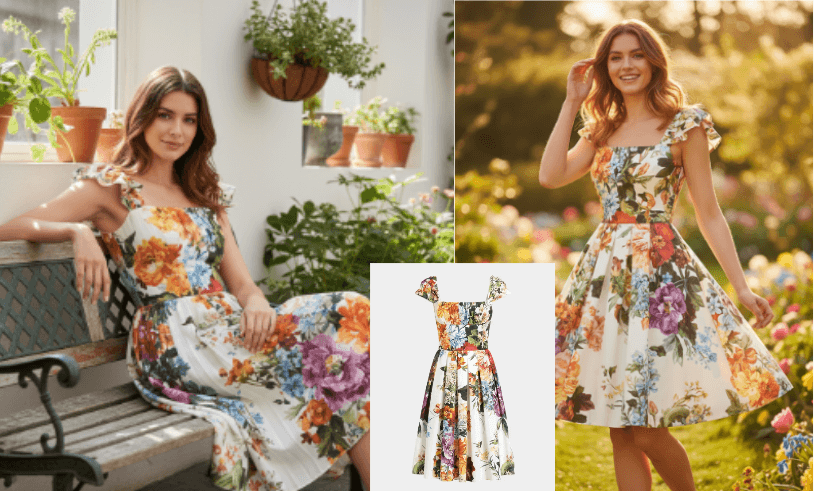
- On-model fashion photos without hiring a single model
- Seasonal and regional variants for different campaigns and markets
-
The Economics: Why Sellers Are Switching
Traditional product photography carries a fixed cost structure: studio rental, photographer day rates, model fees, and post-production — all paid per shoot, regardless of how many images you ultimately use. If a product flops, the photoshoot spend is sunk.
AI product photography inverts this. Costs scale per generation rather than per shoot, which changes the math in three concrete ways:
- Testing becomes cheap. Dropshippers and new brands can validate products with professional-looking imagery before committing to inventory or a studio budget.
- Catalog scaling stops hurting. Adding lifestyle variants for an entire catalog no longer means scheduling additional shoot days — variations come from the same source image.
- Campaign turnaround compresses from weeks to minutes. For seasonal pushes and fast-moving trends, image generation in seconds to minutes makes same-day creative updates realistic.
None of this means traditional photography is dead. Hero brand campaigns and flagship imagery still benefit from a human photographer’s art direction. What changes is the long tail: the hundreds of functional images a store needs for listings, categories, and A/B tests.
-
Where AI Product Photos Fit in the Ecommerce Workflow
The clearest adoption patterns are emerging in four areas:
Marketplace listings. Amazon and similar marketplaces reward listings with a clean primary image and supporting lifestyle and infographic images. AI workflows can produce the white-background main shot and contextual secondary images from the same source photo. Sellers should still verify output against the marketplace’s latest image requirements before publishing.
Fashion and apparel. Turning flat garment shots into on-model photos is the most established use case. Brands describe the model type, age range, and look they want, which also makes diverse representation achievable without organizing separate photoshoots for every market segment.
Jewelry and accessories. Small products like rings, watches, and bags are notoriously hard for generic generators — fine edges, reflections, and material texture get lost. Product-specific workflows now handle these explicitly, preserving the specular detail that makes luxury items look premium.
Multi-market localization. Selling into the US, Europe, and Asia traditionally meant regional shoots with regional models. With described generation, the same product can be re-rendered with locally appropriate settings and styling.
-
How to Create AI Product Photos: A Simple Workflow
The tools in this space have converged on a remarkably simple three-step pattern. DeepKolor, an AI agent for product photography, is one example of how accessible this has become — the entire flow is upload, describe, and download:
- Upload your product image. A flat lay or white-background photo is enough. It works across fashion apparel, jewelry, shoes, accessories, and general ecommerce products.
- Describe the shot you want. Lifestyle scene, model type, background setting, lighting style, brand aesthetic — in plain language, or via templates tuned for fashion, jewelry, and lifestyle photography.
- Generate and download. High-resolution output arrives in seconds to minutes, ready for Shopify, Amazon, or a product catalog.
For sellers who want to explore this, DeepKolor’s AI product photography tool is free to try, and no design skills are required — the barrier to entry is the ability to describe a photo, not to edit one.
-
What AI Product Photography Still Can’t Do
A balanced picture requires the limitations:
- Full creative direction is still human work. The AI executes a described vision; it does not invent a brand identity.
- Quality varies by product category. Reflective, translucent, and highly detailed items demand more prompt iteration than boxed goods.
- Compliance is the seller’s responsibility. Marketplaces update image policies regularly, and commercial usage rights depend on the tool’s plan terms — both need checking before a large rollout.
Treat AI product photography as a production multiplier for functional imagery, not a replacement for brand-level creative strategy.
The unit economics of ecommerce content have fundamentally changed. When a professional-grade lifestyle image costs a few credits instead of a few hundred dollars, the constraint on catalog quality is no longer budget — it is imagination. Sellers who build AI product imagery into their standard workflow now will compound that advantage as the models continue to improve.






