
Share
Share
Share
Share
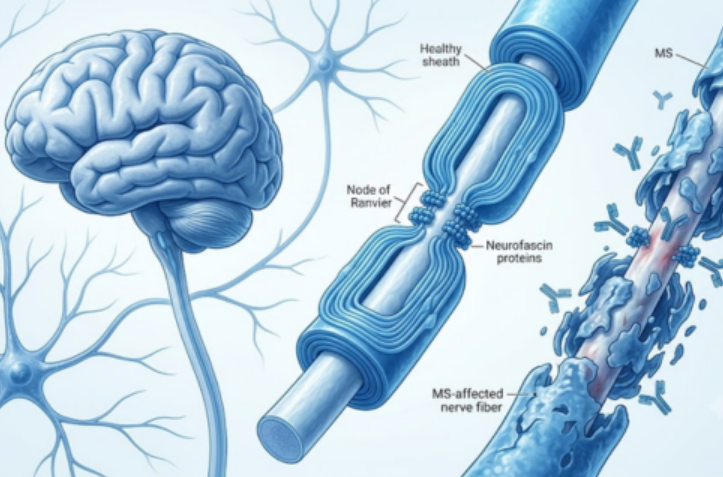
Myelin is a fatty, protective substance that surrounds and insulates the axons of many nerve cells (neurons). It is similar to the plastic insulation around an electrical wire. Its primary job is to help electrical signals travel quickly and efficiently through the nervous system.
Myelin helps:
- Increase the speed of nerve signals
- Protect the underlying axon
- Support efficient communication between the brain, spinal cord, and body
- Help nerve impulses travel over long distances without losing efficiency
However, when the immune system mistakenly attacks components of the central nervous system, inflammation and damage occur to myelin. As a result, the signals travel relatively slowly along the axon. This condition is known as multiple sclerosis.
A person with MS can experience numbness, weakness, vision problems, balance difficulties, muscle stiffness, or other neurological symptoms, depending on the affected region of the brain. That is why early diagnosis is crucial. Here is where the anti-NF140 ELISA kit comes into play.
What is Anti-NF140?
NF140 stands for neurofascin 140. It is a neuronal isoform of the cell-adhesion molecule neurofascin. It is found at the nodes of Ranvier (small gaps between sections of myelin) that support rapid transmission of nerve impulses.
Proper organization of these nodal gaps is crucial for effective neuronal communication. However, inflammation and damage to myelin can alter the axonal structure. Since NF140 is associated with the node of Ranvier, disruption in axonal structure also affects the NF140 levels. As a result, the immune system produces autoantibodies.
Researchers use anti-NF140 antibodies to recognize NF140 autoantibodies, which further help them understand the underlying disease mechanisms.
What is ELISA?
ELISA stands for enzyme-linked immunosorbent assay. It is a plate-based technique used to detect and quantify the presence of analytes in a biological sample. An analyte can be a protein, cytokine, antibody, antigen, etc.
It works by antigen-antibody interactions. It is known for:
- High specificity
- High sensitivity
- Compatibility and versatility
- Affordability
- Fast results
Researchers use anti-NF-140 ELISA kits to detect the presence of NF-140 protein in the sample. It is specifically designed to bind to NF-140.
Role of Anti-NF140 ELISA Kit in MS Research
Investigate Autoimmune Mechanisms in MS
Researchers use Anti-NF140 ELISA kits to study the autoimmune component of demyelinating disease.
MS involves complex interactions between immune cells, inflammatory pathways, myelin, neurons, and glial cells. Researchers measure antibodies against specific neural proteins, which can be further used to investigate whether particular immune responses occur more frequently in certain patient groups.
Anti-NF140 measurements can therefore be incorporated into studies examining:
- Autoantibody profiles in MS
- Nodal and paranodal immune responses
- Differences between patient subgroups
- Relationships between antibody levels and disease characteristics
- Potential mechanisms underlying axonal and neuronal dysfunction
This helps scientists better understand the heterogeneity of MS.
Compare Anti-NF140 Levels Between Study Groups
ELISA-based measurements can also help researchers compare anti-NF140 antibody levels across different populations.
For example, a study may compare samples from:
- Patients with confirmed MS
- Patients with other demyelinating disorders
- Healthy control participants
- Patients experiencing relapse
- Patients in remission
Researchers can analyze differences in antibody concentrations or positivity rates between these groups. Statistical analysis can then determine whether observed differences are meaningful.
This type of experimental design can help investigate whether anti-NF140 antibodies are associated with particular clinical or biological characteristics of MS.
Study Different MS Phenotypes
MS does not follow the same course in every patient. Some individuals experience relapses followed by periods of recovery, while others develop progressive neurological disability.
That is why researchers focus on biomarker research and identify measurable biological signals associated with disease activity and progression. Neurofilament biomarkers, particularly neurofilament light chain (NfL), have received substantial attention because elevated levels can reflect neuroaxonal injury. Recent systematic evidence has linked higher serum NfL levels with disease activity, future relapses, MRI lesions, and progression.
Anti-NF140 represents a different type of biomarker: rather than measuring axonal injury directly, it measures an immune response directed against a nodal protein. That is why researchers study both types of biomarkers. This provides them complementary information about inflammation, autoimmunity, and neuronal injury.
Support Biomarker Research
Biomarkers can help researchers understand disease biology and evaluate potential relationships between molecular changes and clinical outcomes.
Anti-NF140 ELISA measurements can be combined with other experimental data, including:
- MRI findings
- Neurological assessments
- Other autoantibody measurements
- Neurofilament measurements
- Inflammatory biomarkers
- Treatment-response data
This can provide a more comprehensive picture of MS biology than relying on a single laboratory measurement.
Moreover, current evidence does not establish anti-NF140 as a standalone diagnostic marker for MS. Studies of neurofascin antibodies have also highlighted challenges involving assay sensitivity, specificity, and interpretation.
Recent inter-laboratory work found variability among neurofascin antibody testing methods. This reinforces the need for standardized assays and appropriate confirmatory testing.
Evaluate Potential Treatment-Related Changes
Researchers investigate whether anti-NF140 antibody levels change over the course of disease or following treatment.
They collect samples at multiple time points and compare antibody concentrations before and after an intervention. If antibody levels change alongside clinical or biological measures, this may provide clues about the relationship between the immune response and disease activity.
However, such findings require careful interpretation. A change in antibody concentration does not necessarily mean that disease activity has increased or decreased. So, anti-NF140 measurements should be evaluated alongside established clinical and laboratory measures.
Now that you know how anti-NF140 ELISA kits help in MS research, what are you waiting for? Find a reliable supplier to buy high-quality kits to ensure you get accurate and reproducible results.





