Finding qualified people for open roles is still the hardest part of a recruiter’s week, and it gets harder the more technical the role. Post a senior backend position and the applicant queue fills with people who are not close. The engineers you actually want are employed, shipping, and not reading job boards. Waiting for them to apply is not a strategy. It is a filter, and it removes exactly the people you were looking for.
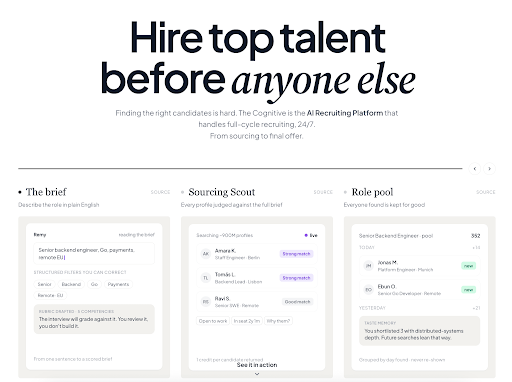
A one-line hiring brief, its requirements marked must-have or preferred, and three candidates ranked against it.
What Candidate Sourcing Means for Modern Hiring
Candidate sourcing is the process of searching for, identifying and contacting potential candidates who have not applied for an open position. Traditional recruiting relies on inbound applications. Sourcing in recruitment is outbound: research first, then direct engagement. It is also called talent sourcing, and the person who does it full time is a sourcer. A talent sourcer finds and engages people; a recruiter takes them from first conversation to offer. Small teams combine the two jobs. Mature teams split them, because the skills are different. An executive search firm sells the same discipline as headhunting, at agency prices.
The distinction from inbound hiring is structural, not cosmetic. An applicant has already decided your company is worth their time, so you screen them. A sourced candidate has decided nothing, so you have to earn a reply. How you search, what you say and how fast you move are all different, and treating sourced people like applicants is the most common reason outbound recruiting fails.
Done well, candidate sourcing turns hiring from a reactive rush into a continuous talent acquisition strategy. When a job requisition opens, a well-sourced pipeline already holds people who match, which cuts time-to-hire and lowers cost per hire without touching the quality bar. Instead of sorting hundreds of unqualified resumes from a job board posting, the recruiter starts from a short list of people who have the exact skills, seniority and background the role needs.
The Power of Passive Candidate Recruitment
What is a passive job seeker? Someone who is employed, not actively looking, and would still consider the right opportunity if approached directly. They are not polishing a resume, not on a job board, and not in your inbound funnel. In engineering that describes a large share of the people worth hiring: a competent backend engineer 18 months into a job they were recruited for, who just merged something significant and is not thinking about leaving.
Passive candidate sourcing is how you reach that group, and it is where the quality is. It also needs a different mindset from reviewing applicants. Active applicants sell themselves to you. With passive candidates, you sell the company and the role to them. A good sourcer studies the person’s trajectory, notices what they have actually built, and writes a message that explains why this role fits where they are going. A generic pitch to a passive candidate gets no reply, which is why the tooling problem and the outreach problem turn out to be one problem.
Proven Recruitment Sourcing Techniques
Building a strong talent pipeline takes more than typing a job title into LinkedIn Recruiter. These are the candidate sourcing techniques that work for technical roles, with the point at which each one stops scaling.
Boolean Search Strings and Search Operators
Boolean search in recruitment is still the foundation. Combining titles, skills and locations with AND, OR and NOT teaches you to think in requirements rather than job titles, and the same boolean search strings run in LinkedIn Recruiter, in a Google X-ray search, and in GitHub’s user search. A working example for a senior backend role in payments:
(“backend engineer” OR “software engineer” OR “platform engineer”)
AND (Go OR Golang)
AND (payments OR “payment processing” OR ledger OR fintech)
AND (remote OR Berlin OR Amsterdam)
NOT (recruiter OR “talent acquisition”)
The X-ray version of the same search runs on Google: site:linkedin.com/in (“backend engineer” OR “platform engineer”) Go payments Berlin. On GitHub the equivalent is language:Go location:Berlin followers:>50, which finds people by what they push rather than what they wrote in a headline.
Boolean strings examples like these are easy to collect, and a Boolean search string generator will write one from a job description in seconds. What is harder to see is the ceiling: Boolean matches strings. A profile that says “payments” ranks. The engineer who led a payments ledger migration but never typed the word does not. Every technique below is, one way or another, an attempt to get past that.
Industry-Specific Platforms and Online Communities
General professional networks are where everyone looks, so they are also where every recruiter’s message lands. Specialised candidates gather elsewhere. Software engineers publish on GitHub and answer on Stack Overflow. ML researchers post to arXiv and compete on Kaggle. Infrastructure people maintain packages on npm, PyPI and crates.io, speak at conferences, and argue in Discord and Slack communities.
A sourcer who reads those surfaces gets two advantages. They find people with no polished profile anywhere, and they see evidence of the work before first contact: a merged pull request, a conference talk, a package with real downloads. The limit is throughput. This is brilliant for one hire and impossible for 40.
Re-discovering Your Own Applicant Tracking System
The cheapest sourcing channel is the one most teams skip. Every past applicant, every silver medallist from a previous loop, and every referral who was not right then is already in your ATS with consent to be contacted. Re-running a new role against that pool before searching outside costs nothing and regularly surfaces people who are now a fit.
Building Strong Internal Referral Networks
Existing employees hold networks of former colleagues, classmates and industry peers at a similar level. A structured employee referral program turns those networks into a channel, and referrals consistently convert well because the employee has already screened for skill and fit. Former employees, the boomerangs, are the warmest cold list you own. The limit is reach: a referral graph is bounded by your current team’s network, and tends to reproduce it.
Technology and Candidate Sourcing Tools
Manual searching does not scale past a handful of open roles. The first generation of candidate sourcing tools automated the clerical layer: find an email, verify a phone number, schedule the follow-up. That is still what most sourcing tools for recruiters do, and it is what most recruitment automation software still means by the word: the recruiter does all the judging.
The current generation of AI sourcing tools does the judging too, and it is worth being concrete about how, because “AI-powered” carries a lot of unexamined weight in candidate sourcing software. I will use our platform at The Cognitive as the worked example, because it is the one I can describe from the inside .
.
The sourcing search: a role described in one line, with the title recognised before any filter is set.
The brief becomes structured filters. A one-line brief such as senior backend engineer, Go, payments, remote EU is parsed into typed fields the recruiter can inspect and correct, rather than fuzzy-matched as a string. Half of the 12 fields describe the person: title, past title, job function, seniority, skills, location. The other half describe their company: current employer, previous employer, industry, headquarters country, specialty, and the technologies the company runs. That last field is technographics, and it is the difference between “everyone whose profile says Go” and “everyone shipping Go at a payments company headquartered in Germany.”
Filters relax themselves. Titles match near-verbatim, so an uncommon title matches almost nobody. The engine runs, reads the real result count, loosens the softest filters until the pool is large enough to rank, and reports what it broadened. A weak tool returns zero and leaves you to guess which filter killed the search.
Requirements are three-valued. Each requirement is must-have, prioritised or soft. Only must-haves are hard gates. In the example that means Go, seniority and location. “Payments” is prioritised, so it ranks first but never excludes. The recruiter can move any requirement between the three and watch the qualifying-pool count answer.
A full-profile read judges each survivor. This is the step that gets past Boolean’s ceiling. Once the pool is narrowed, a model reads each remaining candidate’s complete profile against the full requirement list and reports, requirement by requirement, what the profile proves, what it lacks, and where it simply falls silent. It weighs recency, tenure pattern and trajectory, and it is instructed to say unknown rather than infer an employer, date or skill that is not in the data. That is how the engineer who led the migration but never typed “payments” is found: the read recognises the migration, not the word.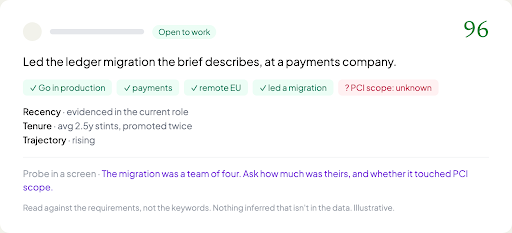
One candidate’s read: verdict, requirements met and missing, tenure, and the one thing to probe in a screen.
Every match explains itself, and nothing found is lost. Each result carries a written verdict, the requirements met and missing, a tenure note, and the one thing worth probing in a first call. Everyone found for a role lands in that role’s talent pool and is excluded from later searches, so the next page is always new faces. Each shortlist or pass decision re-ranks future searches toward what the recruiter keeps choosing, and open roles are re-scanned overnight so a fresh shortlist is waiting at the start of the day.
The point is not the product. It is that AI candidate sourcing is a specific pipeline: parse, filter, relax, read, rank, learn. A technical buyer evaluating any sourcing platform should ask which of those steps it actually performs, and how.
Implementing Proactive Hiring Methods
A steady flow of qualified people requires proactive recruiting, which means engaging talent continuously, even when there is no open requisition.
Creating Talent Pools
A talent pool is a curated database of people who fit the profile of roles you hire for repeatedly, whether or not they have expressed interest yet. Segment it by function, stack, seniority and location so that when a requisition is approved, outreach starts the same day. The strategic form of this is talent mapping: charting who does this job at which companies, at what level, and who is likely to move, before the role exists. By hand it takes weeks, which is why it is the least practised sourcing technique and the first thing a sourcing platform should automate.
Nurturing Relationships Over Time
Collecting profiles is the first step. Staying in touch is what turns a passive prospect into a candidate. Nurture touches that work for engineers are specific and low-pressure:
- A note when your team ships something in their area, with a link to the engineering blog post or changelog rather than a press release.
- An invitation to a technical talk, meetup or open-source release your team is running.
- A check-in when they publish something: a repository, a talk, a paper.
Keep the line open and, when the person decides to look, you are the company they already talk to.
Crafting Outbound Messages That Get Responses
Candidate sourcing lives or dies on the reply rate, and the reply rate lives or dies on the first message. The rules are old: short, specific, about them, with a small ask. Here is the recruiting outreach most sourcing tools will draft, and it is why reply rates sit near zero:
Subject: Exciting Senior Backend Engineer opportunity
Hi [First name], I came across your profile and was impressed by your background. We’re a fast-growing fintech looking for a talented backend engineer. I’d love to tell you more about the role. Are you open to a quick chat?
Nothing in it could only have been sent to this person. Now the version that gets answered:
Subject: your ADR on the dual-write cutover
The decision record you published on running dual writes for 3 weeks instead of a big-bang cutover is the exact argument we lost internally last quarter. We shipped the big bang; it cost us a weekend and a rollback. We’re hiring a senior backend engineer to own the ledger and I’d rather hire the person who already knows why we were wrong. Remote EU, Go, payments. 20 minutes to compare notes?
Four things are doing the work. It names a specific artefact the person made, not “your background.” It admits something about the hiring company, which is disarming and rarely done. It says why this person, not why this role. And it asks for a conversation between peers, with a low-pressure call to action. None of that comes from a template, because all of it comes from reading what the person actually wrote.
The constraint is time. A message like that takes 10 minutes to write, and you need to send 200. Recruiting automation now drafts from the brief and the profile, in the recruiter’s voice, across email and SMS, stops the sequence the moment someone replies, and triages replies interested-first. The goal is not more messages. It is fewer, better ones, sent faster than a person could type them.
Measuring and Refining Sourcing Performance
Sourcing only earns its budget if you measure it. Four candidate sourcing metrics, in the order to look at them:
Response rate. Replies divided by first messages sent. This is the health check on targeting and copy. If it is low, the fix is upstream: wrong people, or the wrong message to the right people. Test subject lines and message structure against it.
Sourced-to-screen. Of those who replied, how many reached a first screen. This tells you whether the profile criteria match what the hiring manager actually wants, which is a different question from whether they match the brief.
Source-of-hire. Of the people you kept, which channel found them. Track it by channel (Boolean, ATS re-discovery, referral, community, sourcing platform) or it tells you nothing about which talent pool feeds your pipeline. Over a few quarters this number decides where a recruiter’s hours should go.
Time-to-hire by channel. Sourced candidates usually move faster than applicants because fit was checked before the first conversation. If yours do not, the screen is repeating work the sourcing should have done.
Continuous review of these four keeps sourcing techniques tuned to a changing market and keeps the pipeline full between requisitions.
Candidate Sourcing FAQ
What is the difference between candidate sourcing and recruiting?
Sourcing is the front of the funnel: finding and engaging people who fit a role, whether or not they applied. Recruiting is the rest: screening, assessing and closing. Small teams have one person do both. Mature teams make sourcing a dedicated function, because search, research and cold outreach are different skills from assessment and offer negotiation.
What is a talent sourcer?
A talent sourcer is the person whose whole job is the front of the funnel: finding, qualifying and making first contact with people who fit a role, then handing them to a recruiter. In technical hiring a good sourcer reads code repositories and technical writing as fluently as a resume.
What is a passive job seeker?
A passive job seeker is someone employed and not actively job-hunting, who would still consider a strong opportunity if approached. Most of the qualified market at any moment is passive, which is why sourcing that reaches only active applicants misses the majority.
What is talent mapping?
Talent mapping is building a picture of where a role’s talent sits: which companies employ people at that level, how many, and who is likely to move, before you have an open requisition. It turns sourcing from a reaction to a vacancy into a standing view of the market.
Is Boolean search still worth learning?
Yes, as a way of thinking rather than the whole toolkit. Boolean forces you to write requirements precisely, and that discipline transfers directly to briefing a sourcing platform. Its ceiling is that it matches words rather than experience, which is the specific limitation AI sourcing tools exist to remove.
Candidate sourcing used to be what a recruiter did when a role was hard. For engineering teams it is now what you do so that fewer roles are, and the teams that treat it as continuous rather than occasional are the ones no longer surprised by a hard requisition.
Sparsh Goyal is the founder of The Cognitive, an AI recruiting platform that sources from ~900M profiles, reveals verified contacts, runs outreach, and conducts live two-way AI interviews, so a candidate goes from found to proven without leaving the platform.