
Share
Share
Share
Share
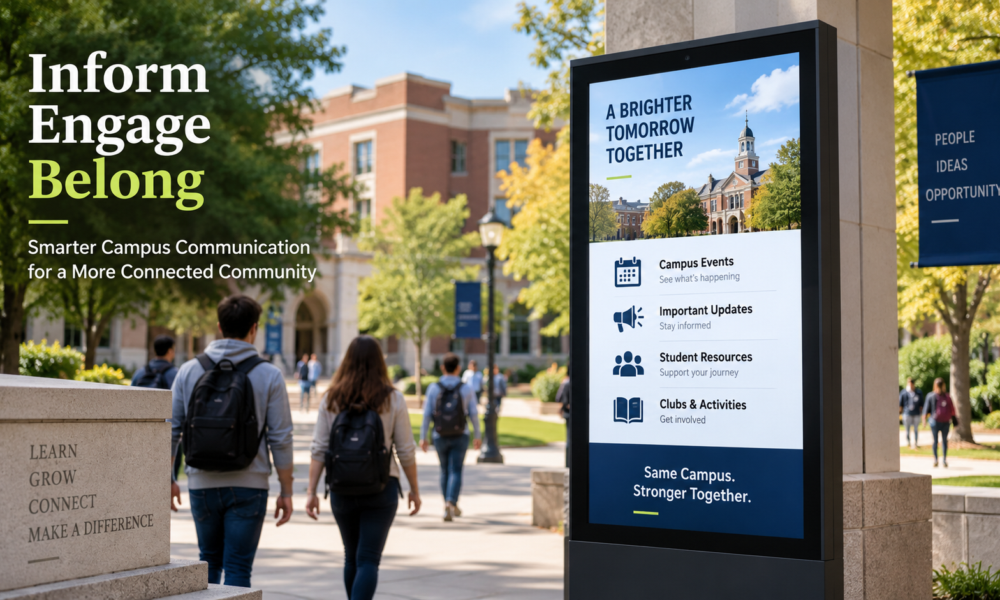
Walk across almost any college campus today and you’ll notice something: the paper flyers, taped-up notices, and static bulletin boards that once cluttered hallways are disappearing. In their place are screens — bright, dynamic, and constantly updated with the information students and staff actually need in the moment.
This shift isn’t just cosmetic. For colleges managing everything from class schedule changes to emergency alerts, digital signage has become a practical answer to a communication problem that’s only gotten harder as campuses grow more dispersed and student attention spans grow shorter.
The Communication Gap on Modern Campuses
Higher education institutions juggle a lot of moving parts: multiple buildings, thousands of students, rotating class schedules, campus events, dining updates, and — critically — safety notifications that need to reach people instantly. Email gets buried. Printed notices go unnoticed or outdated within days. Social media posts are easily missed in a crowded feed.
Screens placed in high-traffic areas — lobbies, cafeterias, libraries, dorms, and hallways — solve this by putting information directly in front of people as they move through their day, without requiring them to check anything.
Why Colleges Are Turning to Purpose-Built Platforms
Generic presentation software or manually updated TVs don’t scale well once a campus has more than a handful of screens. That’s the gap platforms like NoviSign for colleges are built to close. Rather than treating each screen as a one-off, the platform centralizes content management in the cloud, letting a single administrator (or a small communications team) push updates to one screen or hundreds simultaneously, from any browser or device.
A few things stand out in how this plays out on real campuses:
- Speed of updates. Class schedule changes, weather closures, or emergency alerts can be pushed to every screen on campus within minutes, overriding whatever was previously scheduled to display.
- Drag-and-drop content zones. Non-technical staff — often the same people who used to print and tape up flyers — can build layouts mixing campus news, event calendars, social media feeds, and wayfinding maps without design or coding skills.
- Integration with existing tools. Many platforms allow content to be pulled directly from Google Slides, Canva, RSS feeds, and social channels, meaning teams don’t have to recreate content that already exists elsewhere.
- Reliability during outages. Offline playback capability means screens keep showing the last scheduled content even if the network briefly drops — a meaningful detail for anything touching safety communication.
Real-world adoption backs this up: the University of Florida consolidated a patchwork of nearly fifteen different signage systems scattered across departments into a single platform, largely because the previous setup had become too fragmented to manage consistently.
Beyond Announcements: Building a Connected Campus
The more interesting shift is how colleges are using these screens beyond simple announcements. Wayfinding kiosks help new students and visitors navigate unfamiliar buildings. Dining hall menus update automatically by meal time. Career services teams promote job fairs and application deadlines. Residence halls display community bulletins that used to live on corkboards. Even internal staff communications — meeting times, department news — are moving to break-room screens instead of email threads that get ignored.
Taken together, this turns digital signage from a “nice-to-have” convenience into genuine campus infrastructure — one that touches safety, operations, student life, and institutional branding all at once.
The Bigger Picture
As higher education continues to compete for enrollment and student engagement, the small details of how a campus communicates matter more than they used to. A prospective student’s first impression often comes from walking through a lobby; a current student’s sense of being informed (or left out) often comes down to whether they saw the notice in time.
Digital signage won’t solve every communication challenge a college faces. But as an infrastructure layer — quiet, always-on, and increasingly essential — it’s becoming as standard on campuses as Wi-Fi itself.





