Share
Share
Share
Share
Financial institutions spent an estimated $650 billion on technology in 2024, according to McKinsey’s Global Banking Annual Review. That figure includes both internal development and partnerships with fintech companies, reflecting a financial services industry that increasingly operates at the intersection of banking and software engineering. The gap between traditional finance and technology is narrowing, and fintech companies are the primary mechanism driving that convergence.
Why the Gap Existed in the First Place
Traditional financial institutions and technology companies operated under fundamentally different models for decades. Banks prioritized regulatory compliance, capital adequacy, and risk management. Technology companies prioritized speed, user experience, and iteration. Banks measured success in basis points of net interest margin. Technology companies measured success in user growth and engagement.
Infrastructure differences reinforced this divide. Most large banks run core systems built on COBOL, a programming language developed in 1959. A 2023 survey by Temenos found that 43% of banks still operate core banking platforms more than 20 years old. Updating these systems is expensive and risky. S&P Global estimated that a full core banking system replacement costs $50 million to $500 million for a mid-sized bank and takes 3-5 years to complete.
Regulatory barriers also kept the two sectors apart. Banking licenses require minimum capital reserves, extensive compliance frameworks, and regular examinations. Technology companies could launch products in weeks. Banks needed months or years to get regulatory approval for new offerings. This difference in speed created an opening for fintech companies to serve customers faster than banks could.
How Fintech Companies Are Connecting the Two Worlds
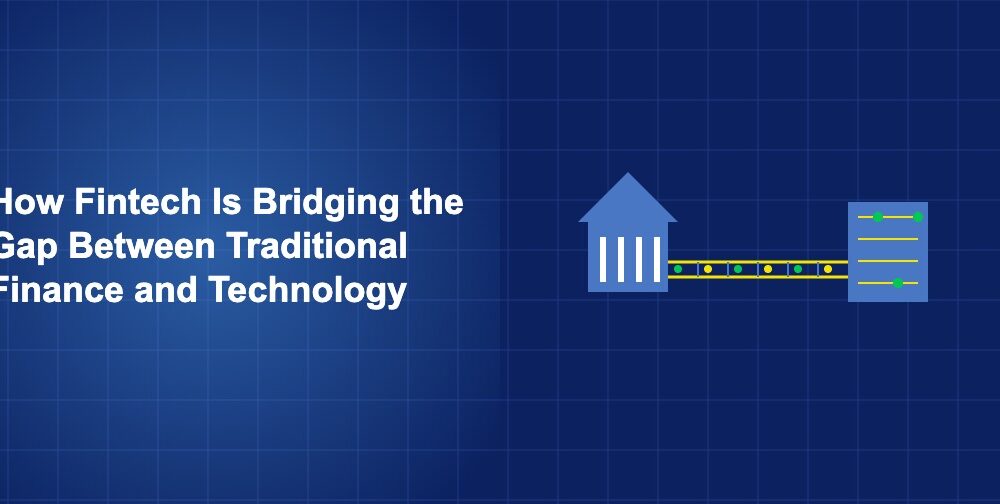
Fintech companies function as translators between traditional finance and modern technology. They build software that interfaces with legacy banking systems while delivering consumer-grade user experiences. financial APIs are powering the next generation of fintech platforms, creating the middleware layer that connects bank data to modern applications.
Plaid connects to over 12,000 financial institutions, allowing fintech apps to access bank account data through modern APIs rather than screen scraping. Stripe provides payment processing that integrates with bank settlement systems through simple developer tools. Marqeta and Galileo enable companies to issue payment cards without building their own card processing infrastructure.
CB Insights reported that banking-as-a-service (BaaS) platforms processed over $100 billion in transactions in 2024. These platforms, including Unit, Treasury Prime, and Synctera, hold bank charters or partner with chartered banks while providing API-first interfaces that technology companies can integrate in weeks rather than months. The result is that any software company can now embed financial services, from deposit accounts to lending to card issuance, without obtaining a banking license.
The Open Banking Movement
the global open banking market is expected to exceed $123 billion by 2031, driven by regulatory mandates in Europe and the UK and voluntary adoption in other markets. Open banking requires financial institutions to share customer data with authorized third parties through secure APIs. This requirement, initially resisted by many banks, has become the foundation for a new category of financial services.
In the UK, over 7 million consumers and businesses used open banking services by the end of 2024, according to the Open Banking Implementation Entity. The most common use cases include account aggregation, which allows consumers to view all their bank accounts in a single app, and payment initiation, which enables direct bank-to-bank transfers without card networks.
BCG estimated that open banking APIs handled over 1 billion calls per month in Europe by 2024. In the United States, the Consumer Financial Protection Bureau finalized its open banking rule (Section 1033) in late 2024, requiring banks to provide consumer data to authorized third parties. This rule, once fully implemented, will bring the US in line with European and UK standards.
75% of banks now collaborate with fintech startups as banks increasingly open their systems to external developers. The shift from closed, proprietary banking systems to open, API-driven platforms represents one of the most significant structural changes in financial services in decades.
Technology Companies Entering Financial Services
The bridge between finance and technology runs in both directions. Technology companies are increasingly offering financial products to their users. Apple launched Apple Card (with Goldman Sachs, later transitioning to other partners) and Apple Pay Later. Google partnered with banks to offer checking accounts through Google Pay. Amazon provides merchant lending and consumer payment plans.
These moves by technology companies create both opportunities and concerns. The opportunity is broader distribution of financial services to consumers who already spend significant time on technology platforms. The concern, raised by regulators in the US, EU, and China, is that technology companies may gain systemic importance in financial services without being subject to the same regulatory oversight as banks.
China’s experience with Ant Group illustrates the tension. Ant Financial grew to process over $17 trillion in annual payments through Alipay before Chinese regulators intervened in 2020, blocking its planned IPO and requiring it to restructure as a financial holding company subject to banking regulations. The Bank for International Settlements cited the Ant Group case as a template for how regulators globally might approach big tech in financial services.
Where the Convergence Stands Today
fintech is reshaping the $300 trillion global financial services industry as fintech companies, banks, and technology companies increasingly compete and collaborate across the same product categories. The distinction between a bank and a fintech company is less clear than it was five years ago. Revolut holds a UK banking license. SoFi operates a national bank charter. Goldman Sachs builds consumer fintech products. Walmart applied for a fintech charter.
The convergence is also visible in talent flows. LinkedIn data from 2024 showed that 23% of senior hires at major US banks came from technology companies, up from 9% in 2018. In the other direction, fintech companies are hiring former bank executives to navigate regulatory relationships. This cross-pollination of talent accelerates the merging of banking expertise and technology capability.
Statista data shows that the combined revenue of companies operating at the intersection of banking and technology, whether classified as fintechs, neobanks, or BaaS providers, reached approximately $320 billion in 2024. That figure is expected to exceed $500 billion by 2028.
The gap between traditional finance and technology has not disappeared, but it has narrowed to the point where the two sectors share infrastructure, talent, and increasingly, customers. Fintech companies built the initial bridges through APIs, cloud-based platforms, and modern user interfaces. The next phase of convergence will involve AI-driven automation, real-time data sharing, and regulatory frameworks that apply consistent standards across all entities providing financial services, regardless of whether they hold a bank charter.