
Share
Share
Share
Share
For most of the last decade, phone accessories were an afterthought. You bought the phone, grabbed whatever case was hanging near the register, and plugged into the charger that came in the box. That world is gone. Apple stopped shipping power adapters with the iPhone 12 in 2020, most Android makers followed, and the European Union made USB-C mandatory for new phones at the end of 2024. The accessory drawer, once a pile of mismatched bricks and cables, has turned into a small ecosystem that people now choose on purpose.
Three technologies are doing most of the rebuilding: gallium nitride power electronics, the Qi2 magnetic charging standard, and a new generation of thin, strong case materials. None of them is flashy on its own. Together they are changing what people carry, how much they spend, and which brands they trust.
The Charger Got Smaller Because the Chip Changed
A traditional wall charger is built around silicon transistors that switch current on and off many thousands of times per second. Silicon works, but it wastes energy as heat, and it cannot switch very fast before those losses climb. That limitation sets the size of everything around it: the transformer, the capacitors and the air space needed to keep the whole thing from running hot.
Gallium nitride changes the math. GaN is a wide-bandgap semiconductor, roughly 3.4 electron-volts against silicon’s 1.1, which lets it handle higher voltages and switch far faster with less loss. Faster switching means the magnetic parts inside the charger can shrink, and lower losses mean less heat to manage. The result is the charger most people now recognize: a cube the size of an old 5W iPhone brick that can power a laptop.
It is worth clearing up one common misunderstanding. A GaN charger does not charge a phone faster than a silicon charger of the same wattage. The phone and the charger still negotiate power through USB Power Delivery, and a 30W silicon brick and a 30W GaN brick will deliver the same 30 watts. What GaN buys you is density. You get more watts in less space, which is why a single multi-port GaN unit can now replace the phone charger, the tablet charger and the laptop charger that used to share a travel pouch.
That consolidation is the real market story. When one device replaces three, buyers pay more attention to the one they keep. Port layout, total wattage budget, how power is split when two devices are plugged in, and whether the charger supports Programmable Power Supply for Samsung’s faster modes have all become buying criteria instead of fine print.
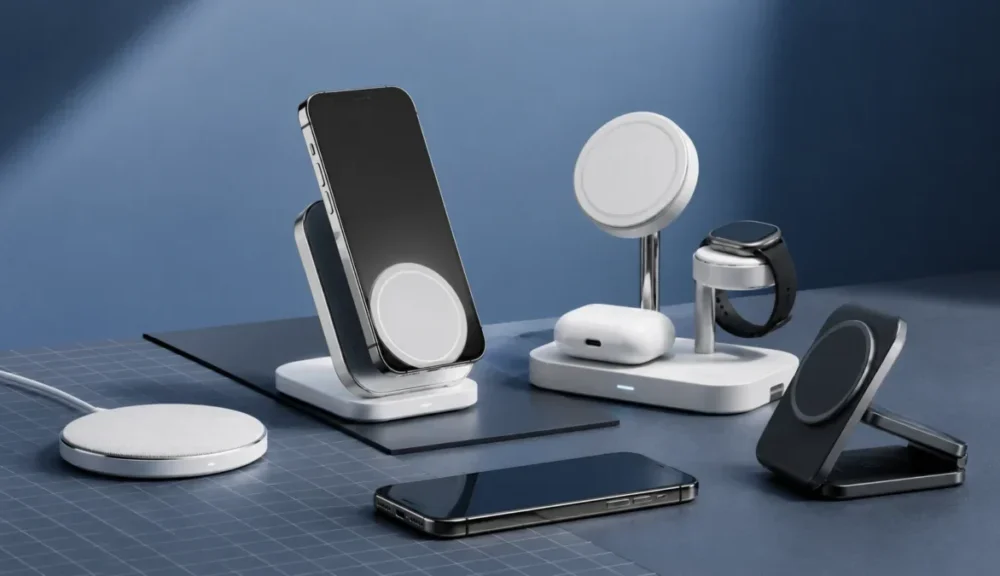
Qi2 Turned Magnets Into an Industry Standard
When Apple introduced MagSafe for the iPhone 12, the ring of magnets behind the phone looked like a proprietary trick. It did not stay that way. In 2023 the Wireless Power Consortium announced Qi2, a standard built on the Magnetic Power Profile that Apple contributed. The idea was simple: if the coil in the charger and the coil in the phone are always aligned, wireless charging wastes less energy and runs cooler.
The next step came with Qi2 25W, often called Qi2.2, which raised the ceiling from 15 watts to 25 watts while adding better thermal management. Android support has been uneven but is moving quickly. Google’s Pixel 10 series shipped with magnets built in, while Samsung’s Galaxy S25 line is “Qi2 Ready,” meaning it supports the charging protocol but depends on a magnetic case to snap onto accessories.
That last detail matters more than it seems. On a large share of phones, the magnet that makes the whole ecosystem work lives in the case, not the device. The case has quietly become infrastructure.
Why the Magnet Changed More Than Charging
Once there was a dependable magnetic mount on the back of millions of phones, accessory makers stopped designing around adhesive. Wallets, stands, car mounts, battery packs and grips could all attach and detach in a second. A magsafe phone grip is a good example of how the category shifted. The old stick-on grip was permanent, blocked wireless charging and left residue when you removed it. A magnetic grip clicks on for one-handed photos or scrolling on a crowded train, then comes off when the phone goes on a charging pad.
That modularity has pushed accessory design toward smaller, single-purpose pieces that people combine however they like. It also rewards precision. A weak magnet array, a case that is a millimeter too thick, or a ring that sits slightly off-center will ruin the experience, and buyers now notice.
Thin Is Back, and It Is Harder to Build
For years, protection meant bulk. Rugged cases added layers of TPU and polycarbonate until a slim phone felt like a paperback. The magnetic ecosystem pushed back against that, for a practical reason: every millimeter between the phone’s coil and the charger’s coil weakens both the magnetic hold and the charging efficiency.
So case makers had to get thinner without giving up protection. The materials that make that possible have migrated from aerospace and sporting goods. Aramid fiber, the same family as Kevlar, offers high tensile strength at a fraction of a millimeter. Polypropylene shells under a millimeter thick keep weight low while resisting scratches. Some cases now add graphene or metal layers to pull heat away from the phone during wireless charging and gaming.
The trade-off is real and worth stating plainly. A 0.5mm shell will not protect a phone the way a rugged case will in a hard drop onto concrete. What it does is preserve the phone’s shape and weight, protect against scratches and scuffs, and keep the magnetic stack thin enough that grips, wallets and chargers work the way they were designed to. For many buyers that is the right balance, especially when a separate screen protector handles the most expensive glass.
What This Means for Buyers
The accessory market has matured from impulse purchases into a small system of parts that need to work together. A few principles make shopping for that system much simpler.
- Buy the charger for everything you carry, not just your phone. Add up the wattage your laptop, tablet and phone need at the same time, then choose a GaN unit with enough total capacity and a sensible split across ports.
- Check the cable, too. Higher-wattage USB-C charging depends on a cable rated for the current. A great charger paired with a thin, unrated cable will quietly fall back to slower speeds.
- Treat the case as the foundation. If your phone lacks built-in magnets, the case decides whether Qi2 accessories work at all. Look for a certified magnet ring and a profile thin enough not to weaken it.
- Look for safety certification. Chargers carrying recognized safety marks such as UL or ETL have been independently tested. Very cheap, uncertified units have been the subject of recalls, and the savings rarely justify the risk.
- Favor accessories that detach. Magnetic grips, wallets and stands let you change your setup without being locked into it, and they do not interfere with wireless charging when removed.
The Business Behind the Small Stuff
There is a reason investors and retailers are paying attention to a category that used to be a checkout-aisle afterthought. When phones stopped shipping with chargers and started relying on cases for magnets, the accessory became a required purchase rather than an optional one. Replacement cycles for phones have lengthened, but accessories get replaced and upgraded far more often, which gives the category steadier demand than the handsets themselves.
That shift has opened room for smaller direct-to-consumer brands that focus on doing a few things well instead of stocking hundreds of generic SKUs. GripLux, for instance, has built its lineup around exactly the pieces this article describes: ultra-thin cases, magnetic grips and compact GaN charging. Specialized brands like that compete less on price and more on getting the details right, whether that is magnet strength, case thickness or honest labeling of per-port wattage.
For the major phone makers, the accessory ecosystem also changes strategy. A phone that works beautifully with a standard magnetic mount and a standard USB-C charger is easier to sell and easier to switch to. Standards like Qi2 and USB Power Delivery lower the cost of changing brands, which in turn raises the pressure on every manufacturer to get the core device right.
Looking Ahead
The next few years are likely to bring more of the same, only refined. GaN will keep moving into higher-wattage products as costs fall and as USB Power Delivery’s Extended Power Range allows up to 240 watts over a single cable. Qi2 adoption on Android should widen, and more phones will ship with magnets built in rather than borrowed from the case. Case materials will keep getting thinner and more thermally aware, because wireless charging and mobile gaming both generate heat that has to go somewhere.
None of these changes will make headlines on launch day. But the next time you pack for a trip and realize one small charger and a thin case with a grip are all you need, you will be looking at the result of some very real engineering. The smartphone may still be the star, but the accessories around it have finally grown up.





