Share
Share
Share
Share
A fresh repair job looks perfect the day you drive it home. Six months later, road salt, sun, and a careless parking spot start undoing that work. You just paid for Car Paint Repair NY shops to blend a panel or repaint a bumper. The last thing you want is a finish that fades or chips within a year .
Here’s the part most people miss. Repaired paint isn’t the same as factory paint, at least not right away. It needs time to cure. Then it needs the right protection once it does. Skip either step, and you’re likely paying for the same repair twice.
Give the Paint Time Before You Touch It
Fresh clear coat is still off-gassing. Solvents trapped underneath need weeks to fully evaporate. Sealing that surface too early traps moisture and chemicals underneath it. That trapped moisture can end up making a kind of haze or adhesion problems later on, sometimes even months after the repair, and then the cause is hard to trace back , because it’s not right there in the moment.
Most reputable shops recommend waiting 60 to 90 days before you apply any protective film or coating. And no , this is not some sales tactic meant to push your appointment out . It’s how the paint actually finishes curing. Some detailers report success applying breathable coatings within one to two weeks. That timeline depends a lot on the specific product, and also how it bonds to the clear coat. When it’s unclear , ask the shop that repaired your car what time they’d wait. They’ve seen how their own paint system behaves in real life, so that’s worth more than some generic rule you pull from the internet.
It also helps to ask what products they used. Some clear coats cure faster than others, and a shop that tracks this closely can usually give you a more specific window than “two to three months.”
PPF: The Physical Shield
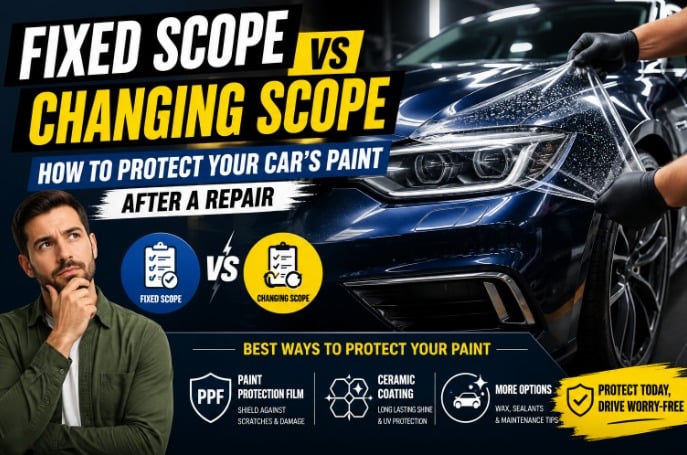
Paint protection film is a clear, thick layer of polyurethane. Installers apply it directly over the repaired panel. Think of it as armor, not polish. It absorbs the hit instead of letting the hit reach your paint.
- Rock chips and road debris bounce off instead of pitting the surface
- Light scratches often heal themselves with heat from sunlight
- Technicians can remove it later without damaging the paint underneath
- Quality film stays invisible once installed correctly
PPF makes the most sense on high-impact zones. That means the hood, front bumper and mirrors and rocker panels. Full coverage exists too, but most drivers get real value from protecting just the areas that take the most abuse. This matters even more after a repair. A repainted panel typically shows chips and wear faster than the original factory finish does, since the new paint layer hasn’t had years to fully harden the way the surrounding factory finish has.
Cost is part of this decision too. Protecting just the high-impact areas runs far less than wrapping the entire car, and for most daily drivers, that’s the smarter place to spend the budget. Full coverage still makes sense for anyone planning to keep the car a long time or preserve resale value on a higher-end vehicle.
Ceramic Coating: The Chemical Layer
PPF stops physical damage. Ceramic coating kinda handles the rest of it. It’s like a liquid polymer that sticks to the clear coat, and then it cures into a tough glass like film. It won’t magically stop a rock chip, but it does block a bunch of the stuff that slowly makes paint look dull with time.
UV rays, bird droppings, tree sap and road grime end up sitting on top of the coating, instead of digging into it. Water basically beads up, then it rolls off. So you get less water spotting and there’s also way less scrubbing during wash day, which is pretty nice. Anyone dealing with car paint in New York through brutal winters knows what road salt does to a finish. That ability to fight off salt and de icing stuff is more valuable than the shiny, glossy appearance people usually mention first, in a sort of quick way.
A ceramic coat by itself isn’t really going to save you from a nasty deep scratch or some parking-lot dent. It’s not meant for that sort of work. If you match it with paint protection film on the panels that get hit the most, then you end up with a combination that handles both categories of trouble, more or less at once.
Most pro level ceramic coatings tend to hang around for about two to five years, but it varies, depending on how you rinse the car and keep it up afterward. Rough automated washes with brushes tend to grind the coating down quicker, while a careful hand wash is way gentler.
Why Layering Both Makes Sense
Many owners treat this as an either-or decision. It shouldn’t be one. PPF absorbs impact. Ceramic coating repels contaminants and adds gloss. Apply both, with ceramic going over the film, and you gain hydrophobic properties that PPF doesn’t have on its own. You also gain an extra layer of UV resistance for the panels the film doesn’t cover.
The sequence matters here. Start with paint correction if surrounding panels show swirl marks or oxidation. Technicians install PPF next, on the repaired area and any other high-impact zones. Ceramic coating goes on last, across the whole vehicle, like the final touch, not really optional. That last layer kinda ties everything together, so the repaired panel doesn’t really pop out compared to the rest of the car. If you skip that ceramic top layer, a fixed area that has PPF on it can sometimes look a bit off, especially in terms of how the light reflects— you notice it more under direct sunlight, and then the sheen can be slightly different from the original factory paint.
Doing this in the wrong order causes real problems. Coating over paint that hasn’t cured, or installing film over a surface that still has embedded contaminants, shortens the life of both products significantly.
A Few Things Owners Get Wrong
Keep the receipt from your repair. Keep the receipt for any protection you apply afterward too. Another driver might hit your car down the road. Insurers often cover reapplying PPF or ceramic coating as part of that claim. That coverage usually requires proof of the original installation, so don’t lose the paperwork.
Don’t assume any detailer can handle post-repair protection well. A trained eye catches things an untrained one misses. Someone who inspects paint for a living can spot inconsistencies in a repair job quickly. Uneven clear coat thickness is one example. Poor blending at the panel edge is another. That kind of inspection gives you a second check on the shop’s original work, and it’s worth more than most owners realize.
Don’t rush the timeline just because the car looks ready, either. Looking cured and being cured aren’t the same thing. Patience here saves you a redo later. And once the protection is on, stick to pH-neutral car shampoo. Harsh detergents strip the finish faster than daily driving ever will.
Protecting Your Investment for the Long Run
Repainting a panel is expensive. Doing it twice because the first protection job failed is worse. Car Paint Repair NY drivers already deal with enough, between winter road salt and summer UV exposure. Getting the sequence right matters. Wait out the cure period. Choose PPF for impact zones. Finish with ceramic coating over the full vehicle . That combination is what actually makes a repair last , and it protects the money you already spent getting the panel fixed in the first place.
About Spectrum Auto Inc.
Spectrum Auto Inc. handles collision repair, plus ADAS calibration, and Tesla-certified services for folks in West Nyack, Montrose, Cortlandt, and around Rockland County. Their crew uses OEM parts and follows factory trained procedures in a pretty steady, no drama kind of way. Every repaired panel is built to match the rest of the vehicle, in both structure and finish. That standard gives drivers dealing with car paint in New York conditions a repair that holds up over time, not just on the day it leaves the shop.
FAQs
- How long should I wait to apply ceramic coating after a paint repair?
Most shops recommend 60 to 90 days so the clear coat can fully cure. Some breathable coatings can go on sooner. Check with your repair shop before you schedule anything.
- Can PPF be applied directly over a freshly repaired panel?
Yes, once the paint has cured enough. Applying it too early traps solvents underneath and can cause adhesion issues.
- Does insurance cover PPF or ceramic coating after an accident?
Often, yes. You’ll need proof of the original installation. Keep your receipts and mention the protection when you file a claim.
- Is ceramic coating enough on its own after a repair?
It helps shield from UV rays, various chemicals and grime, but it wont really handle physical impacts. When you match it with PPF on the high-impact panels, you get more full coverage overall.