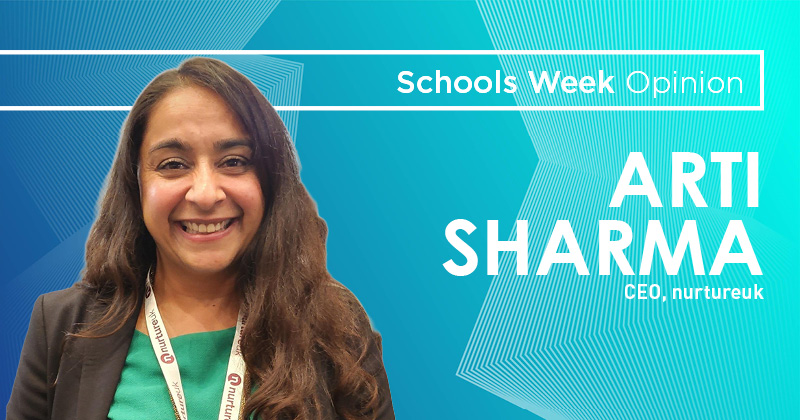
To be more than just a room, secondary school inclusion bases should be designed with a clear purpose to aid reintegration, says Arti Sharma
The expectation that every secondary school should have an inclusion base marks a significant shift in how we think about supporting vulnerable learners.
The government’s ambition is clear: fewer exclusions, stronger mainstream inclusion and better support for pupils with additional needs.
But a room is not a strategy.
If inclusion bases are to make a meaningful difference, we must move beyond the idea that simply designating a space will solve deep-rooted challenges.
Done well, these bases can be transformational. Done poorly, they risk becoming holding rooms – places where pupils are parked rather than supported.
At nurtureuk, we have spent more than 50 years championing and developing nurture groups – the UK’s original inclusion-focused intervention.
Decades of frontline experience have taught us a great deal about what makes such provision succeed, and what causes it to falter.
Underlying needs
First, purpose must come before provision.
An effective inclusion base is not defined by soft furnishings or a separate timetable.
It is defined by a clear, shared purpose: to remove barriers to learning by addressing pupils’ underlying needs.
Leaders must be explicit about who the base is for, what outcomes are expected, how progress will be measured and how pupils will reintegrate successfully into mainstream lessons. Without this clarity, even the most well-intentioned space will drift.
Second, relationships are the intervention.
Inclusion bases work when they are staffed by skilled adults.
Pupils who attend are often carrying experiences of instability, anxiety or repeated failure. They do not need containment, they need connection.
The adults in these spaces must be able to build trust, model co-regulation and create predictable, emotionally safe environments.
This requires training, supervision and time for reflective practice. Investment in bricks and mortar without investment in people will not deliver sustainable impact.
Inclusion provision is too often reactive
Third, prioritise social and emotional development – early.
Too often, inclusion provision is reactive. Pupils are referred at crisis point, and support is improvised.
Our experience shows that early and regular assessment of children’s social and emotional needs enables schools to be proactive and preventative, tailor interventions and track progress meaningfully.
When staff understand a pupil’s social and emotional needs as well as their academic profile, support becomes targeted rather than generic, and reintegration is far more successful.
The most effective provision focuses explicitly on developing social and emotional skills, building self-regulation, resilience, communication and confidence.
These are not “soft” outcomes; they are the foundation on which academic success rests.
When pupils learn to recognise and manage their emotions, form trusting relationships and experience success in small, structured steps, their capacity to engage in mainstream learning grows and any need for additional, specialist support is more easily identified.
Fourth, inclusion bases must be integrated into whole-school culture.
If the base becomes an island, it will fail. Clear referral pathways, transparent criteria and regular review points are essential.
So is strong communication between base staff, subject teachers and pastoral teams. Time spent in the base should reinforce, not replace, classroom learning.
Support for belonging
Crucially, leaders must guard against stigma. An inclusion base should be framed as a support for belonging, not a sign that a pupil has fallen short.
Language matters. So does leadership messaging. When the entire school community understands that inclusion is everyone’s responsibility, these bases become part of a graduated, preventative approach rather than a last resort.
The drive to establish inclusion bases presents a genuine opportunity. We know early, relational intervention can change trajectories for children who need targeted support.
But inclusion is not about where a pupil sits. It is about whether they feel safe, understood and able to learn.
That is the measure against which every inclusion base should be judged.