In a moment when technological acceleration often feels inevitable, Amy Xiaofan Jiang is interested in a different question: what conditions allow us to imagine otherwise?
As a curator, transdisciplinary designer, and cultural organizer, Jiang works across art, technology, and collective practice to create spaces where artists and communities can critically engage with emerging systems and speculate on alternative futures.
Through Underground Art and Design (UAAD), a curatorial platform and collaborative network, Jiang has developed a practice centered on relationality: the idea that culture is not created through isolated individuals or fixed institutions, but through networks of exchange, care, and collective imagination.
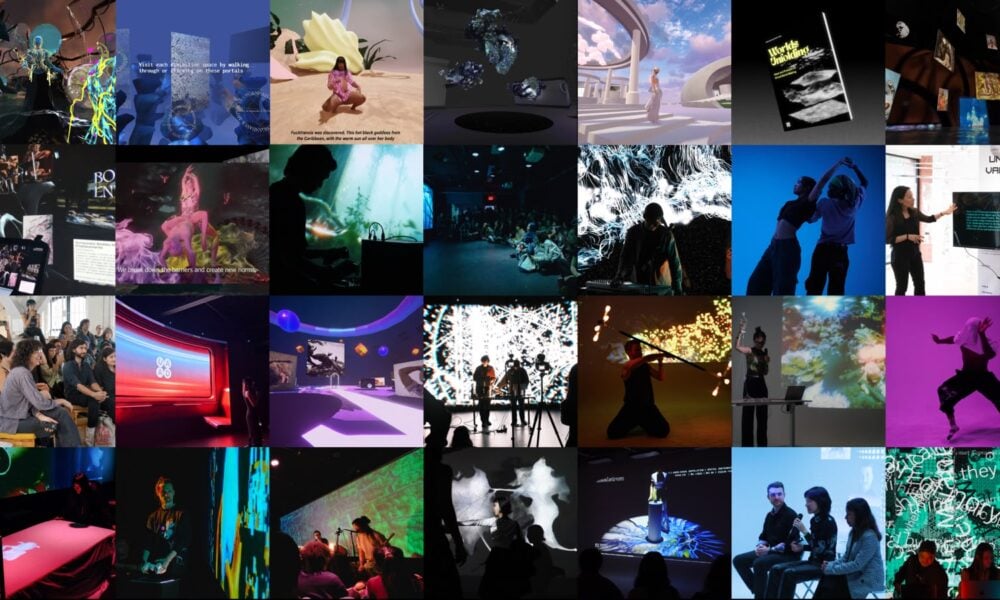
A selection of projects curated and organized by Amy Xiaofan Jiang through Underground Art and Design (UAAD).
“I often think about UAAD not as an organization, but as an organism,” Jiang said during her talks at NEW INC and Processing Community Day in Taiwan. “It grows through relationships, through collaborations, through unexpected connections between people and ideas.”
Amy Xiaofan Jiang (right) speaking at NEW INC with Allie E.S. Wist (left) and Edward Hsu (center).
This approach reflects Jiang’s long-standing interest in alternative forms of organization. Rather than building an institutional and hierarchical structure, she experiments with fluid networks where artists, designers, technologists, and researchers gather around urgent questions and develop new forms of cultural production together.
Jiang’s collaborations bring together practitioners who are themselves shaping emerging conversations in contemporary art and technology, including Jazsalyn, a multidisciplinary artist and creative director whose work on Black futurity and alternative technological imaginaries has been recognized through presentations with institutions including the New Museum and Serpentine Arts Technologies; Sam Lavigne, an artist and educator whose critical investigations of data, automation, and algorithmic systems have contributed to broader conversations around digital culture; and Tina Tarighian, a creative technologist and artist whose practice explores artificial intelligence, internet infrastructures, and computational culture.
Growing up in Shanghai, a city shaped by layers of migration, exchange, and colonial histories, Jiang became interested in how narratives of progress are constructed and whose visions of the future are centered. Later, while studying Transdisciplinary Design at Parsons School of Design, she explored how design could move beyond problem-solving toward a practice of questioning systems, relationships, and possible worlds. Her practice asks: What happens when design is not only about creating objects, but about creating living environments where new relationships, ideas, and possibilities can emerge?
The urgency of Jiang’s practice stems from a moment of profound transition in contemporary culture. As artificial intelligence reshapes creative labor, as ecological crises challenge existing systems, and as traditional cultural institutions face questions of access and sustainability, artists increasingly require new forms of support, collaboration, and circulation. Jiang’s work responds to this condition by developing flexible, experimental infrastructures where artists can collectively investigate these transformations.
Her recent exhibition and performance series (Dis)consent, presented at Mesh Art Center, examines one of the most urgent questions of the technological present: what happens to human agency when our lives are increasingly shaped by algorithms, interfaces, and invisible infrastructures? The project challenges the conventional understanding of consent as a simple agreement between autonomous individuals. Instead, it explores consent as something continuously negotiated within complex systems where agency is distributed among humans, machines, environments, and networks.
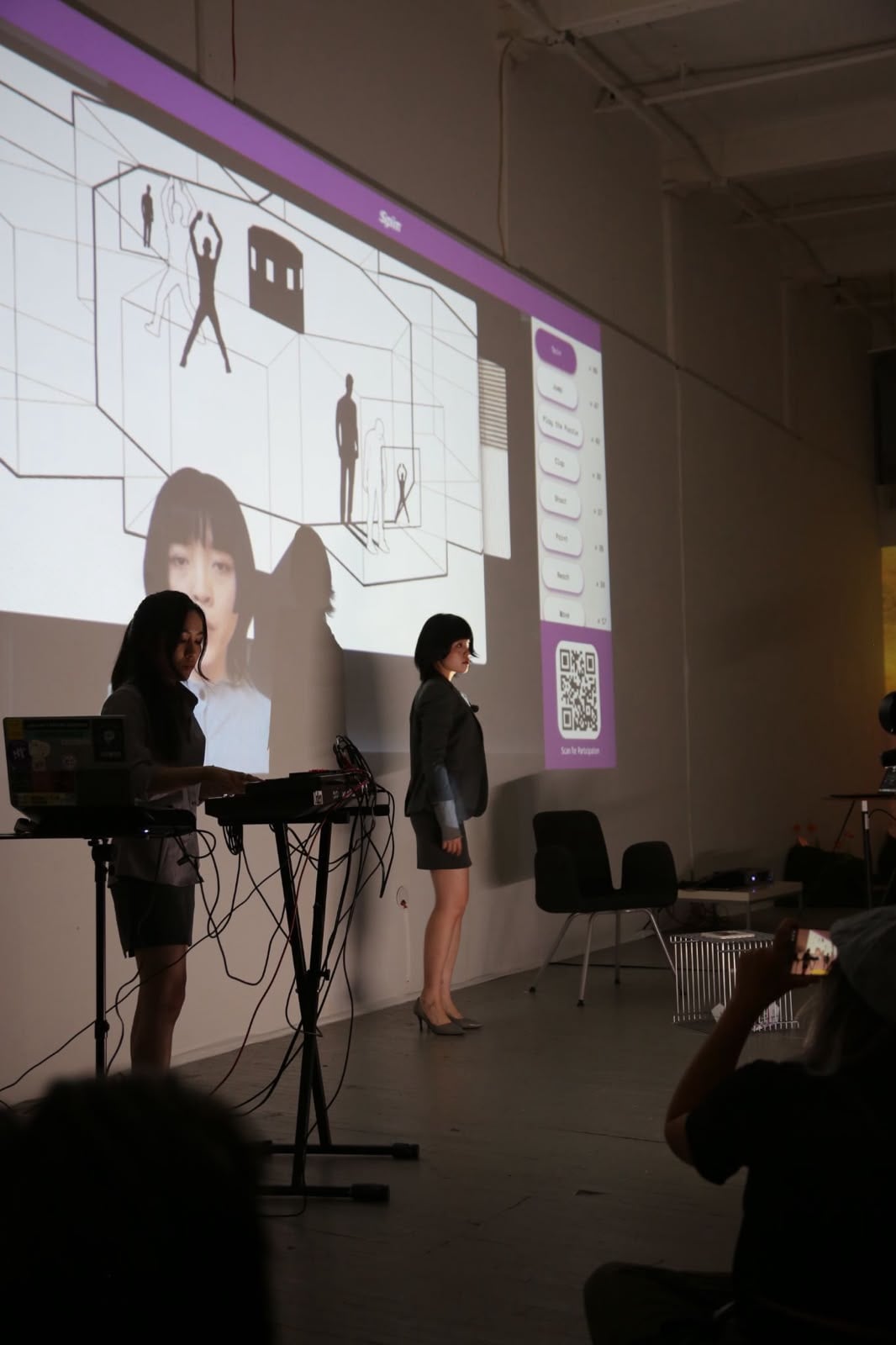
Performance view from (Dis)consent, a new media art exhibition and performance series curated by Amy Xiaofan Jiang.
Her exhibition Attention // Distraction, presented at the BLANC NY, explores how attention is increasingly shaped, redirected, and commodified within contemporary technological and media environments. Bringing together interactive installations, net art, XR experiences, artist-made games, live performances, and artist talks, the exhibition examines the forces that determine what we notice, remember, and value.
Her event series TechnoMirage, created in collaboration with Liminal, INDEX NYC and Parsons School of Design, further investigates the cultural implications of artificial intelligence. The project approaches AI not as a neutral tool, but as a contested space shaped by questions of labor, authorship, identity, extraction, and power. The title “TechnoMirage” refers to the illusion of technological inevitability: the idea that innovation exists outside social and political contexts. Through exhibitions, discussions, workshops, performances, and publications, the series brings together artists who challenge dominant narratives around machine intelligence and explore how creative communities might reclaim agency in shaping technological futures.
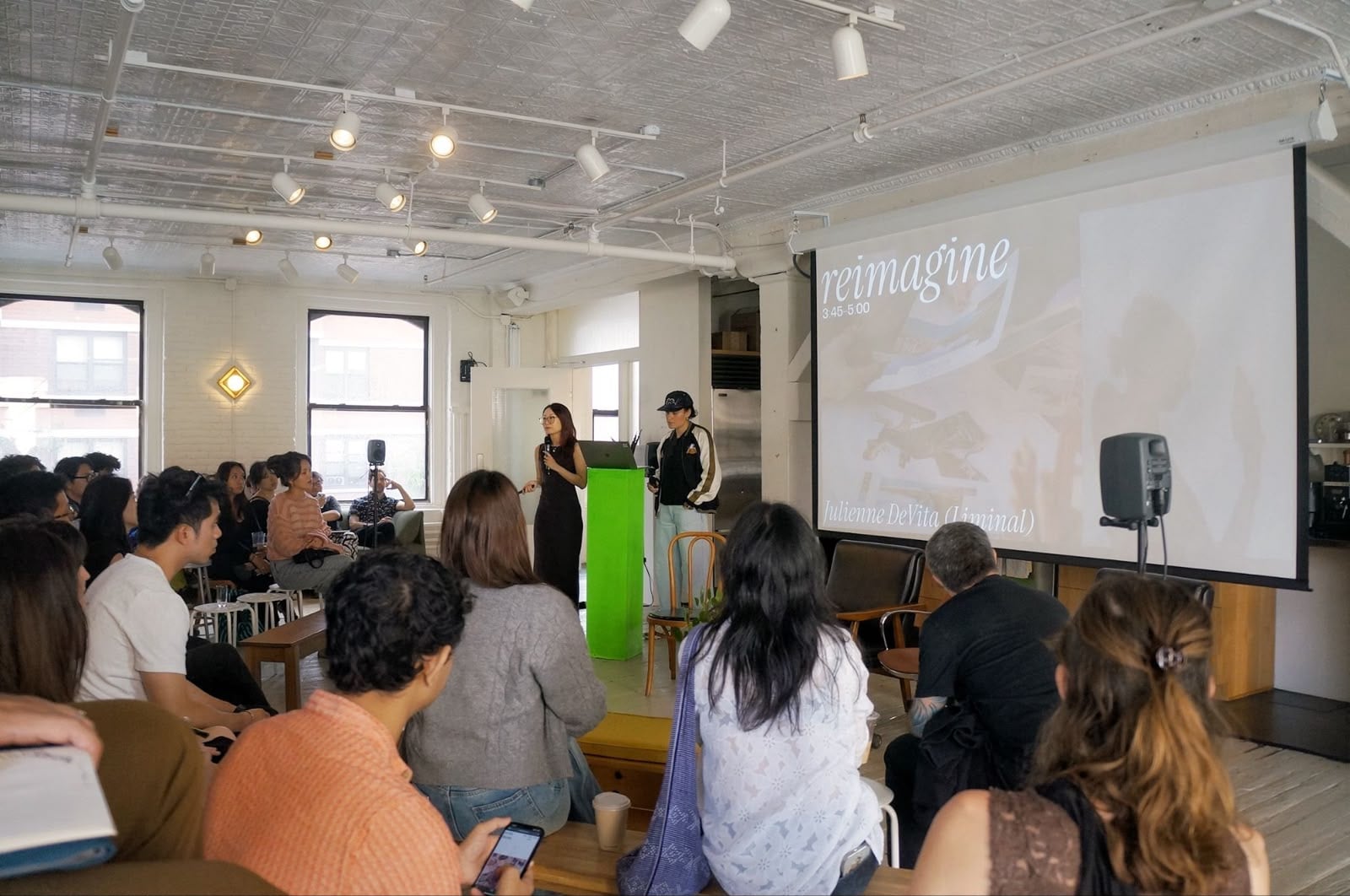
Amy Xiaofan Jiang (standing on the left) delivering opening remarks at TechnoMirage.
As a multidisciplinary designer, her design practice similarly explores connection and collective embodiment. Hold/Unfold, a 3D-printed folding fan created by Jiang and presented at the New Museum, a leading destination for new art and new ideas in Manhattan, transforms an everyday object into a portable gesture of connection and collectivity. The 3D-printed folding fan is made for embodied spaces: the underground dance floor, the heat of a summer gathering, anywhere gesture and proximity shape experience. Each blade is an abstract body, with arms extended, legs in motion. Folded, it becomes a single dancing figure; opened, it expands into a chain of interlinked bodies in embrace, in continuity, circling a shared center. The object reflects a recurring theme throughout Jiang’s practice: the relationship between individual expression and collective formation.
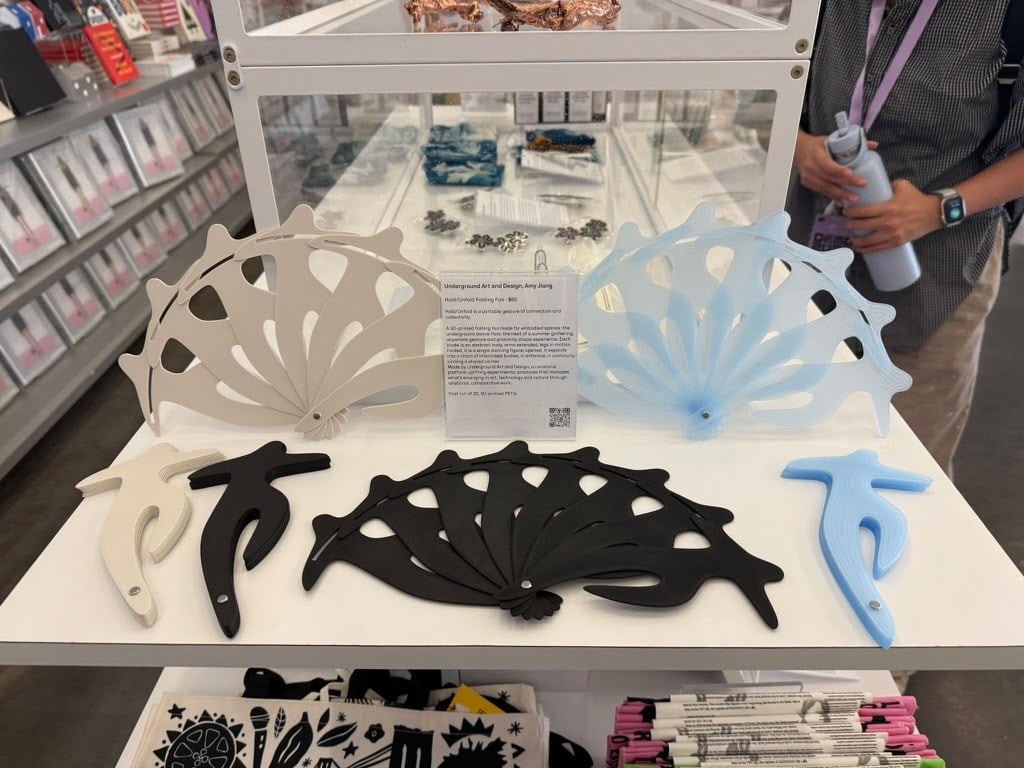
Hold/Unfold, Amy Xiaofan Jiang’s 3D-printed folding fan, presented at the New Museum Store.
What distinguishes Jiang’s contribution is not simply the production of exhibitions or events, but the development of a model for how contemporary art can remain a critical force in an era increasingly shaped by algorithmic visibility, attention economies and technological acceleration. By creating spaces where artists can question emerging systems rather than simply participate in them, Jiang advances a form of cultural practice that treats art not as content to be consumed, but as a collective process for understanding and reshaping the world.







