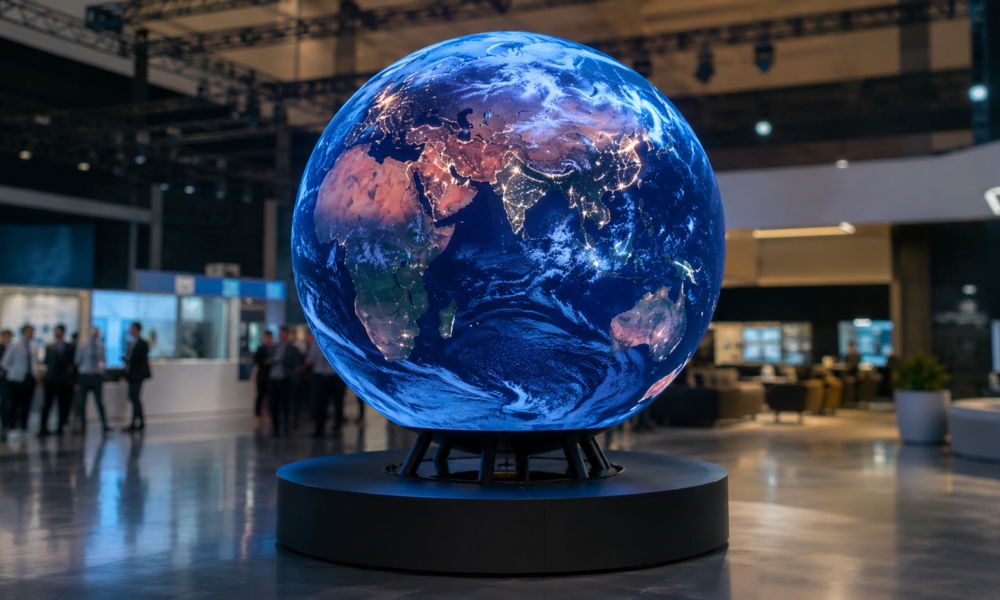
LED sphere screens are no longer a niche product. From airport atriums to flagship retail stores and science museums, 360° spherical displays have become a signature element for brands and venues. However, pricing can be quite complex. Most buyers are surprised by the difference between the price per square meter/dollar and the final invoice.
This guide will show you how to calculate your budget and compare different specifications.
What Does an LED Sphere Screen Actually Cost? (Real Budget Ranges)
A realistic total project budget looks like this:
| Cost Component | % of Total Project Cost |
| LED panel modules | 50–65% |
| Control system (video processor, PC, cabling) | 10–15% |
| Steel structure + mounting hardware | 10–20% |
| Power distribution + heat management | 5–10% |
| Shipping, customs, on-site installation | 5–12% |
| Content production (equirectangular format) | Often overlooked — budget $2,000–$15,000+ |
Example: 2-meter diameter indoor P3 sphere
- Surface area: 12.57 m²
- Panel cost at $1,200/m²: ~$15,100
- Control system, structure, cabling, installation: ~$8,000–$12,000
- Realistic total: $23,000–$27,000 (not $15,000 as panel cost alone would suggest)
Example: 5-meter outdoor P6 sphere
- Surface area: 78.54 m²
- Panel cost at $1,000/m²: ~$78,500
- Supporting systems, IP66 structure, wind-load engineering, logistics: ~$40,000–$60,000
- Realistic total: $118,000–$140,000+
Pixel Pitch vs. Viewing Distance: How to Choose
This is the single most important specification decision, and it directly drives cost. The formula is simple:
Optimal viewing distance (meters) = pixel pitch (mm) × 3 to 4
| Pixel Pitch | Optimal Viewing Distance | Best Use Case | Relative Cost |
| P2 | 0.6–0.8 m | Luxury retail, close-up exhibits | Highest |
| P2.5 | 0.75–1 m | Exhibition halls, conference lobbies | High |
| P3 | 0.9–1.2 m | Museums, hotel atriums (≤3m diameter) | Mid |
| P4 | 1.2–1.6 m | Large interior venues, reception areas | Mid-low |
| P6 | 1.8–2.4 m | Outdoor plazas, transport hubs | Lower |
| P10 | 3–4 m | Outdoor landmark installations | Lowest |
Practical implication:
A 1.5-meter diameter sphere installed in a retail store, where customers will walk within 1 meter, you require a P2 or P2.5 LED display. To save costs,Choosing a P4 LED display would result in a grainy display. Conversely, for a 5-meter diameter outdoor sphere, when viewed from 10 meters away, there is no difference in display quality between P3 and P6 displays, but a P3 display costs approximately 2-2.5 times more than a P6 display.
Diameter & Surface Area: The Cost Multiplier Effect
Sphere surface area scales with the square of the radius (A = 4πr²). This means cost does not scale linearly — it accelerates:
| Diameter | Surface Area | Approx. Panel Cost (P3 Indoor) | Total Project Est. |
| 1 m | 3.14 m² | $3,140–$6,280 | $10,000–$14,000 |
| 1.5 m | 7.07 m² | $7,070–$14,140 | $18,000–$26,000 |
| 2 m | 12.57 m² | $12,570–$25,140 | $25,000–$40,000 |
| 3 m | 28.27 m² | $28,270–$56,540 | $55,000–$90,000 |
| 5 m | 78.54 m² | $78,540–$157,080 | $140,000–$230,000 |
Increasing the diameter from 1 meter to 2 meters does not double the cost, but rather roughly quadruples it. Please incorporate this into the site planning before finalizing the dimensions.
Indoor vs. Outdoor: Specification and Cost Differences
| Specification | Indoor | Outdoor |
| Brightness | 800–1,500 nits | 5,000–8,000 nits |
| IP Rating | IP31–IP43 | IP65–IP67 minimum |
| Pixel Pitch | P2–P5 | P4–P10 |
| Structural requirement | Standard steel frame | Wind-load rated, corrosion-resistant |
| Cost premium vs. indoor equivalent | Baseline | +30–60% |
Outdoor displays require LEDs with a brightness of 4500 or higher, an IP65 weatherproof cabinet. You need Extra caution for ceiling or roof mounting. For any outdoor dome display exceeding 2 meters in height, you should have an independent structural engineer review the installation design, rather than simply relying on these best LED display manufacturer‘s installation guidelines.
Control Systems: What Integrators Don’t Always Explain
The control system determines image quality, reliability, and future compatibility.
Novastar is one of the most widely used systems for LED sphere panels in China. It offers powerful 4K processing capabilities, a mature software ecosystem such as NovaLCT and the VNNOX cloud platform, and excellent global local support. It is the recommended default choice for most commercial spherical panel installation projects.
Colorlight offers an affordable alternative for simple installation projects with limited budgets.
A key question to ask your supplier is: Does the video processor natively support isometric cylindrical projection or spherical coordinate mapping? Stretching a planar rectangular video onto a sphere will result in significant polar distortion. For images to render correctly on a sphere, your content production workflow must output in an isometric cylindrical projection format. This format is the same standard used for 360° video and VR content.
What to Ask Before You Buy: A Practical Checklist
These questions separate experienced suppliers from those who will leave you managing problems post-installation:
Technical
- What is the dead pixel rate specification, and what does your warranty cover for pixel failure?
- What refresh rate does the panel support? (≥3,840 Hz recommended to eliminate flicker in video recordings)
- How is the sphere assembled — welded modules or mechanical clip systems? (Clip systems allow field replacement without specialist tools)
- What is the maximum power draw, and does the quote include power distribution infrastructure?
Logistics & installation
- Is the sphere shipped pre-assembled or in modules? (Modules are cheaper to ship but require on-site assembly time)
- What is the rated wind load for outdoor units, and is there a structural certification document?
- Is a full-size test installation available before final production locks in?
Content & integration
- Does the control system include a content management platform, or is that licensed separately?
- What file formats and frame rates are supported?
- Is there an API for real-time data integration (weather, social feeds, etc.)?
Recommended Configurations by Application
Small Retail/Pop-up Displays
1 meter in diameter, indoor P2.5 rating, approximately 800 nits — Total budget: $12,000 to $18,000
Best for: Product launches, luxury retail counter displays, brand promotion events
Museum/Science Center Installations
2-3 meters in diameter, indoor P3 rating, approximately 1,200 nits — Total budget: $28,000 to $60,000
Best for: Interactive educational content, permanent exhibition focal points
Shopping Mall Atrium Center Decoration
3-5 meters in diameter, indoor/semi-outdoor P4 rating, approximately 2,000 nits — Total budget: $60,000 to $130,000
Best for: Flagship brand displays, seasonal content promotion events
Outdoor Plaza Landmarks
5 meters or more in diameter, outdoor P6 rating, IP66 protection rating, 6,000 nits or more — Budget: $130,000 to over $250,000
Best for: Urban landmark installations, transportation hub advertising, theme parks
Summary
The price of an LED spherical screen depends primarily on its surface area, pixel pitch, and installation location. Panel costs typically account for only 50% to 65% of the total project budget.
The most common mistakes buyers make are specifying pixel pitch without calculating the actual viewing distance and underestimating the cost of the integration layer. As a leading spherical screen manufacturer, SightLED recommends first using a viewing distance formula as a selection criterion, and then determining the diameter size based on your space.
For a detailed quote, please contact SightLED. We will provide a complete and detailed quote within 24 hours.







