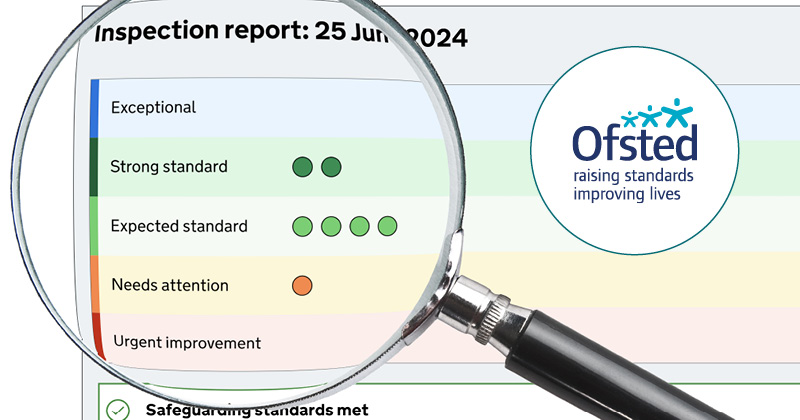
Leaders have shared their views on the new inspection regime after Ofsted published its first full report cards for schools.
Reports for 21 schools – 12 primary schools and nine secondaries – inspected under the framework that took effect in November were published this morning.
As schools volunteered for the inspections, we would expect the outcomes to be positive.
The inspectorate has previously said the “likely three most commonly awarded grades” will be the middle three – ‘needs attention’, ‘expected standard’ and ‘strong standard’.
Schools Week analysis shows that of the 143 individual grades given to the 21 volunteer schools, just three ‘needs attention’ grades were given, across three schools.
The grades were instead largely clustered around the middle and second-highest point on the five-point scale, with 75 at ‘expected standard’ and 56 ‘strong standard’.
Meanwhile nine ‘exceptional’ grades were awarded, across two primary schools and one secondary.
Concerns over ‘attendance and behaviour’ grouping
St Leonard’s Church of England Primary Academy, in Hastings, received ‘needs attention’ for ‘attendance and behaviour’, alongside six ‘expected standard’ grades.
Inspectors said “pupils behave well” but that “attendance is not high enough”.
“Leaders have taken steps to reduce the barriers some pupils face in attending school, but “this is not yet effective enough” meaning some pupils “miss too much school”, particularly those with SEND.
Headteacher Faith Rew said this “highlighted how judgments are interconnected, with one grade influencing others”.
She said it is “regrettable” that under the new inspection toolkit the school’s “well‑established strengths in behaviour are obscured by a ‘needs attention’ judgment relating solely to attendance”.
Data shows the school’s absence rate sat at 7 per cent in 2023-24 – above the national average of 5.5 per cent. Meanwhile its persistent absence was 19.1 per cent – above a 14.6 per cent national average.
“While we fully accept our responsibility to improve attendance for all pupils … we remain proud of the consistently positive, responsible and kind behaviour, strong engagement, and positive attitudes to learning shown across the school,” said Rew.
Secondary scoops five ‘exceptional’ grades
Leigh Academy Halley, a secondary school and sixth-form in Greenwich, was highest-rated of the 21 schools. It received five ‘exceptional’ grades, and two ‘strong standard’.
Inspectors said pupils “of all ages and from all backgrounds are welcomed, nurtured, challenged and supported” at the “exceptionally inclusive” school, where they “feel safe, attend very well, and thrive”.
Principal Ben Russell said the school “could not be more delighted”.
Simon Beamish, chief executive of Leigh Academies Trust, said the school “faced low confidence from families” and behaviour issues when it joined the trust in 2018.
“We reset expectations, built a calm and orderly culture, and put inclusion at the centre of every decision. We backed that up with strong teaching, strong pastoral systems, and clear accountability, day in and day out.”
He described the report cards as “very different” to previous Ofsted reports.
Report cards ‘much longer’
With detailed narratives for every judgment area, they “are much longer”. Beamish, added: “I do wonder how many parents will get to the end”.

Echoing comments by other leaders who have faced new-style inspections, Beamish described the process itself as “very demanding”.
Ten inspectors and a quality assurance inspector attended the school across two days.
“We noticed much less of a focus on curriculum and much more on groups and individual pupils, which is what we expected,” he told Schools Week.
Beamish also voiced concerns over the ‘achievement’ area of the toolkit, where he felt some grade descriptors “read in a very one-dimensional way”.
“It is only right that in a school like Halley with a very high level of mobility, disadvantage and EAL, these [descriptors] are interpreted carefully with proper regard to the characteristics of the pupil cohort.”
Achievement descriptors ‘one-dimensional’
He said inspectors “eventually took this on board”, but “it took some time for them to get their head around it”. He felt context was not taken into account as much as “we had been led to believe”.
Aerodrome Primary in Croydon received two ‘strong standard’ grades, and five ‘expected standard’. It is among four REAch2 schools inspected under the new framework.
Writing for Schools Week, national director of education Andrew Rigby, described Ofsted’s new secure-fit grading model as “a double-edged sword”.
“We’ve seen schools meet every descriptor for strong except one—and then land at expected.”
But he said inspectors stressed that ‘expected standard’ is a high bar. “It really does signal that a school is doing the right things consistently and well.” He said he was pleased to see the narrative section of Aeorodome’s report card “reflect what makes the school tick”.
Meanwhile Shaftesbury Primary School in Forest Gate, London, scored three ‘exceptional’ grades, and four ‘strong standard’.
Headteacher Alma Begum said the new inspection framework “genuinely felt different”. Inspectors were “transparent” and the process “collaborative” with leaders.
Meanwhile the approach was “thorough”. Inspectors spent “extended periods” in classrooms, and listened carefully to pupils, staff and parents.
She said the addition of the nominee role was “invaluable”. “Their presence offered consistent support for both the headteacher and staff throughout the process,” she said.
Begum “felt genuinely listened to” and that her school’s context “was carefully considered at every stage”.
‘New format makes it easier for parents’
Ark Castledown Primary Academy in Hastings received six ‘strong standard’ grades and an ‘exceptional’ for inclusion.
Inspectors described it as “an extremely inclusive school” were staff “quickly identify pupils’ needs” and use “the best strategies to reduce barriers and aid success”.
Lorraine Clarke, director of primary at Ark, said the trust was “delighted”. She said the inspection process “felt thorough and constructive, giving a clear and balanced picture of the school’s strengths.
“We believe the new report format makes it easier for parents and the wider community to understand what really matters in education, and we welcome this step forward in transparency and clarity.”
Report cards for the first non-voluntary Ofsted inspections under the new framework, which began in December, are yet to be published.
Andy Jordan, inspection and accountability specialist at leaders’ union ASCL, said this will give “a better understanding of how the new system is working”, adding: “We will be keeping a close eye on this and supporting members as necessary.”
Meanwhile he said high grades for volunteer schools were “anticipated” and “reflect[s] the hard work that has gone on in these institutions.”
How has grading changed?
Under the new framework, Ofsted inspectors grade schools using a five-grade scale – from ‘urgent improvement’ to ‘exceptional’ – across a minimum of six different judgement areas.
Additional grades are given for those with sixth-form or early years provision, while schools are also judged to have either ‘met’ or ‘not met’ safeguarding requirements.
Ofsted has stressed the new system is a total departure from the previous four-grade system, which saw schools rated from ‘inadequate’ to ‘outstanding’.
Guidance says ‘expected standard’ means a school “is doing everything that it should be doing”, adding this is “a high standard”.
Meanwhile ‘needs attention’ is “an indication that there is work to be done to reach the ‘expected standard’.” Ofsted says this is “not a ‘fail’ but it highlights where issues can be addressed before they become bigger problems”.
‘Exceptional’ is only awarded for “practice that is among the very best nationally, which should be shared with other schools or providers to help them improve.”