
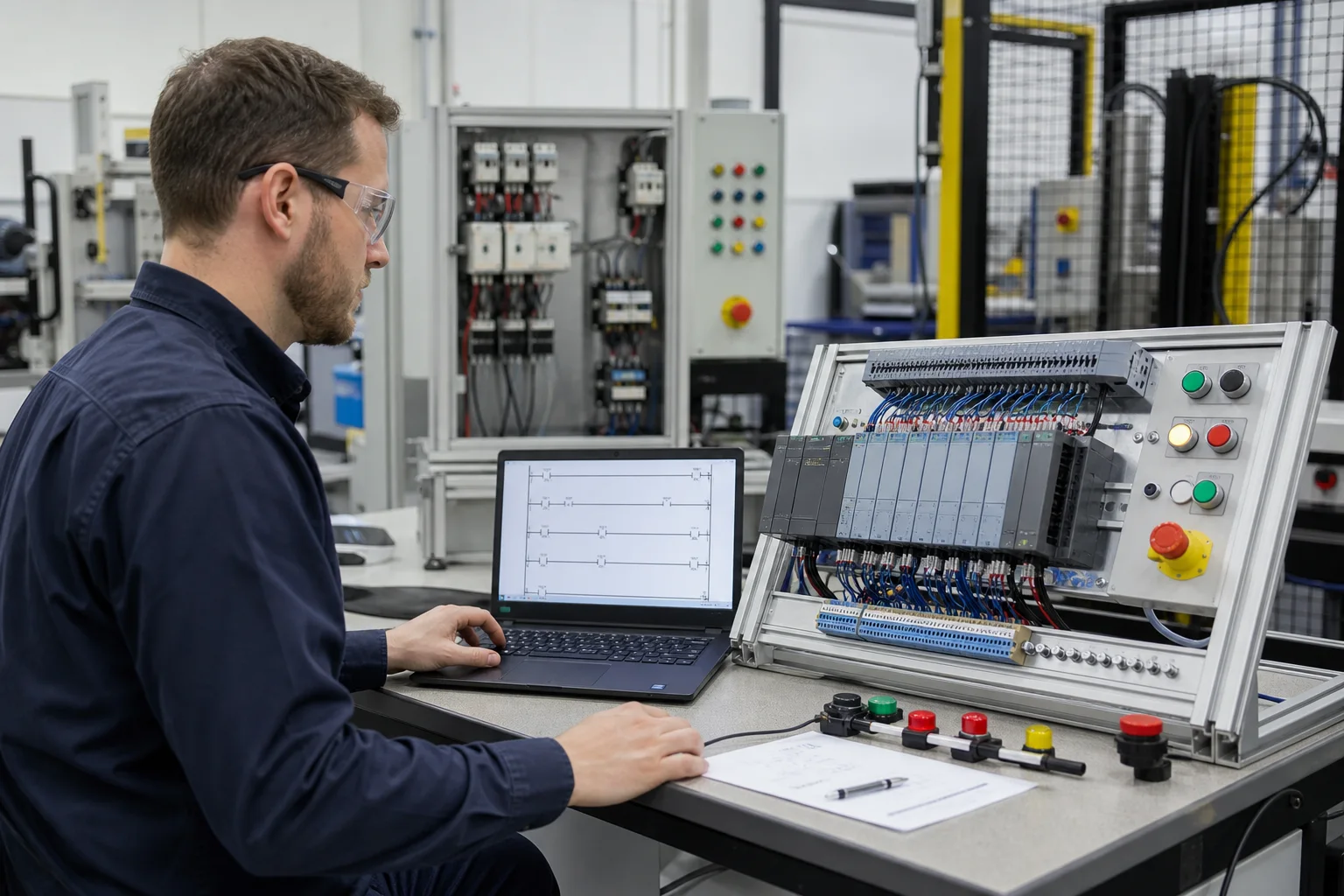
If you’ve been searching for a Beginner’s PLC Training Course or exploring what a PLC Programming Training Course actually covers, you’ve already taken the most important step — recognizing that this is a skill worth pursuing. There’s a persistent myth floating around in technical circles that programmable logic controller training is only for a specific type of person — someone who already has years of electrical experience, an engineering degree, or at least a background that somehow touches industrial automation. It’s a myth that has held back countless capable people from pursuing one of the most in-demand and financially rewarding skill sets in the modern technical workforce. The truth is refreshingly different: PLC controls training is genuinely accessible to almost anyone who approaches it with curiosity, patience, and a willingness to build knowledge systematically from the ground up.
Whether you’re a seasoned electrician looking to expand your capabilities, a fresh graduate trying to make yourself more employable, or someone entirely outside the technical world who simply finds industrial automation fascinating, there is a learning path available to you. And increasingly, that path is more affordable, more flexible, and more beginner-friendly than ever before.
What Exactly Are Programmable Logic Controllers?
To appreciate why learning this technology matters, it helps to understand what programmable logic controllers actually are and what they do in the real world. A PLC is an industrial computer — rugged, reliable, and purpose-built to operate in the demanding conditions found on factory floors, in water treatment plants, inside energy facilities, and across countless other industrial environments.
Unlike the computers most people are familiar with, PLCs don’t run general software or browse the internet. They execute one critical task continuously: reading signals from input devices like sensors, switches, and buttons, processing that information according to a programmed logic sequence, and then issuing commands to output devices like motors, valves, and indicators. This cycle repeats constantly, often hundreds of times per second, ensuring that automated systems respond to changing conditions in real time with extraordinary precision and consistency.
Every time a bottling line fills containers to exactly the right level, every time a conveyor system sorts packages by weight, and every time a ventilation system adjusts airflow based on occupancy — a PLC is the intelligence making it happen. These systems are everywhere, and the people who understand how to program and maintain them are in genuinely high demand across virtually every industrial sector.
The Case for Starting at the Beginning
One of the most important things to understand about learning PLC controls is that there is absolutely no shame — and in fact significant wisdom — in starting from scratch. Many people who eventually become highly skilled automation professionals began their journey with zero programming experience and very little knowledge of industrial systems. What they had was a starting point and the discipline to keep building on it consistently over time.
Enrolling in a PLC Programming Training Course as a complete beginner is not just acceptable — it’s actually the recommended approach for most learners. Courses designed with beginners in mind don’t assume prior knowledge. They introduce concepts in a logical, sequential order, explaining not just how to perform a task but why it works the way it does. This deeper level of understanding is what allows learners to eventually apply their knowledge flexibly in real-world situations, rather than simply following memorized steps without true comprehension.
The biggest barrier for most beginners isn’t the complexity of the material — it’s the fear that they don’t belong in the conversation. Once that fear is set aside, most people find that the foundational concepts of PLC logic are surprisingly intuitive, especially when they’re presented clearly and in a well-structured learning environment that respects the learner’s starting point.
What a Beginner’s Course Actually Covers
A well-designed Beginner’s PLC Training Course takes learners through a carefully sequenced progression that builds genuine competence without overwhelming. Here’s a realistic picture of what that learning journey typically looks like from start to finish:
System Orientation and Hardware Basics
Before writing a single line of logic, beginners need to understand the physical system they’re working with. This includes learning about the different modules that make up a PLC system, how inputs and outputs are wired to field devices, and how the controller communicates with the equipment around it. This contextual hardware foundation makes everything that comes later significantly easier to understand and apply.
Introduction to Ladder Logic
Ladder Logic is the programming language most beginners start with, and for very good reason. Its visual format — deliberately designed to resemble the relay logic diagrams used in traditional electrical control systems — makes it one of the more intuitive programming languages for people coming from technical or electrical backgrounds. Even those without that background tend to find it more approachable than text-based coding languages, and most learners pick up the basic syntax faster than they expected.
Basic Instructions and Program Structure
Early lessons focus on the fundamental building blocks of any PLC program: contact instructions, which represent input conditions, and coil instructions, which control outputs. From there, learners progress to slightly more complex instructions like timers, counters, and basic comparison functions. Each new instruction is typically introduced through practical examples that demonstrate how it would be applied in a real industrial automation scenario, connecting abstract instruction sets to tangible, meaningful applications.
Software Navigation and Project Setup
Understanding the programming environment is just as important as understanding the logic itself. Beginner courses dedicate meaningful time to helping learners navigate the software interface, set up a new project correctly, organize tags and data tables, and use online monitoring tools to observe how a program behaves while it’s actively running. This software familiarity is what allows learners to eventually work efficiently and confidently in a professional environment.
Simple Program Development and Testing
By the time a beginner’s course reaches its later stages, learners are typically building and testing complete small programs — solving specific automation problems from scratch. This hands-on practice is where knowledge transforms from theoretical understanding to practical capability, and where most learners experience the deeply satisfying moment when all the individual pieces come together into something that actually works.
Why This Knowledge Opens Doors
The industrial automation industry is growing, and it shows no signs of slowing down. The integration of automated systems across manufacturing, food and beverage production, pharmaceuticals, energy, logistics, and building management is accelerating year over year. Alongside that growth is a well-documented and persistent shortage of qualified professionals who can design, program, commission, and maintain these systems effectively.
This reality means that someone who completes even a foundational level of PLC controls training immediately becomes more attractive to employers across a wide range of industries. For electricians, it’s the difference between being a technician who maintains systems and one who can also program and troubleshoot them — a distinction that typically comes with meaningfully higher earning potential. For engineers, it provides the practical controls knowledge that academic programs often fail to fully deliver. For career changers, it represents a documented, demonstrable skill that signals both technical ability and genuine professional initiative to hiring managers who see dozens of resumes without it.
Practical Tips for Getting the Most Out of Your Training
Learning PLC controls effectively isn’t just about watching videos or reading through lesson material passively. The people who make the fastest and most durable progress are the ones who actively engage with what they’re learning at every stage of the process.
Practice constantly and deliberately. Most programming software used for PLC development can be downloaded and run in offline or simulation mode, meaning you can write, test, and modify programs without any physical hardware at all. Use this opportunity aggressively. Write programs to solve small, self-defined problems after each lesson. Try to build something meaningful from scratch without referring to examples before checking your work.
Don’t rush past confusion. When something doesn’t make sense — and there will be moments when things don’t — treat that as a productive signal rather than a discouraging one. Sit with the confusion, revisit the explanation, and try approaching the concept from a different angle. Understanding deeply why something works, rather than just how to replicate it, is what builds the kind of competence that transfers to new situations.
Connect every concept to a real application. Whenever you learn a new instruction or programming concept, ask yourself where you would see it used in an actual industrial environment. Imagining a timer instruction controlling a conveyor startup delay or a counter tracking completed assembly cycles makes abstract concepts concrete, memorable, and far easier to retain.
Build progressively and resist shortcuts. It’s tempting to jump ahead to more advanced topics when the basics start to feel comfortable. Resist that temptation. Automation programming is deeply cumulative — later concepts depend entirely on earlier ones being genuinely well understood, not just partially familiar.
Anyone Can Start — The Question Is When
PLC controls training is not gatekept by prior experience, academic credentials, or a specific professional background. It is open, genuinely accessible, and learnable by anyone who chooses to invest the necessary time and effort consistently. The industry needs skilled professionals, the learning resources available today are the best they have ever been, and the career rewards for those who develop this knowledge are very real and very tangible.
The only thing standing between where you are right now and a solid foundation in programmable logic control is the decision to begin. And that decision, whenever you choose to make it, is one you are very unlikely to regret.