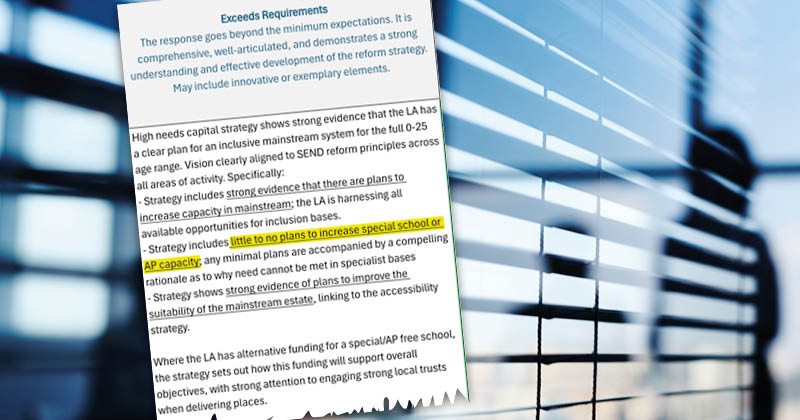
Councils will be given top marks by the government if their SEND reform proposals include “little to no” plans to increase special school or alternative provision capacity, it has emerged.
Documents seen by Schools Week also reveal the Department for Education’s threat to revoke council SEND powers if they “persistently fail”, including unprecedented action of transferring responsibilities to a trust.
Education secretary Bridget Phillipson will sign off on councils’ “local SEND reform plans”, which they must submit in exchange for the government writing off 90 per cent of their historic SEND deficits.
These plans will help to drive forward the DfE’s SEND reforms to make mainstream schools more inclusive.
Documents sent to councils this week reveal the government will use a “quality assessment” framework to judge the plans, with four ratings from “requirements not met” to “exceeds requirements”.
The best areas have to go beyond “minimum expectations” with a “comprehensive, well-articulated” response that “demonstrates a strong understanding and effective development of the reform strategy”.
To achieve top marks on their high needs capital strategy, the council must show “strong evidence” that it has a clear plan for an inclusive mainstream system, such as an increased capacity in mainstream and improving the building’s “suitability”.
But it should also include “little to no plans to increase special school or AP capacity”.
Any minimal plans proposing specialist expansion would need to have a “compelling rationale as to why need cannot be met in specialist bases”, the documents say.
Profound and multiple learning disabilities
Acceptable reasons include insufficient places for pupils with need types that are “less frequently met in inclusion bases”.
Examples include profound and multiple learning disabilities and some “acute cognition and learning needs or medical needs”.
Other reasons include there not being enough places for pupils with “complex needs”, despite the council “having embraced opportunities to meet need in specialist bases”.
But alternative funding provided to some councils which decided to cancel their special or AP free school project has “more flexible grant conditions and can be used to create special school places”.
Councils will still be considered to “meet” requirements – the second highest rating – if they plan to increase special or AP capacity with a “compelling rationale”.
Town halls with no such rationale for why the need cannot be met in a specialist base in mainstream would get a “working towards requirements” judgment.
Warren Carratt, chief executive at Nexus MAT, said it “was nothing short of appalling” and feared it would push councils to “not plan for more special school places and therefore pre-empting the outcome of what should be individual, child-focused needs assessments”.
“The proposed reforms are intended to transform our system and are currently being consulted on, with meaningful change not coming for at least three years.
“At the same time, councils are being told to write plans for the here and now, that ignore reality and assume that promised land has already been delivered, when it’s supposed to be something that government are consulting on, to get it right.”
One council official told Schools Week that the government “should be talking about having the correct level of specialist provision – inclusion bases and special schools, to meet needs and reduce the reliance on independent provision and education other than at school”.
‘Unequivocal’ expectations
Special schools are under immense pressure, with approximately 8,000 more secondary pupils on roll than reported capacity in 2023-24, according to DfE data.
Projections published last month suggest the DfE expects the proportion of pupils in state-funded special schools to rise from 1.9 per cent to 2.1 per cent by 2032-33, before dropping down to 1.9 per cent again by 2034-35.
This compares to a rise of pupils in specialist bases from 0.3 per cent to 0.8 per cent over the same timescale.
In the white paper, the DfE said its reforms represent a “fundamental reset to the specialist sector”. But all pupils who have a special school place by September 2029 will be able to stay there until the end of their education.
The DfE told Schools Week the law requires councils to ensure there are sufficient places for pupils in their area, including those with SEND.
The government’s expectations across local services are now “unequivocal”, and they want every area to “rise to the challenge”, with support from government officials.
Where there is strong evidence that local need cannot be met in mainstream, capital can still be invested in specialist places for pupils with “the most complex needs – ensuring that no LA will be forced into a position where they cannot meet their sufficiency duties”.
A spokesperson said special schools will “always have a vital role for children with the most complex needs, but we know that most children thrive when supported closer to home alongside their peers, and that earlier, group-based intervention in mainstream settings can prevent needs escalating”.
Intervention threat
In a letter co-signed by Phillipson and health secretary Wes Streeting, councils were told they have seen “wide variation in local outcomes that cannot be explained by systemic changes alone”.
The government’s expectations across local services are now “unequivocal”, and they want every area to “rise to the challenge”, with support from government officials.
But for areas with the “most acute performance concerns”, officials will be placing “heightened scrutiny on the extent to which you are doing everything within your control to implement the reforms effectively”.
This includes “a close examination of leadership capability, the pace and grip with which you act, and clear accountability through a named senior responsible officer”.
The government will also use returned plans to assess ongoing performance and delivery, to best allocate support and challenge.
The department will “act decisively” where progress “does not materialise”.
But, when “failure is persistent, we will not hesitate to use the full range of intervention powers including removing the licence to deliver SEND services”.
Brand new intervention powers
The DfE told Schools Week that as a last resort it could use statutory powers “up to and including transferring SEND responsibilities to a trust”.
This has never happened before. It has been used to remove children’s social care services from failing councils.
Councils have until June 19 to submit a plan. If a council does not meet the threshold for approval it will be required to revise and improve the plan by November.
They have been asked to provide a three-year “high-level roadmap”, as well as focused delivery plan for 2026-27.
Once agreed, the DfE will issue a grant covering 90 per cent of high needs-related dedicated school grants deficits accrued up to the end of March.
Alongside the quality assessment framework, the plans will be checked through a series of “tiers”.
This includes a SEND delivery board chaired by Tim Coulson, director-general of the DfE’s regions group, which will make recommendations to Phillipson. Kevan Collins, Phillipson’s SEND delivery adviser, will also sit on the board.
Areas will be required to provide quarterly data returns. The DfE will give them “visualised analysis and benchmarking” to support “local delivery, monitoring and evaluation”.
DfE officials and health regional SEND leads will use this data, discussions at quarterly meetings, the reform plan and Ofsted reports to “assess performance and delivery at the local level”.
Experts at hand ‘group model’
Future deficit support before the government takes on the cost pressures of SEND in 2028 will take into account a council’s successful delivery of their approved plan.
This will include “appropriate use” of investment to establish the “experts at hand” service, a core part of the reforms aiming to boost the availability of external support for schools.
However, the DfE is yet to publish key information about its reforms.
Council officials have also warned of a tight timescale. The government’s consultation on the SEND reforms will only close in May.
“We don’t want to commit to a plan we can’t deliver, but to get the financial relief we have to submit a plan that meets their requirements,” one said.
“Ideally we can submit a plan that meets their requirements and which we are confident in, but I’d say that’s a difficult sweet spot to find.”
In the documents, the government does state that the plans will be “within the current statutory framework”, so areas “will not be required to implement any policy that is being consulted on or that will require legislative change”.