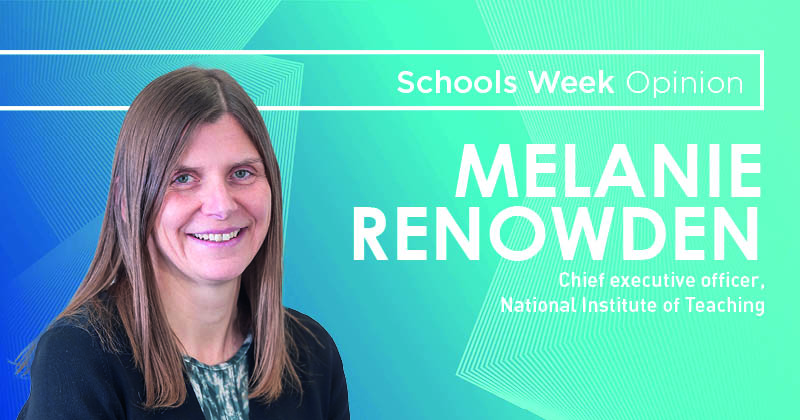
Using evidence from schools, the NIoT’s Teacher Education Dataset will help the sector deliver the schools white paper’s aspirations, says Melanie Renowden
At last, it’s here. The lengthy lead-up to the schools white paper has concluded with the government showing it is working through a reassuring thud of documents landing on the desks of teachers and leaders.
Contained within are the long-awaited plans to recruit 6,500 additional teachers, proposed reforms to the SEND system, a renewed focus on the success of disadvantaged children and a wider programme of school improvement.
The white paper is ambitious, its scale significant, and the reform programme it kicks off has already been framed by Bridget Phillipson as a decade-long.
If its publication marks the end of the beginning, we are now just at the start of what will be a complex, risky and sustained period of implementation.
Translating white paper aspirations into improved pupil outcomes will depend on whether teachers and leaders have the knowledge, capacity and confidence to enact them.
Nowhere is this more pressing than in SEND. Evidence continues to suggest that many teachers lack confidence in meeting the needs of pupils with SEND and this is the most frequently cited area for further training.
Promising start
The government’s plans for a £200 million SEND training offer for school staff, the creation of training materials for schools, and the formal expectation that all school staff receive training in SEND and inclusion all rightly point to this challenge.
It’s a promising start, which can be bolstered by efforts across the suite of statutory and national professional development made up of initial teacher education, the early career teacher entitlement and national professional qualifications.
But while the government can set expectations and run targeted training, most professional learning is delivered directly by schools and trusts, and by the 76 per cent of teachers who say they help develop others.
To get the best for children – particularly those experiencing the greatest barriers to success – from this decentralised ecosystem of professional learning, we need to connect the workforce with the latest evidence on effective teacher education and give them the tools to evaluate how well it works in diverse contexts.
We also need to be scrupulous about the precious commodity that is teacher time, so professional development is spending it as wisely as possible.
This is not only a matter of implementation fidelity, it is a matter of retention.
In 2025, around three in 10 teachers and leaders reported they were considering leaving the profession within 12 months, most citing stress, wellbeing and workload.
Reform that increases burden without strengthening capability risks undermining its own aims.
Anonymised data
Understanding what effective teaching looks like and how it translates into improved outcomes for all learners is essential.
Over the past year, the Teacher Education Dataset (TED) project has taken promising steps in this direction.
Using anonymised teacher and pupil data from participating school trusts, TED is beginning to generate insights into teaching practices, professional development pathways and their relationship to pupil progress, including for pupils with SEND.
As the dataset grows, it has the potential to inform both national policy and local leadership decisions, helping ensure that teacher education is grounded in evidence of impact.
We must also ensure that all schools have access to high-quality evidence about what works in teacher education and leadership development.
This is the purpose of the newly-launched NIoT Evidence Portal. Built around a global meta-review of robust evidence and drawing on expert perspectives from schools and trusts, the portal is a comprehensive, free-to-use resource for anyone responsible for developing educators.
We hope the Evidence Portal will make it easier for teacher educators and school leaders not only to digest research, but to mobilise it effectively, in their contexts, for the benefit of all children.
This week’s reforms are consequential for all those in schools, both children and staff.
If we get what comes next right, the outcome will be truly consequential too: a system where every child, regardless of background or circumstance, is taught by a well-supported, expert teacher equipped with the knowledge and skills to help them to be happy and successful at school.