
Share
Share
Share
Share
Early-stage startups face a quiet unfairness. They get judged on how they look long before anyone can judge what they built.
A customer lands on a rough site and assumes the product is rough too. An investor sees a thin deck and reads it as a thin team. The work might be excellent. But if it looks small, people treat it as small. For years, closing that gap cost money most founders did not have. A designer. A photographer. An agency retainer. Looking credible was a paid privilege.
That has changed. AI and a wave of free tools have collapsed the cost of professional visual branding to near zero. The interesting part is not that founders can now afford to look good. It is what the new constraint becomes once budget stops being the barrier.
What used to cost money
Three things used to stand between a founder and a credible brand.
Identity was the first. A logo, a color system, a typeface pairing. That meant a designer and a few weeks.
Imagery was the second. Hero shots, product photography, lifestyle scenes. That meant a photographer, a studio, or a stock subscription.
Presentation was the third, and the most overlooked. Even with a logo and a product, you had to show them to the world. On a sign. On a package. On a phone. That meant a designer again, building mockups by hand.
Each step had a gatekeeper and a bill. A pre-revenue startup often skipped all three and shipped something that looked like a side project.
What replaced it
Every one of those steps now has a cheap or free path.
Identity is the easiest. AI-assisted tools generate logo directions, color systems, and type pairings in minutes. A founder still has to choose well, but the blank page is gone.
Imagery followed. AI image tools produce hero visuals, backgrounds, and concept shots without a camera or a studio. The output is not always usable as-is, but it gives a small team a starting frame it could never have afforded before.
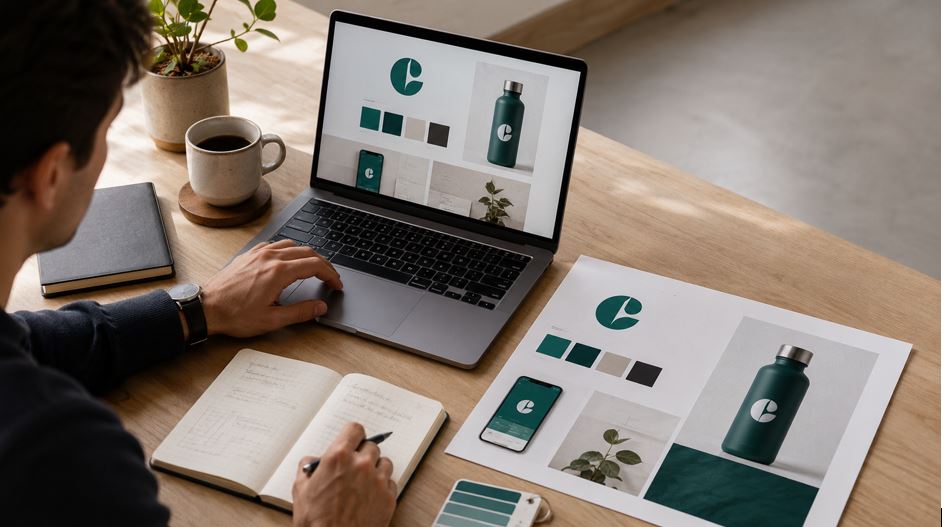
Presentation is where the last gap closed. You no longer need a designer to show your product in context. Free libraries of ready-made mockups let a founder drop a logo onto a storefront or a label onto a bottle and get a realistic result in minutes. We built one of those free libraries at Excellent Mockups, and it exists because presentation used to be the step that quietly stopped founders cold. The tool matters less than the shift. The thing that once required a hire is now a few clicks.
Put together, a founder can assemble a coherent visual brand, product imagery, and real-world presentation before the company has a dollar of revenue. That was not possible three years ago.
Why looking credible early actually matters
This is not vanity. Visual credibility does real work at the stage when a startup has nothing else to show.
Before a company has traction, people judge it on signals. First customers decide whether to trust a checkout in seconds, and a large part of that decision is how finished the thing looks. Investors meet hundreds of decks, and a polished one earns a longer read. Partners size you up on your website before a call. In every case, the visual layer is standing in for proof you do not have yet.
So the founder who looks like a real company gets treated like one sooner. That head start compounds. It is the difference between a first customer who converts and one who bounces, between a warm investor reply and silence.
The catch nobody mentions
Here is the twist. When production gets free and instant, it also gets generic.
The same AI tools everyone uses produce the same look everyone has. The internet is filling with a recognizable AI sameness. Logos that could belong to anyone. Hero images with that slick, hollow, generated feel. When everyone can produce a professional-looking asset, professional-looking stops being the bar.
So the constraint moved. It used to be a budget. Now it is judgment. The founders who stand out are not the ones with the best tools, because the tools are the same for everyone. They are the ones with taste and discipline. They pick one coherent system and apply it everywhere. They resist the urge to use every effect the AI offers. They edit ruthlessly, and they keep it consistent across the site, the deck, the packaging, and the product.
Consistency is the real signal now. A modest brand applied with discipline reads as more credible than a flashy one applied at random. AI hands you the raw material. It does not hand you restraint.
What this means for founders
The practical takeaway is simple. Stop treating good branding as something you cannot afford yet. You can. What you have to bring instead is judgment.
Assemble the stack. Use AI for identity and imagery. Use free mockups to show your product in the real world. Then do the part the tools cannot. Choose one direction and commit to it. Cut everything that looks generic. Keep it consistent everywhere a customer or investor will see you.
Looking like a real company is no longer a question of money. It is a question of taste and consistency, and those have always been free. The startups that understand that will look credible long before their balance sheet says they should. The rest will blend into the AI-generated noise with everyone else.
The budget excuse is gone. What you do with that is the new differentiator.





