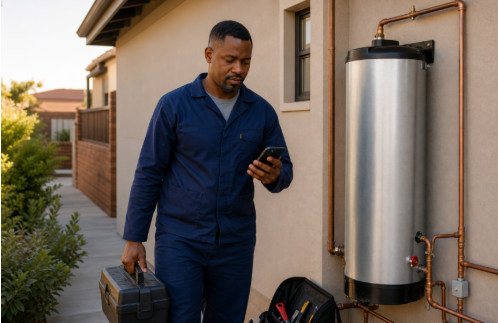
The gig economy’s next frontier isn’t another app for knowledge workers; it’s the plumber.
A decade ago, ride-hailing, food delivery and freelance knowledge work were digitised almost overnight. Anyone who has hailed a car with three taps or hired a freelance designer through a marketplace has felt the shift. Yet in most cities, booking a plumber, an electrician or a tiler still runs on the oldest infrastructure there is: word-of-mouth, a fridge magnet, or a string of unanswered phone calls. That gap between how digitised a service is and how essential it is has persisted far longer than almost anywhere else in the economy. It is now closing — and it is closing fastest in emerging markets, where the structural conditions for a quote-comparison marketplace happen to be unusually favourable.
Local trades resisted platformisation longer than taxis, takeaways or task-based freelance work for reasons that are structural rather than accidental. Supply is fragmented and largely informal — a market of sole operators and small crews rather than a handful of large firms. Demand is infrequent and one-off; a household might hire a plumber once every few years, not the daily-habit cadence that made ride-hailing an obvious app. Above all, trades are what economists call credence goods: the buyer typically cannot judge the quality of the work before it happens, and often struggles to judge it afterwards either. You can rate a five-minute ride within seconds of stepping out of the car. Judging whether a geyser was installed correctly can take months, if the fault shows up at all.
That combination — fragmented supply, infrequent demand, unverifiable quality — makes trades the hardest marketplace problem in the services economy. It also makes them the most valuable one to solve, because the same conditions that repelled platform builders are precisely the conditions under which a platform adds the most value.
Four forces are converging to make this the moment local trades finally digitise, particularly outside the wealthiest markets.
Force 1: Mobile-first consumers and digital payments
Marketplaces need two rails to function: a way to discover a provider, and a way to pay one without friction. Smartphone penetration and mobile money solved both simultaneously across large parts of the emerging world. The same wave that let consumers in Latin America transact comfortably with a stranger through MercadoLibre, or across African markets through Jumia, normalised the basic trust act a trades marketplace depends on: paying someone you have never met, based on a profile and a rating rather than a personal referral.
Force 2: The trust problem a marketplace actually solves
This is where a platform’s value is highest, not lowest. Ratings, written quotes, vetting and a dispute mechanism matter more for a plumber than for a taxi, precisely because the buyer cannot verify quality upfront. A written quote, compared against two or three others before any work begins, converts an unknowable risk into a comparison exercise — the closest a credence good can get to being priced like a commodity. Consider a homeowner in Pretoria facing a burst geyser: rather than gambling on the first number listed in an old-style directory, they get several written quotes through a quote-comparison service such as a Pretoria plumbing outfit called Plumber Pretoria, compare them side by side, and choose on price, response time and stated scope rather than luck. That single act — comparing quotes before committing — is the trust mechanism the entire model is built on.
Force 3: Formalising an informal sector
Marketplaces do something governments and trade bodies have struggled to do for decades: they pull independent, often entirely informal tradespeople into a discoverable, reviewable market. A single-operator electrician with no marketing budget and no way to be found by anyone outside his existing referral network suddenly has a channel to a book of work he could never have built alone. The effect runs both ways — supply expands because previously invisible operators become findable, and small operators gain access to demand that used to belong exclusively to whoever had the biggest yellow-pages ad.
Force 4: Expectation transfer
Consumers who learned, through ride-hailing and delivery, to expect a visible price, a rated provider and an instant booking now carry that expectation into every other purchase. The reflex is almost involuntary at this point: why can booking a car happen in three taps while booking a plumber still means five unanswered calls? Once an expectation is set in one category, it does not stay contained to that category — it becomes the baseline a consumer applies everywhere.
None of this should be mistaken for an inevitability that happens smoothly or completely. Margins in trades marketplaces are thin, and the unit economics of on-demand labour are harder than the unit economics of on-demand rides. Quality control at scale is genuinely difficult when the “product” is a person’s craftsmanship rather than a standardised trip or meal. Dispute resolution is messier too — a botched tiling job is a different kind of argument than a late delivery. A physical trade, tied to a specific location, a specific set of tools and a specific set of hands, will never be commoditised as cleanly as a ride from A to B. Marketplaces narrow the trust gap in local trades; they do not close it entirely, and anyone underwriting this shift should price that friction in rather than assume it away.
The pattern that played out in mobile payments looks likely to repeat here: emerging markets, unburdened by an entrenched incumbent alternative, may leapfrog the developed world rather than follow it. In markets where the existing options are a thin national directory and a handful of brand-name chains, a quote-comparison platform is not competing against a mature, trusted system — it is competing against the status quo of unanswered phone calls. That is a considerably lower bar to clear. The platform model will keep spreading vertical by vertical and region by region, and the local trades that resisted it longest may turn out to be the ones where its arrival matters most.