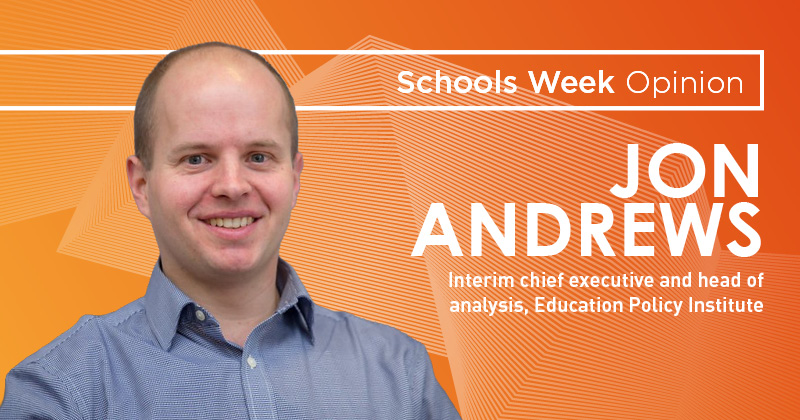
The white paper’s “experts at hand” plan is positive, while hints of reform for school performance measures echo the EPI’s feelings about current shortcomings, writes Jon Andrews
At the last general election, the Labour Party manifesto argued that the education system fails to meet the needs of all children.
This week, nearly two years on, we finally have a white paper outlining the government’s strategy to rectify this.
Predictably, the proposed SEND reforms have drawn the most attention.
The challenges facing the SEND system are well-documented. Yet for too long, it has felt as though the solutions were perpetually just around the corner.
But many will see reason to be optimistic.
Experts at hand
Significant additional funding to underpin the introduction of “experts at hand” will give schools better access to specialist support, while individual support plans will aid transparency.
However, parents will need reassurance that tiered support and reforms to EHCPs do not simply become a new set of hoops to jump through or further distance them from decisions around their child’s education.
And if they see any of the proposals as a watering-down of what has often been hard-won access to support, the government’s back benches will soon let them know.
Other aspects of the white paper, while less prominent in the headlines, could prove equally significant.
In the decade that the Education Policy Institute has spent measuring the attainment gap between disadvantaged pupils and their peers, the divide has narrowed only twice, and one of those instances followed a pandemic-related spike.
Particularly concerning is the gap for persistently disadvantaged pupils, who remain nearly two years behind by the time they sit their GCSEs.
We have long argued that the funding system – which fails to distinguish between short-term and long-term poverty – must better reflect this reality.
The commitment to targeted funding for those in the deepest poverty is welcome, though we await further detail on its practical implementation.
Defining disadvantage
Most interesting in that regard is how we define disadvantage. While eligibility for free school meals has been the long-standing metric for schools in England, its use is not without issues.
Our research demonstrates that many eligible families are not registered for their entitlement – a problem that is particularly acute in early years settings and at the beginning of primary school.
Similarly, between the white paper and the government’s response to the curriculum and assessment review, there is some recognition of the need to reform school performance measures.
As they stand, these metrics often act as a disincentive for schools to remain inclusive. Proposed reforms to progress 8 to include creative subjects may not have received universal praise, but they go some way toward recognising curriculum breadth.
Furthermore, the introduction of an additional measure for pupils with low prior attainment may provide overdue recognition for schools admitting a higher proportion of these learners.
However, giving this measure the same status as the headline metric will be easier said than done.
Workforce wanted
In the longer term, the rollout of “school profiles” has the potential to offer a more rounded understanding of school performance, though exactly what those will look like remains in the wait and see column.
Any structural changes require a workforce to implement them.
The government’s delivery plan for 6,500 additional teachers asks the right questions, and early signs on recruitment are positive.
But 6,500 is a net national target and it could be met in full while the schools that struggle most to recruit see little improvement.
More fundamentally, the white paper asks a great deal more of teachers, who will need to support more children with SEND, and meet new training requirements.
The experts at hand service should ease some of that burden, but it will take time to build and depends on a specialist workforce that is itself in short supply.
Whether the job of teaching becomes more or less attractive as a result may matter more than any recruitment target.
Overall, this white paper sets out significant ambitions and provides a potential roadmap toward a system that works for all. Ultimately, however, its success hinges on a great deal that is yet to be fully set out.